Add in the continued rise of private labels (with more than 80% of U.S. consumers rating store-brand food products as equal to or better than national brands), Gen Z's fluid brand loyalty, and the decline of third-party cookie targeting, and the stakes are clear: a reactive, channel-by-channel approach to CPG marketing no longer cuts it.
This guide covers the full picture — what CPG marketing actually involves in 2026, the core challenges brands face, six proven strategy pillars, why packaging deserves a seat at the strategy table, and how to build a data-driven marketing plan that drives measurable growth.
Key Takeaways
- CPG marketing in 2026 requires coordinated omnichannel execution, not isolated tactics
- Six core pillars drive CPG growth: digital/performance, social/influencer, in-store promotions, content/SEO, experiential, and DTC/email
- Packaging is the highest-leverage, lowest-discussed marketing channel — it converts (or loses) consumers in 4–6 seconds
- First-party data collection is now a core strategic priority — brands that own their consumer data hold a measurable competitive edge
- Smaller brands win by owning fewer channels completely, not spreading thin across all of them
What Is CPG Marketing — and Why It's Different in 2026
CPG marketing encompasses every paid and organic activity — online and offline — used to generate awareness, purchase intent, and loyalty for consumer packaged goods. What separates it from general product marketing is brutal in its simplicity: zero switching costs, endless consumer alternatives, and a purchase decision that often happens in the time it takes to glance at a shelf.
The 4 Ps Have Gotten More Complicated
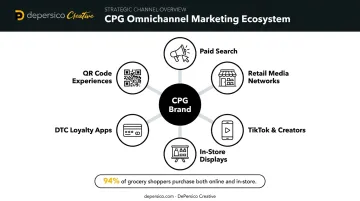
The classic CPG framework — product, price, place, promotion — still holds. But "promotion" in 2026 now spans:
- Paid search and retail media networks
- TikTok trends and creator-led content
- Endcap displays and in-store sampling
- DTC loyalty apps and email sequences
- QR codes on packaging linking to digital experiences
That breadth reflects a structural shift. NielsenIQ reports that online sales contributed nearly 75% of total grocery dollar growth in 2025, while 94% of grocery shoppers purchased both online and in-store. CPG brands can't choose between channels — they have to win in both environments simultaneously.
The Gen Z Loyalty Problem
67% of Gen Z consumers say private-label products are just as good as national brands, and among those with a named favorite brand, more than half say they'd switch for a better price or higher quality. For 2026 and beyond, that's simply the baseline every CPG brand is working against.
Key CPG Marketing Challenges Brands Face Today
Product Differentiation on a Crowded Shelf
With 32,000 SKUs in a single store, standing out demands more than a good product. Differentiation has to operate across visual identity, messaging, price positioning, and channel strategy. McKinsey data shows 75% of CPG innovations fail — often not because the product is poor, but because it fails to communicate value fast enough to earn a trial.
The "Epidemic of Disloyalty"
Today's shoppers switch brands based on price, availability, social buzz, and packaging appeal — and often all four at once. 79% of consumers globally report trading down, with private labels capturing a significant share of that shift. For CPG brands, loyalty isn't a given; it has to be continually earned.
The First-Party Data Deficit
Most CPG products move through retail intermediaries, which means brands rarely own direct purchase data. According to EY, retailers hold both discovery and purchase data — leaving CPG manufacturers dependent on retailer collaboration for even a partial view of consumer behavior.
That gap has real consequences:
- Audience targeting relies on third-party data that's increasingly restricted
- Personalization is difficult without knowing who's actually buying
- Campaign optimization lags because attribution is murky
- Competitive intelligence goes to whoever has the better retail partnership
89% of CPG marketers now report actively building a first-party data strategy to close that gap. The three challenges above — differentiation, loyalty, and data ownership — sit at the center of nearly every growth conversation happening in CPG right now.
The 6 Core CPG Marketing Strategies for 2026
No single channel wins the shelf. The most effective CPG brands in 2026 run these six strategies as a coordinated ecosystem, not a menu of options.
Digital and Performance Marketing
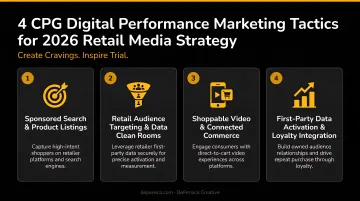
The U.S. CPG industry spent nearly $50 billion on digital advertising in 2024 — a 16.6% year-over-year increase. That spend is shifting fast toward retail media networks (projected to exceed $62 billion in 2025) because they offer something standard display can't: purchase-intent targeting powered by retailer first-party data.
Key tactics for 2026:
- Paid search to capture high-intent shoppers actively researching products
- Programmatic display for scale and frequency across the open web
- Retail media (Amazon, Walmart Connect, Kroger Precision Marketing) to reach buyers at the point of decision
- Retargeting based on website visits, email engagement, and app activity
With Google maintaining third-party cookies in Chrome (but blocking them in Incognito mode by default), the pressure to build owned data infrastructure remains real — even if the immediate cliff has been avoided.
Social Media and Influencer Marketing
Social media builds community, showcases personality, and drives both in-store and online purchase consideration. Right now, micro- and nano-influencers are delivering the most consistent results across CPG categories.
According to Captiv8's 2024 benchmarks, Instagram nano-influencers achieve an average organic engagement rate of 6.23% — far above what macro influencers typically generate. Kantar's 2025 research found that creator-led content for micro-brands exceeded standard U.S. brand distinction benchmarks by 4.85x.
For everyday CPG products — snacks, beverages, pantry staples — a local creator with 8,000 highly engaged followers often outperforms a celebrity partnership with a fraction of the budget. 50% of Gen Z consumers have tried a new snack based on an influencer recommendation.
In-Store and Retail Promotions
Despite explosive online growth, in-store shopping still drives the majority of CPG volume. Online grocery represents approximately one-fifth of total grocery spending, meaning four-fifths of decisions still happen in the physical aisle.
Effective in-store tactics include:
- Endcap displays that extend brand narrative beyond the standard shelf
- In-store product sampling — one study found a 95.2% sales lift from sampling programs versus 34.4% for floor stickers
- Couponing and loyalty offers tied to shopper card programs
- POS materials (shelf talkers, display cards) that reinforce the brand story consumers have seen online
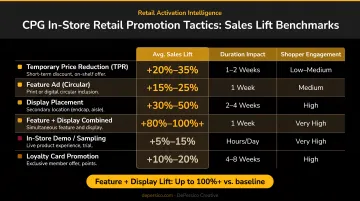
The goal isn't in-store tactics in isolation — it's ensuring the visual brand language a consumer sees at the endcap matches what they saw in a TikTok video the week before.
Content Marketing and SEO
Recipes, tutorials, lifestyle articles, and educational content build organic traffic while deepening consumer relationships over time. For food and beverage brands specifically, this is one of the most natural content strategies available — people are already searching for what to cook.
The mechanics that matter:
- Optimize for queries consumers are actually asking ("easy weeknight dinners with X ingredient")
- Build content around product use cases, not just product features
- Maintain a consistent brand voice across every piece
- Use content to build an email list and retargeting audience
A well-optimized recipe article can rank for years, collecting first-party data every time a reader subscribes or downloads. That compounding return is what makes content one of the few CPG marketing investments that gets more valuable over time, not less.
Experiential and Pop-Up Marketing
Limited-time brand activations create something no digital ad fully replicates — a physical memory tied to the brand. They also generate UGC and earned media simultaneously, delivering outsized returns for brands that execute well.
The Pop-Tarts Bowl offers a compelling recent example. Kellanova's edible mascot activation at the 2024 college football bowl game drove 9x more share of voice than 20 other non-Kellanova bowls combined and produced a 275% increase in social engagements — all from a single experiential concept that translated directly into sustained digital buzz.
Direct-to-Consumer (DTC) and Email Marketing
DTC channels give CPG brands what retail can't: a direct customer relationship. P&G derives more than 17% of total sales from digital channels; Nestlé targeted 25% by 2025. The strategic case goes beyond revenue — it's about data ownership and customer lifetime value.
Once that first-party relationship exists, email becomes the highest-ROI tool for nurturing repeat purchases. According to Litmus, retail and consumer goods email marketing delivers a 45:1 return, with 35% of companies reporting ROI between 10:1 and 36:1.
DTC entry points for CPG brands without full e-commerce infrastructure:
- Loyalty and rewards programs (General Mills launched Good Rewards as its first brand loyalty program)
- Recipe/lifestyle websites with email capture
- Subscription boxes or direct ship for premium SKUs
- Mobile apps tied to product use
Why Packaging Is Your Most Powerful CPG Marketing Channel
Every dollar spent on digital, social, and experiential marketing ultimately drives a consumer toward a shelf — physical or digital. What happens in that moment determines whether the investment converts.
At the physical shelf, packaging is the last advertisement. It either closes the sale or loses it to a competitor, often within 4–6 seconds.
What Makes Packaging Work as a Selling Tool
Effective CPG packaging communicates through a deliberate hierarchy:
- Brand name and primary descriptor readable at 3–5 feet
- Flavor, format, or variety — the first decision-filter most shoppers apply
- Core benefit — the answer to "why this one?"
- Trust signals — certifications, claims, awards that validate the choice
Visual hierarchy gets shoppers to pause. The words on pack determine whether they pick it up. DePersico Creative calls this creative linguistics — the deliberate selection of words and phrases that create emotional or logical connection within seconds. It covers everything from the brand name to the tagline to the front-panel product descriptor. A single well-chosen phrase can drive trial; an unclear one sends a browser to the next option.
The Cost of Underdeveloped Packaging
Packaging mistakes are common — and expensive. The most frequent issues include:
- Competing messages that dilute a single primary claim
- Color choices that contradict brand positioning (organic kale smoothies in red packaging)
- Typography that's illegible at arm's length
- Inconsistent design across a product line that erodes brand recognition
The Tropicana redesign became an industry case study in how quickly this goes wrong — a packaging change that confused loyal customers so thoroughly it resulted in a $30 million sales drop before the brand reverted.
That kind of outcome is avoidable — but only with a structured approach to evaluating what your packaging actually communicates before a redesign goes to market.
Structured Brand Analysis: The SWIFI Process
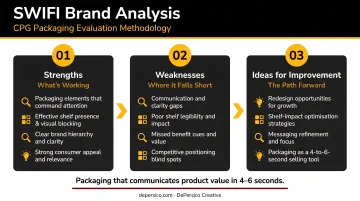
DePersico Creative has worked with brands including Kellogg's, Campbell's, and McCormick using a proprietary methodology called SWIFI — Strengths, Weaknesses, and Ideas for Improvement. The process evaluates how consumers actually perceive a product during a grocery run, with three focused phases:
- Strengths — What the packaging already communicates well, and which brand equities are worth preserving
- Weaknesses — Which visual and perceptual elements cause the product to blend into the category rather than stand out
- Ideas for Improvement — Strategic recommendations combining competitive whitespace analysis, creative linguistics, and visual hierarchy to drive trial
The Idahoan Steakhouse potato line is a documented example of this process in action. After the redesign — which incorporated professional food photography, a warmer color palette, and refined messaging — Idahoan saw a 75% incremental sales increase for casseroles. Category share in the casserole segment jumped from 11.6% to 23.1%. The redesigned package also won Better Homes and Gardens Best New Product, voted on by over 80,000 consumers.
How Strong Packaging Performs Across Every Channel
A strong package design doesn't just perform at the physical shelf. It also:
- Increases Amazon click-through rates through thumbnail legibility and appetite appeal
- Shows up clearly in influencer content and UGC when the design is visually distinctive
- Anchors paid social assets with a consistent visual system
- Strengthens sell sheets and trade presentations with a cohesive brand image
The implication: packaging investment isn't siloed to the shelf. A single well-executed redesign generates returns across retail, e-commerce, earned media, and trade — simultaneously.
Building a Data-Driven CPG Marketing Plan
Set Goals That Ladder Up to Business Outcomes
Use the SMART framework — specific, measurable, achievable, relevant, time-bound — but anchor goals to real business objectives: growing market share in a specific region, winning a new retail account, increasing repeat purchase rate by a defined percentage.
"Increase brand awareness" is not a CPG marketing goal. "Grow in-store velocity in the Northeast by 15% in Q2" is.
Collect First-Party Data Without a Full DTC Channel
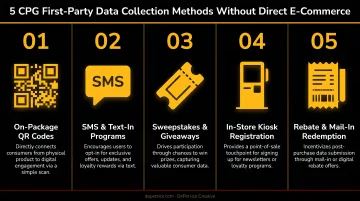
Even without e-commerce infrastructure, CPG brands can build a first-party data asset through:
- Loyalty programs tied to purchase proof (receipt scanning, UPC entry)
- Recipe and lifestyle websites with email registration
- Sweepstakes and sampling requests that capture contact data
- QR codes on packaging — PepsiCo grew its first-party data stores by 50% using QR codes on product packaging and in-store POS placements
- Mobile apps that invite consumers to register and engage
The long-term value of this asset compounds. A brand that spends three years building an owned consumer database has a structural advantage in targeting, personalization, and competitive intelligence no budget can replicate.
Key KPIs to Track
| KPI | What It Measures |
|---|---|
| Customer acquisition cost | Efficiency of paid channels |
| Repeat purchase rate | Loyalty and product satisfaction |
| In-store velocity (units/store/week) | Retail momentum and distribution quality |
| Social engagement rate | Audience quality and content resonance |
| Earned media value | ROI from influencer and UGC campaigns |
| Average cart value | Cross-sell and bundle performance |
For email benchmarks, Litmus's industry data provides a concrete reference point: a 45:1 ROI for retail and consumer goods email programs sets a realistic performance target for brands building DTC/email infrastructure.
Backward and Forward Analytics
Mature CPG marketing operations run two analytical modes simultaneously:
- Backward-looking — attribution modeling, sales lift analysis, engagement reporting that explains what happened
- Forward-looking — predictive modeling that forecasts purchase behavior, inventory needs, and channel ROI
According to Catalina's 2025 CPG marketing research, 46% of CPG marketers plan to enhance AI capabilities focused on content personalization, and 45% on customer segmentation. These priorities apply at every budget level. Starting with simple cohort analysis and repeat purchase modeling gives growing brands the analytical foundation to act on data — not just collect it.
Frequently Asked Questions
What is a CPG in marketing?
CPG stands for consumer packaged goods — everyday products that consumers use and replace regularly, including food, beverages, household staples, and personal care items. CPG marketing covers every strategy and campaign brands use to drive awareness, trial, and repeat purchase across retail and direct channels.
What are the most effective CPG marketing strategies in 2026?
The six core pillars are digital/performance marketing, social and influencer, in-store promotions, content and SEO, experiential, and DTC/email. The most effective approach combines multiple channels under a consistent brand identity, anchored by packaging that converts shelf attention into purchase.
How does packaging design impact CPG sales?
Packaging is the primary point-of-purchase marketing tool. Consumers make split-second decisions at the shelf, and strong visual hierarchy, clear messaging, and appetite appeal directly drive trial rates. Strategic packaging redesigns have driven sales increases of up to 40% in food, beverage, and personal care categories.
What is the difference between CPG marketing and retail marketing?
CPG marketing promotes a specific branded product to build consumer demand wherever it's sold. Retail marketing drives traffic and sales for a specific store or platform. The two overlap frequently in co-marketing programs: a joint endcap promotion, for example, serves both objectives at once.
How can small CPG brands compete with national brands on a limited budget?
Focus investment where impact-per-dollar is highest: packaging quality, local influencer partnerships, in-store sampling, and content marketing. Define a tightly targeted audience and own that segment before expanding. National brands' media budget advantage disappears when a challenger brand goes deeper in a specific niche.
What role does first-party data play in CPG marketing?
First-party data gives brands direct insight into customer preferences and purchase behavior, enabling more personalized campaigns, higher-converting retargeting, and reduced dependence on retailer intermediaries. Loyalty programs, QR codes, and direct digital touchpoints are the most reliable collection channels for CPG brands.