That's not a small thing. A weak name creates friction. A strong one creates cravings.
Whether you're launching a packaged snack, opening a café, or building a restaurant concept from scratch, the name you choose shapes how customers feel before they ever taste your product. This article covers 101 creative food brand name ideas organized by business type — plus a practical guide to evaluating, testing, and finalizing a name that actually works.
Key Takeaways
- Strong food brand names trigger an emotional or sensory reaction in seconds — before a shopper reads a single product description.
- The best names fit your brand's personality: rustic and nostalgic, bold and modern, health-forward and clean, or playful and distinctive.
- This list covers 101 names organized by food business type, from restaurants and bakeries to gourmet brands and packaged snacks.
- Before finalizing any name, test domain availability, run a USPTO trademark search, and check social media handles.
- Pair your name with consistent packaging and positioning; neither works without the other.
What Makes a Great Food Brand Name
A food brand name has one core job: communicate identity and trigger a reaction in two to four words. Not describe your entire product. Not tell your brand's origin story. Just create an immediate feeling fast enough that the shopper doesn't have to think about it. Warmth, appetite, curiosity, trust — whatever fits your brand — delivered instantly.
The Science Behind Food Name Appeal
Word choice in food naming isn't arbitrary. Research published in the Journal of Business Research shows that sound symbolism directly shapes brand perception — front vowels and fricative consonants create lighter, more refined associations, while back vowels and hard stops signal boldness and power.
The concrete vs. abstract distinction matters just as much. A peer-reviewed study on food name concreteness found that high-concreteness names are rated higher in deliciousness, while abstract names are perceived as healthier. "Golden Crust Bakery" scores on appetite; "Pure & Simple" signals clean eating. Neither is wrong — they're optimized for different goals.
That's why "Velvet Roast" feels premium and "Crunch Co." feels energetic before you even know what the product is.
Descriptive vs. Evocative Names
Two fundamentally different approaches work in food naming:
- Descriptive names ("Fresh Harvest Bakery") tell customers exactly what they're getting, reducing friction for first-time buyers. Research by Wansink et al. found descriptive menu labels increased sales by 27% — a dynamic that applies equally to brand names.
- Evocative names ("Bloom & Bake") build emotional equity over time. They don't explain; they invite. Best suited for brands with strong visual identity and marketing investment to build meaning around the name.
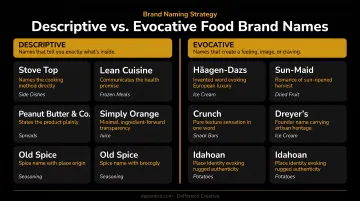
For a new packaged product entering a competitive retail shelf, descriptive often wins early. For a brand building long-term loyalty and premium positioning, evocative names grow stronger over time.
The Four-Factor Test
DePersico Creative, a food and beverage branding agency with over 45 years of experience, evaluates every food brand name against four criteria:
| Factor | What It Means |
|---|---|
| Relevance | True to the product or category |
| Uniqueness | Not in competitive use; trademark-screenable |
| Simplicity | Easy to pronounce and spell — including by retail buyers |
| Memorability | Uses alliteration, wordplay, or sound symbolism |
What to Avoid
The most common naming mistakes that cost brands real money:
- Too generic — "The Food Company" or "Fresh & Tasty" could belong to anyone
- Too narrow — a name built around one dish or one city limits your ability to grow
- Trend-dependent — names chasing a food moment can feel dated within two years
- Trademark-vulnerable — using descriptive category language creates legal risk (in 2024, Momofuku sent seven cease-and-desist letters to brands using "chili crunch" terminology before eventually backing down)
Avoiding these traps is only half the process. Before committing to any name, run this quick checklist:
- Is it easy to say aloud and spell from memory?
- Does it work on a package label, a sign, and a social media handle?
- Is the .com domain available?
- Has it cleared a USPTO trademark search?
- Can it grow with the brand if you expand products or markets?
101 Creative Brand Name Ideas for Your Food Business
The names below are organized by food business type. Find the category that fits your concept, then look for names that match your brand's personality and tone.
Restaurant & Casual Dining Names
Restaurant names should set the dining mood the moment someone hears or reads them — warm and welcoming, vibrant and social, or bold and chef-driven. They fit full-service dining, fast casual, and neighborhood spots alike.
- The Rustic Table
- Crave Kitchen
- Fork & Flame
- Gather & Graze
- Sizzle & Sear
- Urban Feast
- Hearth & Harvest
- The Flavor Lab
- Melt & Mingle
- Bold Bites
- Savory Haven
- Farmhouse Feast
- Vine & Dine
- The Cozy Spoon
- Bloom & Dine
Bakery & Pastry Shop Names
Bakery names should feel warm, nostalgic, and irresistible — the kind of name that makes you picture a warm kitchen before you ever walk through the door.
- Butter & Bloom
- Golden Crust
- The Whiskery
- Flour & Sugar
- Rise & Bake
- Dough & Co.
- Crème & Crust
- The Sugar Loft
- Baked With Love
- Pastry Perfection
- Artisan Bites
- Simply Baked
- The Cake Cottage
- Mornings & Muffins
- Tart & Tasty
Café & Coffee Shop Names
Café names should feel welcoming without being sleepy — whether you're running a cozy neighborhood spot or a focused single-origin roastery.
- Brew & Bloom
- The Velvet Cup
- Morning Mugs
- Bean & Butter
- Sip & Savor
- Rise & Roast
- Pour Over & Co.
- Aroma & Co.
- The Daily Drip
- Espresso Haven
- Campfire Coffee
- Wanderlust Coffee
- High Grounds
- Velvet Roast
- Café Serenity
Food Truck & Street Food Names
Food truck names need to work hard fast — when the truck is parked on a busy street, the name is your entire marketing budget. Bold, fun, and instantly communicative wins every time.
- Rolling Bites
- Curbside Cravings
- The Roaming Fork
- Sizzle & Serve
- Flavor Street
- Street Feast
- The Street Chef
- Wrap & Roll
- Pit Stop Eats
- Mobile Munchies
- Fork It Over
- The Gourmet Nomad
- WanderBite
- Urban Bites Express
- Heat & Eat
Healthy, Vegan & Organic Food Brand Names
Names in the wellness food space should communicate freshness and purpose — earthy and authentic, not clinical or trend-chasing. The U.S. organic market reached $76.6 billion in sales in 2025, with demand driven by consumers who read labels closely and respond to language signals like "natural," "rooted," and "pure."
- Root & Leaf
- Purely Grown
- Nourish & Bloom
- The Clean Plate
- Sprout & Stem
- Verdant Market
- The Harvest Table
- Wild & Wholesome
- Earth's Bounty
- Conscious Cravings
- Flora Feast
- Vitality Kitchen
- The Wholesome Loaf
- Rooted & Raw
- Simply Rooted
Snack, Packaged & Specialty Food Brand Names
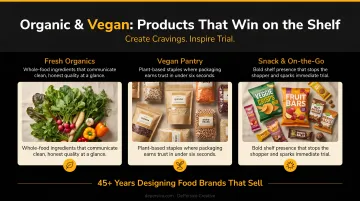
Packaged food brand names carry significant commercial weight. U.S. supermarkets stock an average of 31,795 items — your name needs to trigger appetite and communicate brand personality in a single glance.
- Crunch Theory
- CraveBox
- The Crunch Co.
- Bold & Baked
- Snack Society
- The Artisan Pantry
- Fire & Salt
- Golden Batch
- The Good Grain
- Spice Theory
- The Daily Bite
- Purely Pressed
- Harvest & Co.
- The Flavor Vault
- Crafted Goods
Fine Dining & Gourmet Brand Names
Upscale and gourmet names should feel polished and evocative of quality — often drawing on classical language, natural imagery, or culinary heritage. A name like "Maison" or "Heirloom" does more in one word than a paragraph of positioning copy ever could.
- The Gilded Palate
- Maison Flaveur
- Sable & Sage
- Lumina Dining
- The Obsidian Table
- Aurelia Fine Foods
- The Cultivated Plate
- Prestige & Palate
- The Ivory Table
- Celeste Dining
- The Heirloom Table
How to Choose and Finalize Your Food Brand Name
The "Say It Out Loud" Test
Say the name out loud. Then ask someone else to say it. A strong food brand name should pass the radio test: if someone heard it once in conversation, could they find it again?
If people stumble on the pronunciation, spell it wrong, or ask "what does that mean?" — those are signals to reconsider.
The name also has to sound natural in real usage: "I'm heading to Crave Kitchen" should flow. "Let me grab some from The Artisan Pantry" should feel effortless.
The Availability Checklist
Shortlisting a name without checking availability is where most forced rebrands begin. Run all four of these before making any decision:
- Domain name — Search for the .com first. With over 171.9 million .com and .net registrations currently active, exact-match short domains are scarce. If the .com isn't available, consider whether that's a dealbreaker for your digital presence.
- Social media handles — Check Instagram, TikTok, Facebook, and X/Twitter. Consistent handles across platforms matter for discoverability.
- USPTO trademark search — Use the USPTO trademark search tool to check Classes 29, 30, 31, 32, and 43 depending on your product category. Likelihood of confusion exists when a name is similar to an existing mark and the products are related — both conditions matter.
- State/local business registration — Check your state's business entity database before filing.
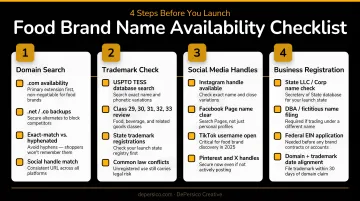
One critical note on descriptive names: the USPTO can refuse registration of marks that merely describe an ingredient, quality, or characteristic of the product. A name like "Crunchy Snack Co." has trademark vulnerability built in from day one.
Long-Term Scalability
A name built around one product, one city, or one trend can become a constraint as your business grows. Dunkin' Donuts dropped "Donuts" from its name in 2019 specifically because the word limited how customers perceived the brand's coffee and beverage business. Chobani never named itself after yogurt — which is exactly why expanding into oat milk and coffee creamer felt natural rather than jarring.
Name your brand's personality and values, not its current product list. "Harvest & Co." can expand into dozens of SKUs. "Artisan Sourdough Loaves" cannot.
Testing With Real People
Once you've stress-tested the name on scalability and availability, validate it with real people. Test your shortlist of three to five names with your actual target customers — not colleagues and family who are too close to give honest feedback.
Ask three specific questions:
- Does this name make you curious about the product?
- Does it tell you something about what the brand offers?
- Would you remember this name tomorrow?
The answers will surface confusion, unintended associations, and phonetic problems before they become expensive rebranding decisions.
When a Name Isn't Enough: Turning Your Name Into a Brand
A great name is a starting point, not a finish line. The name sets a promise. Everything else — packaging, photography, typography, copy — has to deliver on that promise within the first few seconds of shelf contact.
DePersico Creative, which has spent over 45 years helping food and beverage brands build shelf presence, frames this as a systems problem: what the name suggests, the packaging must confirm. Their work with brands like Kellogg's, Campbell's, and McCormick is built on the principle that naming and packaging design are not sequential tasks — they're a single integrated strategy.
Their Yummy Health project is a clear example. The packaging needed to position a healthy snack as genuinely craveable rather than merely nutritious. DePersico developed the positioning line "Crave something GOOD!" — creative linguistics that bridged the gap between health-forward naming and appetite appeal. The name and the message worked as one.
For Sea Best, adding "restaurant quality" directly under the brand name on packaging wasn't a tagline decision — it was a positioning decision that changed how retailers and consumers evaluated the product. The repositioning helped fuel distribution into new Northeast markets and expand the product line from nine to 34 SKUs.
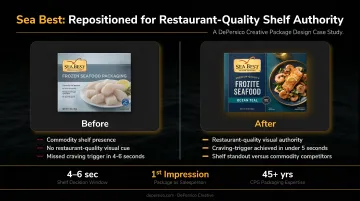
The principle applies whether you're launching from scratch or refreshing an existing product: a name alone won't move units. It takes naming, positioning, and packaging working together to convert shelf attention into a sale.
If you're building a food brand and want naming, creative linguistics, and packaging working together from day one, DePersico Creative provides that integrated support for both startups and established national brands.
Frequently Asked Questions
What is a catchy brand name?
A catchy brand name is short, easy to say, and creates an immediate mental image or emotional reaction. In food branding, the best names trigger appetite or curiosity, pulling the consumer in before any other marketing kicks in.
What are some creative brand name ideas for a food business?
The categorized list above covers 101 options across seven food business types. The strongest food brand names pair vivid, sensory language with a clear personality signal — one that immediately telegraphs whether the brand is warm and homey, boldly modern, or wellness-focused.
What food business names attract customers?
Names that attract customers tend to be easy to remember, aligned with the target customer's values, and supported by strong visual branding. "Crave Kitchen" works because it communicates both category and emotional vibe instantly, the same reason "Root & Leaf" signals wellness without sounding clinical.
How do I come up with a unique name for my food brand?
Start from your brand's core promise: what feeling or result does the product deliver? Brainstorm words that capture that essence, then test combinations for rhythm, memorability, and trademark availability — filtering every finalist through four criteria: relevance, uniqueness, simplicity, and memorability.
Should my food brand name describe my product or evoke a feeling?
Both approaches work, depending on context. Descriptive names reduce friction for new customers and perform well in crowded categories, while evocative names build stronger emotional equity over time but require more marketing investment upfront. Your category, competition level, and early visibility budget should guide the decision.