F&B brands face a two-front marketing challenge: winning at the physical shelf where purchase decisions happen in seconds, and building awareness across the digital channels where discovery and loyalty develop over time. Neglect either front and you leave growth on the table.
This guide covers 15 actionable strategies across three areas — brand foundation, digital marketing, and community building — that work together as a compounding system.
Key Takeaways
- Packaging, brand positioning, and visual identity must come first — digital tactics extend reach, but can't fix a weak foundation
- Digital channels (social, SEO, email, paid ads, video) extend shelf presence into consumers' daily lives
- Community strategies like influencer partnerships, sampling, and loyalty programs turn first-time buyers into repeat customers
- Multi-channel brands consistently outperform competitors relying on a single tactic or platform
- Start by auditing your packaging and core visual identity before scaling digital spend
What Is a Food and Beverage Marketing Strategy?
An F&B marketing strategy is an integrated plan that connects a product with the right buyer across every touchpoint: the retail shelf, your website, social feeds, and the community forming around your brand.
What makes F&B different from other industries is the central role of sensory cues, appetite appeal, and impulse buying. Shoppers don't need a sales pitch. They need to feel a craving the second they see your package.
Every strategy in this guide serves at least one of three core objectives:
- Gets your product into shoppers' consideration sets (brand awareness)
- Converts that awareness into a first purchase (trial)
- Turns one-time buyers into loyal, repeat customers (retention)
Foundation Strategies: Packaging, Positioning & Visual Identity (Strategies 1–4)
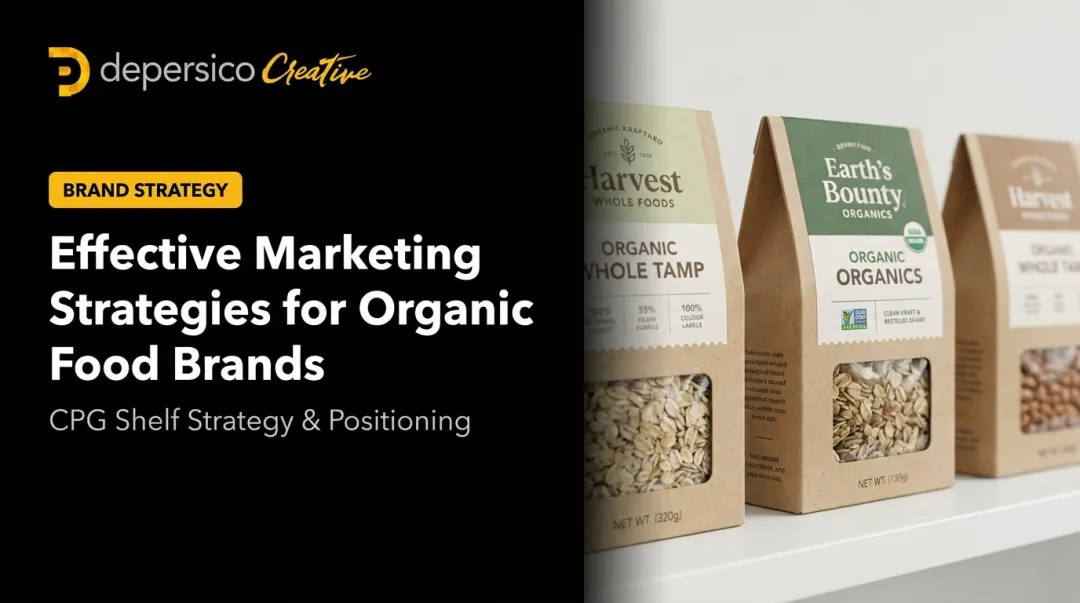
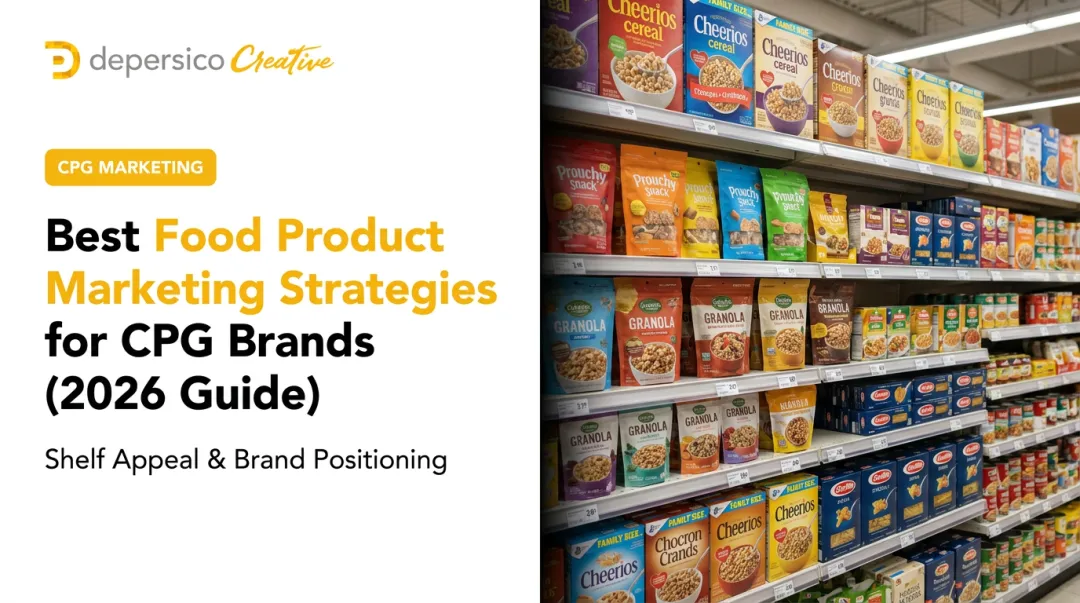
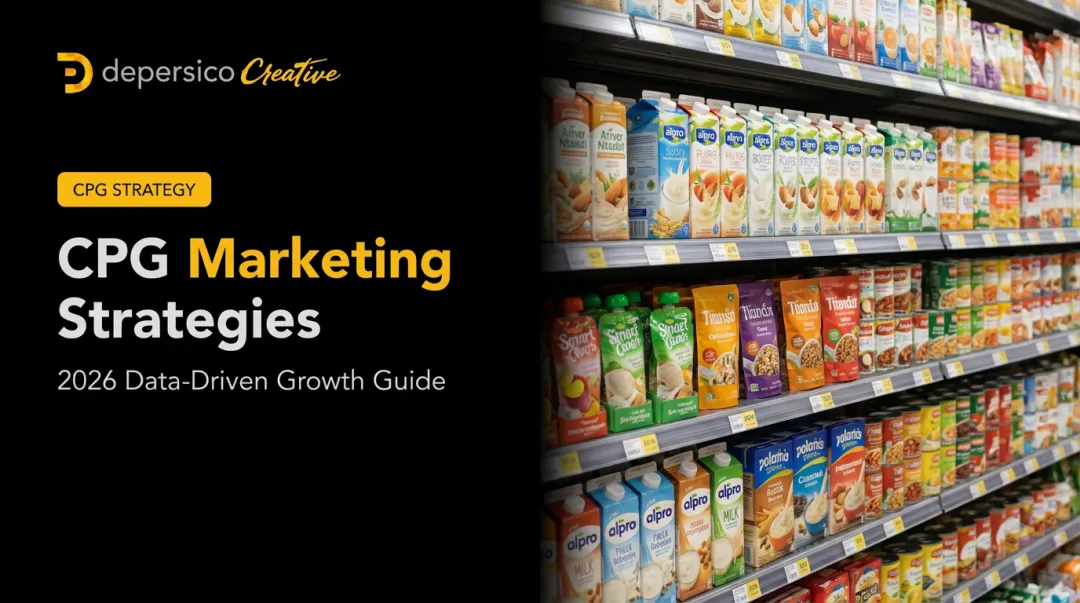
These four strategies form the foundation everything else depends on. Without a compelling shelf presence and clear brand identity, even well-funded digital campaigns underperform — shoppers decide in seconds, and the product itself does the closing.
Strategy 1: Use Packaging as a Strategic Selling Tool
According to POPAI research, 76–82% of grocery purchase decisions are made in-store. Your packaging is your primary salesperson — and it has roughly 3–5 seconds to close the deal, according to Avery Dennison.
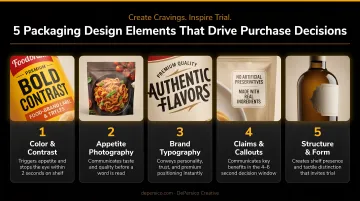
Effective packaging design prioritizes:
- Visual hierarchy — what a shopper sees first, second, and third must be deliberate
- Color strategy — bold, high-contrast palettes that stand out in a crowded category
- Appetite-triggering imagery — photography that creates an immediate craving response
- Benefit-forward copy — the primary value proposition communicated before anything else
- Legibility at distance — brand name and product descriptor readable at 3–5 feet
A 2025 peer-reviewed study on tea packaging found that visual packaging elements directly influenced purchase intention with a total effect of 1.073, including both direct and indirect effects through brand experience.
For brands serious about packaging performance, a structured brand audit is the right starting point. DePersico Creative's proprietary SWIFI process (Strengths, Weaknesses, and Ideas for Improvement) evaluates how consumers actually perceive a product during the 4–6 second shelf decision window.
The analysis covers visual hierarchy, ingredient claims, brand story differentiation, competitor whitespace, and the specific cues that trigger trial — then translates those findings into a redesign roadmap.
Strategy 2: Define a Clear Unique Value Proposition (UVP)
A UVP is the one specific, believable reason a consumer should choose your product over the 20 other options on the same shelf. It needs to be immediately obvious on pack and consistently echoed across all marketing.
Common UVP levers in F&B:
- Ingredient sourcing or quality
- Health benefits or dietary positioning
- Taste profile or flavor experience
- Brand origin or founder story
- Production process or authenticity
Start by researching competitor claims to find genuine gaps. Then test your messaging with real consumers before committing it to packaging and campaign copy. DePersico's Creative Linguistics approach — identifying the specific words and phrases that resonate within seconds — applies four tests to every message: Is it relevant? Unique? Simple to pronounce? Memorable?
Strategy 3: Build a Consistent Brand Identity & Storytelling Strategy
A brand story transforms a commodity into something consumers feel connected to. A 2025 study published in Foods found that food graphic storytelling raised purchase intention scores from 3.77 (control) to 4.30 among participants — a meaningful lift from narrative alone.
The key elements of an effective F&B brand story:
- Founder origin or company heritage
- Product mission or purpose
- Ingredient authenticity or process transparency
Transparency matters here. FMI research shows 76% of grocery shoppers said ingredient and production transparency was important to their purchasing decisions in 2023, up from 69% in 2018.
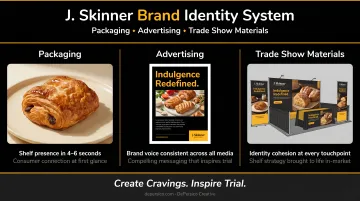
Consistency across every touchpoint is what makes the story compound. Packaging, website, social media, email, and point-of-sale materials should share the same typography, color system, photography style, and verbal tone. The J. Skinner® rebranding — executed by DePersico Creative — demonstrates what this looks like in practice: a consistent visual and verbal identity rolled out across packaging, consumer and trade ads, billboards, and a trade show presence contributed to branded sales increases of 210–340% compared to average national sales.
Strategy 4: Invest in Professional Food Photography
High-quality food imagery is the primary creative asset across every F&B marketing channel. According to Salsify's 2025 Consumer Research, 77% of shoppers said product images and videos were extremely or very important to completing a purchase. Amateur photography doesn't just look bad — it actively undermines perceived product quality and consumer trust.
Professional food photography requires:
- Controlled lighting that enhances appetite appeal
- Food styling expertise (props, plating, arrangement)
- Composition aligned with the brand's visual identity
- Multiple angles for packaging, ads, and social applications
Working with an agency that has an in-house test kitchen and photography studio — as DePersico Creative does at their West Chester, PA facility — means food, styling, and photography happen in one place, on one schedule.
Food can be prepared fresh, styled, and shot in the same session, maintaining consistency across a product line. All images come with full usage rights, so clients can deploy the same assets across packaging, billboards, social media, and retail presentations without restriction.
Digital Marketing Strategies for F&B Brands (Strategies 5–10)
Digital channels let F&B brands extend their shelf presence into consumers' daily lives. The key is choosing platforms based on where your specific target buyer spends time — not simply defaulting to the most popular channels.
Strategy 5: Build a Platform-Specific Social Media Presence
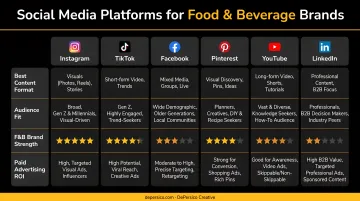
Platform selection matters more than total presence. Match your energy to where your audience actually is:
| Platform | Best Use Case |
|---|---|
| Appetite-driven visual content, lifestyle imagery | |
| TikTok | Recipe demos, behind-the-scenes, trend participation |
| Recipe discovery, meal planning audiences | |
| Reaching retail buyers and B2B partners |
Maintain a consistent posting cadence with a mix of product content, behind-the-scenes footage, and user-generated content (UGC) reposts. UGC builds social proof without production cost.
Strategy 6: Prioritize Short-Form Video Content
Short-form video is the fastest-growing discovery format for food brands. Rival IQ's 2024 Social Media Industry Benchmark Report found that Food & Beverage brands achieved a 3.95% median TikTok engagement rate per video — one of the stronger engagement benchmarks across any category.
Practical guidelines for F&B short-form video:
- Hook viewers in the first 3 seconds — TikTok's own data confirms this is the critical retention window
- Keep videos focused on a single idea (recipe, taste reaction, process clip)
- Always include on-screen captions for silent viewing
- Post consistently rather than sporadically for sustained algorithmic reach
Recipe demos, taste reactions, and production process clips consistently drive organic reach without ad spend.
Strategy 7: Use SEO and Blog Content to Drive Organic Traffic
Keyword-optimized blog content captures in-market buyers searching for recipes, ingredient information, or product comparisons. It builds long-term organic traffic at a lower cost per acquisition than paid channels — and the content compounds in value over time.
Start with keyword research to understand what your target buyers actually search. Common high-intent F&B search categories include:
- Recipe searches tied to your product category
- Ingredient or health benefit queries
- Product comparison searches ("best X for Y")
- How-to and preparation content
Link blog content directly to relevant product pages to move readers toward purchase, not just toward more reading.
Strategy 8: Build an Email Marketing List That Converts
Email consistently delivers the highest ROI of any digital channel. Litmus reports an average return of $36 for every $1 spent, with retail, e-commerce, and consumer goods averaging 45:1.
Segment your list by customer stage for better results:
- New subscribers — welcome sequence, brand story, first-purchase incentive
- Active buyers — product launches, recipe content, loyalty rewards
- Lapsed customers — win-back offers, new product announcements
Use email for time-sensitive promotions, limited seasonal SKUs, and loyalty program updates — not just newsletters that get ignored.
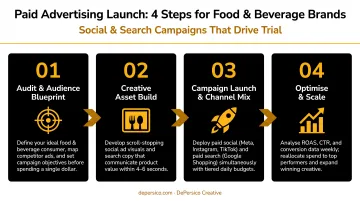
Strategy 9: Invest in Paid Advertising Across Social and Search
Paid social (Meta, TikTok) and Google Shopping ads extend reach beyond what organic alone can achieve for F&B brands, especially for new product launches.
Before launching any paid campaign:
- Define one goal — awareness, trial, or conversion (not all three at once)
- Test at least two creative variants — different hooks, visuals, or copy angles
- Scale only the top performer — don't spread budget across underperformers
- Layer in retargeting — re-engage website visitors who browsed but didn't buy
Retargeting tends to convert at lower cost than cold audiences — these visitors already know the category and were close enough to buy that they clicked through. Even a modest retargeting budget can recover a meaningful percentage of that lost traffic.
Paid advertising builds awareness fast, but what shoppers find when they search your brand after seeing an ad matters just as much. That's where reputation management comes in.
Strategy 10: Actively Manage Online Reviews and Reputation
For retail-distributed brands, star ratings on Amazon, Walmart.com, Instacart, and similar platforms directly influence both consumer purchase decisions and retail buyer confidence during line reviews.
- Build a systematic post-purchase review request process
- Respond to negative reviews with genuine resolution offers — not defensive replies
- Monitor review trends to catch recurring product or packaging issues early
Retail buyers notice review patterns during line reviews. A product sitting below 4.0 stars with no brand response signals poor quality control — and gives buyers an easy reason to pass on a reorder.
Community and Relationship-Building Strategies (Strategies 11–15)
The most durable F&B brands build communities around their products. These strategies convert one-time buyers into repeat customers and generate authentic word-of-mouth that paid advertising can't replicate at scale.
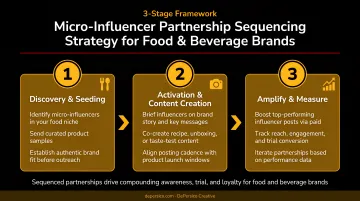
Strategy 11: Partner with Micro-Influencers in Your Niche
Micro-influencers (roughly 10K–100K followers) in food, health, and lifestyle categories deliver higher engagement rates and more trusted recommendations than large celebrity partners. Research from Matter Communications found that 81% of consumers said social posts from influencers, friends, or family drove interest in a product, with 69% trusting influencers over direct brand communications.
Prioritize audience alignment over follower count. An influencer with 25,000 followers who speaks directly to your target buyer profile will outperform a 500,000-follower account whose audience demographic doesn't match.
A practical sequencing approach:
- Product seeding first — send product to relevant creators with no strings attached
- Assess authentic reactions before approaching any paid arrangement
- Scale to paid partnerships only with creators whose audience engagement has proven genuine
Scripted endorsements consistently underperform organic reactions, even at higher spend.
Strategy 12: Optimize Your Google Business Profile for Local Discovery
Even nationally distributed brands benefit from local SEO. Many consumer purchase decisions start with searches like "where to buy [product] near me." A complete, photo-rich Google Business Profile with current hours, product images, and regular posts increases visibility for regional buyers and drives foot traffic to retail stockists.
National brands that skip this step leave a direct acquisition channel unattended — one that costs nothing beyond setup time.
Strategy 13: Pursue Co-Marketing and Brand Collaborations
Partnering with complementary brands exposes both parties to each other's loyal audiences without significant budget. Classic F&B co-marketing pairings work because the products are naturally used together — salsa and chips, peanut butter and jelly, coffee and creamer.
Validate the partnership with low-risk formats first:
- Shared social post or story mention
- Co-branded giveaway or sweepstakes
- Recipe collaboration featuring both products
Scale to co-packaged products or joint events only after validating audience overlap and brand compatibility.
Strategy 14: Use Sampling, Events, and Experiential Marketing
In-person sampling remains one of the highest-converting tactics in F&B because it eliminates the biggest barrier to first purchase: product uncertainty. You can't describe a taste experience through an ad — but you can let someone experience it directly.
Effective sampling approaches include:
- In-store grocery demos convert well because shoppers arrive already in buying mode
- Food festivals and pop-ups build brand recognition in high-foot-traffic environments
- Influencer product seeding extends sampling reach through trusted third-party voices
- Social giveaways serve as a digital sampling alternative for e-commerce-distributed brands
A 2018 peer-reviewed scoping review on food retail environments confirmed that taste tests and food demonstrations consistently drive trial and incremental sales of sampled products.
Strategy 15: Build a Loyalty Program and Referral Incentive Structure
Loyalty programs increase customer lifetime value by rewarding repeat purchases with points, exclusive products, or early access. Referral programs turn satisfied customers into low-cost acquisition channels.
The most important design principle for referral programs: make it simple. A unique link or discount code with a meaningful reward for both the referrer and the new buyer performs far better than multi-step redemption processes that create friction.
For loyalty programs, consider rewards that reinforce the brand relationship — early access to new flavors, exclusive recipes, or insider content — not just price discounts that train customers to wait for promotions.
Conclusion
All 15 strategies work best when built on a strong brand foundation. Digital reach and community tactics amplify a compelling brand — they don't rescue a weak one. Brands that invest in packaging, visual identity, and a clear UVP first will see every subsequent dollar spent on digital and community marketing return more.
Start with an honest evaluation of your packaging and brand identity. They're the first thing most consumers encounter — before any digital ad, social post, or campaign reaches them.
DePersico Creative works with F&B brands at every stage — from first-time founders launching a single SKU to national CPG portfolios managing multiple product lines. The goal is always the same: close the gap between where a brand looks today and where it needs to perform to inspire trial and build lasting loyalty.
Start with a free consultation. Reach out to Paul directly at paul@depersico.com or (484) 454-3844.
Frequently Asked Questions
What is the 3-3-3 rule for marketing?
The 3-3-3 rule is a practitioner framework (not a formal academic model) that suggests focusing on 3 core messages, 3 audience segments, and 3 marketing channels. For F&B brands, this translates to keeping campaigns focused rather than spreading messaging too thin across too many platforms simultaneously.
What are the 5 C's of marketing strategy?
The 5 C's — Company, Customers, Competitors, Collaborators, and Context — form a situation analysis framework used before building a campaign. F&B brands use it to audit their competitive environment, understand buyer motivations, and spot partnership opportunities before committing to a plan.
What are the 4 brand strategies?
The four brand strategies are:
- Line extension — a new variant under an existing brand (Diet Pepsi)
- Brand extension — an established brand entering a new category (Oreo ice cream)
- New brand — a distinct identity launched independently (PepsiCo's STARRY)
- Flanker/fighting brand — a separate brand protecting market position (STAGG alongside Hormel chili)
What is the 3-7-27 rule in branding?
This practitioner mental model suggests consumers need roughly 3 interactions to recognize a brand, 7 to begin remembering it, and 27 to develop genuine trust. That's why consistent F&B marketing across multiple channels — rather than a single touchpoint — is necessary to build a loyal customer base.
What makes food and beverage marketing different from other industries?
F&B purchase decisions are heavily sensory and impulse-driven, with shoppers making choices in seconds based on appetite appeal and packaging cues — not research. The decision window is compressed and largely happens at the shelf, making packaging a frontline marketing tool in a way that doesn't apply to most other product categories.
How important is packaging in food and beverage marketing?
Packaging is often the only marketing touchpoint between the brand and the consumer at the exact moment of purchase decision. Both visual design and copy language directly determine whether a shopper picks up the product or passes it by — making it the single highest-leverage asset in retail F&B marketing.