The products that fail aren't always inferior. Many of them taste great. They fail because of poor market timing, underdeveloped packaging, compliance oversights, or distribution strategies that don't match where the target customer actually shops.
This guide is for food entrepreneurs launching their first product and established brands adding to their line. Both face the same core challenges: validating an idea, developing a formula that survives commercial production, navigating compliance, building packaging that sells, and distributing through the right channels before the money runs out.
What follows is a six-step framework covering every stage — from concept validation through post-launch scaling.
Key Takeaways
- Validate first — survey target buyers or run a small batch sale before committing to full development costs
- Test at scale — confirm your formula holds up through a co-manufacturer run, not just your test kitchen
- Get compliance right early — FDA labeling and allergen requirements aren't optional, and fixing them late is expensive
- Packaging is your salesperson — shoppers decide in seconds; packaging design drives purchase decisions, not just aesthetics
- Price for margin — target 40–50% gross margin or your unit economics won't support growth
- Launch, then iterate — track sell-through rate and repeat purchases; those two metrics drive every decision that follows
Step 1: Validate Your Concept with Market Research
Skipping market research is how promising products end up in the clearance bin six months after launch. Most founders underestimate two things: how saturated most food categories already are, and how specific consumer demand actually is.
The Three Research Layers
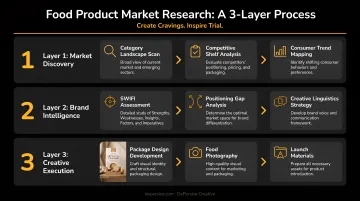
Before writing a single formula or booking a co-packer, work through these three layers:
Trend and category analysis — Use tools like Mintel GNPD, SPINS, and retail observation to understand where your category is growing, where it's declining, and what's already crowding the shelf. Mintel reported in 2024 that only 29% of U.S. CPG launches in the first five months of the year were genuinely new products — the rest were extensions, reformulations, or relaunches. Real white space is rarer than it looks.
Competitive research — Walk the actual shelf. Buy the competition. Understand how they're positioned, what claims they're making, and where the gaps are. If five brands in your category already claim "clean ingredients," that's baseline consumer expectation, not a point of differentiation.
Direct consumer research — Surveys, social listening, food community forums, and structured focus groups with people outside your immediate circle. The goal is to verify that someone other than your friends and family would pay money for this product.
What You're Actually Testing
Research consistently points to the same launch failure causes: products consumers don't understand, products that don't deliver on their claims, and weak pre-launch research. The research phase isn't about confirming that your product tastes good. It's about confirming that:
- A specific consumer has a specific unmet need
- Your product addresses that need in a way they'd pay for
- The market isn't already saturated with close substitutes
Get these answers before recipe development begins. Reformulating or repositioning after production runs are booked costs far more than a few weeks of upfront research — and that's before factoring in the shelf time you've already lost.
Step 2: Develop and Test Your Product Formula
A recipe that works at home is a starting point, not a finished product. The real challenge is ensuring taste, texture, and quality hold up when you move from a kitchen to commercial production volumes — different equipment, different batch sizes, different processing conditions.
Formula Refinement Priorities
- Run blind panel tests across multiple formula versions — internal teams lose objectivity fast.
- Document shelf life before approaching retail buyers. IFT describes accelerated shelf-life testing as a way to get quality and safety data in a fraction of real-time.
- Complete nutritional analysis if you're making any health claims. It's also federally required for the Nutrition Facts panel on most packaged foods.
- Audit for all nine major allergens. Sesame became the ninth in January 2023 under the FASTER Act — build your formulation and production process around preventing cross-contact.
In-House R&D vs. Co-Packing
Most emerging brands lack commercial production equipment, so working with a co-manufacturer is the norm. The critical mistake is waiting until your formula is locked before getting them involved. Oklahoma State Extension recommends evaluating co-packers on:
- Experience with similar products
- Equipment capability and certifications
- Minimum order quantities (MOQs) relative to your launch volume
- Willingness to provide production records and samples
Bringing a co-packer in during formula development prevents costly reformulations when your recipe first hits industrial equipment. IFT notes that successful scale-up requires formulating for industrial processing from the start, not retrofitting a kitchen formula afterward.
Step 3: Navigate Compliance, Production, and Supply Chain
Compliance failures can end a brand before it gets started. A recall or label violation in the first year — when your reputation is still forming — often causes permanent damage with buyers and consumers.
FDA and USDA Requirements
The regulatory landscape breaks down by product category:
| Agency | Jurisdiction |
|---|---|
| FDA | Most packaged foods, beverages, dietary supplements |
| USDA FSIS | Meat, poultry, and egg products |
For FDA-regulated products, the FDA Food Labeling Guide outlines every required label element: statement of identity, net quantity, manufacturer name and address, Nutrition Facts panel, and ingredient list. All nine major allergens — including sesame as of January 1, 2023 — must be clearly disclosed.
Non-compliance risks go beyond fines. They include product recalls, retailer delistings, and reputational damage at the exact moment you're trying to build credibility with buyers and consumers.
Supply Chain Essentials
Lock in ingredient suppliers before scaling. According to a 2022 Deloitte consumer products survey, nearly 90% of food and beverage brands said higher ingredient prices directly shaped operations, and nearly 50% halted production on certain products entirely. Supply chain failures at launch are among the top reasons strong products underperform.
Plan for:
- Minimum order quantities that match your production schedule
- Lead times for both ingredients and packaging materials
- Buffer inventory to absorb supplier delays without missing retail commitments
Unit Economics: Know Your Numbers
Supply chain costs feed directly into your unit economics — and the numbers must work before you commit to commercial production. Food CPG consultants and industry sources consistently cite 40–50% gross margin as the target range for emerging brands to be viable. That margin must absorb:
- Ingredient costs and tolling fees
- Packaging materials and co-packing charges
- Freight and storage
- Distributor margin (typically 15%) and retailer margin (typically 40%)
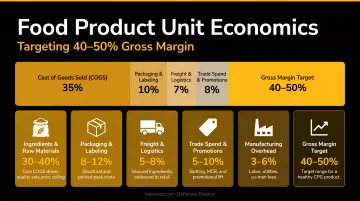
If the math doesn't work at your target MSRP, reformulate, find efficiencies, or reprice. Launching with broken unit economics is a structural problem that growth alone won't fix.
Step 4: Create Packaging and Branding That Sells
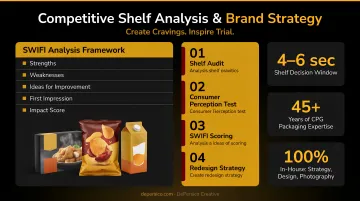
On a retail shelf, your packaging is doing the selling. Explorer Research found that packaging has just one to two seconds to engage shoppers, drawing from research with more than 50,000 shoppers annually. A 2014 POPAI grocery study found that 76% of purchase decisions are made in-store — meaning most buyers arrive with no brand preference locked in.
That's the environment your packaging has to win in.
What Strategic Packaging Must Do
Effective food packaging accomplishes several things simultaneously — and all of them in under two seconds:
- Communicate the brand identity and product category instantly
- Stand out visually against adjacent competitors on the shelf
- Trigger appetite appeal through imagery and color
- Satisfy regulatory labeling requirements without cluttering the design
- Deliver a front-of-pack message clear enough that shoppers understand what they're buying without picking it up
The Role of Brand Identity Elements
Logo, color palette, typography, and imagery must work as a cohesive system. Each element carries a signal. Handwritten typography suggests homemade craft. Elegant photography positions a product as restaurant-quality. Bold color blocks communicate value. Clean white space reads as premium.
The language on the front of pack matters just as much as the visuals. This is where creative linguistics — the deliberate selection of words and phrases that create immediate appetite appeal and emotional connection — determines whether a shopper picks up your product or moves on.
DePersico Creative, a West Chester, PA-based food and beverage packaging agency with over 45 years in the category, describes creative linguistics as identifying "the most effective and compelling words and phrases that quickly create a strong appeal and connection with your product from an emotional or logical perspective." Where copywriting focuses on persuasion, creative linguistics functions as a strategic conversion tool on the shelf.
That language strategy doesn't happen in isolation. DePersico's SWIFI process (Strengths, Weaknesses, and Ideas for Improvement) opens every packaging engagement with a competitive shelf analysis — mapping what competing products are communicating, where visual sameness has taken hold, and where a new brand can break the pattern and earn a second look. That analysis shapes the packaging strategy before any design work begins.
Practical Design Considerations for Retail
- Shelf placement context — Designs that work at eye level don't always translate to floor-level or endcap positions. Consider where your category actually lives.
- Category conventions — Some should be followed (so shoppers can identify the category), some should be deliberately broken (so your product stands out within it).
- Photography — Custom food photography, not stock, creates the appetite appeal that drives trial. DePersico operates an in-house test kitchen and studio specifically to produce packaging photography that works across retail, e-commerce thumbnails, and social media simultaneously.
- Regulatory integration — Nutrition facts, allergen statements, and ingredient lists are non-negotiable. The skill is incorporating them without undermining the front-of-pack visual hierarchy.
For brands going to retail, the packaging partner you choose matters. Agencies with deep food category experience bring competitive shelf intelligence to the work — which is often what separates a product that earns repeat placement from one that gets pulled after the first reset.
Step 5: Plan Your Pricing, Distribution, and Pre-Launch Marketing
Pricing Framework
Start with your cost of goods. Then build the channel math backward from retail:
- Retailer margin: typically 40% of MSRP
- Distributor margin: typically 15% of MSRP
- Target brand gross margin: 40–50% of MSRP
If your COGS can't support those layers at a price point your category will bear, you have a unit economics problem — and it needs to be solved before launch, not after.
Distribution Channel Options
| Channel | Advantages | Considerations |
|---|---|---|
| Regional grocery | Fastest path to retail velocity data | Slotting fees ($250–$1,000 per item per store), promotional requirements |
| Independent specialty | Lower barriers to entry | Smaller volume, good for proof of concept |
| DTC e-commerce | Margin retention, direct consumer data | Higher CAC, requires strong digital execution |
| Farmers markets / pop-ups | Immediate consumer feedback, sampling | Not scalable alone |
| Food service | Volume opportunity | Long sales cycles, custom packaging |
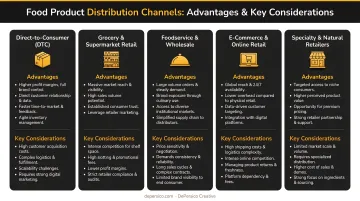
Pick one channel, execute it well, and use the velocity data to make the case for the next. Spreading thin across multiple channels at launch usually means doing none of them well.
For grocery retail, be prepared for category manager conversations around margin expectations, promotional support commitments, and velocity projections. Have your sales data — even from a smaller channel — ready before those meetings.
Pre-Launch Marketing Essentials
- Build brand presence before launch — Teaser content, behind-the-scenes production stories, and brand narrative on social media before the product is available. This is how you arrive at launch with an audience rather than building one from scratch.
- Sampling — In-store sampling drives trial, and trial is what converts a first-time shopper into a repeat buyer. Budget for multiple sampling events; the second and third tend to outperform the first as brand recognition builds.
- Media and influencer outreach — Target food bloggers, local press, and food media before launch, not after. Reviews and mentions that go live on launch day matter far more than coverage that appears weeks later.
Your brand story needs to be complete before you run any paid marketing. Promotions can generate trial; they can't generate loyalty for a product whose identity hasn't been defined yet. Know what you stand for before you spend on visibility.
Step 6: Launch, Measure, and Scale
What Launch Day Actually Requires
Launch day is an operational coordination challenge as much as a marketing one. Production must be delivered, shelves must be stocked, and digital campaigns need to go live in sync.
Have a communication plan in place with every partner — co-packer, distributor, retail contacts, marketing team — and a checklist confirming each dependency before you flip the switch.
Metrics That Tell You the Truth
Track these post-launch:
- Retail sell-through rate — Are units moving off the shelf before the next delivery?
- Reorder velocity — Are retailers reordering, and how quickly?
- DTC conversion rate — Are site visitors purchasing?
- Repeat purchase rate — Are first-time buyers coming back?
High trial with low repeat is the most important signal to take seriously. The product experience isn't matching the packaging promise, or the packaging attracted the wrong buyer in the first place. Either way, it's a product or positioning problem, not a marketing spend problem.
Building Toward Scale
Once your metrics confirm velocity and repeat purchase in one channel, you have the proof needed to expand. At that point:
- Expand into adjacent distribution channels with actual sell-through data in hand
- Add SKU extensions or flavor variants only after the core product is proven
- Use early retail data to anchor conversations with larger buyers — velocity per store per week is the language category managers speak
Frequently Asked Questions
How do you launch a new food product?
Follow six core stages: validate the concept with market research, develop and test the formula for commercial production, secure compliance and manufacturing, build strategic packaging and branding, set pricing and distribution, then launch with measurable goals and iterate based on performance data.
What are the 4 P's of product launch?
In a food product context: Product (your formulation and what makes it unique), Price (what you charge relative to cost and competition), Place (where and how it's distributed), and Promotion (how you create awareness and drive trial). All four need to work together before launch.
What is the 5 ingredient rule?
It's a clean-label consumer trend, not a regulatory requirement. Products with five or fewer recognizable ingredients are perceived as simpler and more trustworthy by health-conscious shoppers. University of Georgia notes that "clean labeling" has no legal definition — it's a positioning strategy, particularly effective in health, natural, and better-for-you categories.
What is the 2 2 2 rule for food?
The 2-2-2 rule is a USDA food safety guideline, not a product development framework. The principle: refrigerate leftovers within 2 hours of cooking, consume within 2 days, and discard anything left at room temperature for more than 2 hours.
How long does it take to launch a new food product?
Most products require 12 to 24 months from concept to retail shelf. Timeline depends on formulation complexity, regulatory review needs, co-packer lead times, and chosen distribution channel.
What makes food packaging successful on retail shelves?
Successful packaging communicates brand identity instantly, stands out within its category, uses compelling language and imagery to trigger appetite appeal, and motivates a purchase decision in the one to two seconds a shopper is standing in the aisle. Packaging that performs starts with brand strategy, then builds toward execution.