Growing a snack brand requires solving two problems simultaneously. First, you need a product and identity compelling enough to earn trial from a shopper who makes purchase decisions in roughly 13 seconds at the shelf (Nielsen). Second, you need the operational and distribution infrastructure to actually get that product in front of enough people to build momentum.
Neither problem is easy. Solving only one guarantees failure.
This article covers the five pillars of snack brand growth: brand identity, product development, local-first distribution, channel diversification, and marketing operations. Work through them in sequence, and they form an integrated roadmap rather than a scattered checklist.
Key Takeaways
- Strong brand identity — especially packaging — is the foundation everything else depends on
- Flavor innovation toward spicy, global, and better-for-you profiles is where consumer demand is heading
- Dominating one local market before expanding nationally produces more durable national growth
- Retail and DTC channels work better together than separately
- Marketing should drive trial, repeat purchase, and premiumization — not acquisition alone
Build a Brand Identity That Earns Shelf Space
Packaging is your only salesperson on retail shelves. There's no one standing next to your product explaining what makes it worth trying. Design, language, and visual hierarchy do that work alone — and they have seconds to do it.
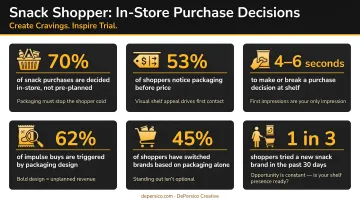
That's not a metaphor. Nielsen research puts the average in-store brand purchase decision at 13 seconds. POPAI's shopper engagement research found that 82% of purchase decisions are made in-store, with 62% being unplanned. For snack brands, that means most of your buyers weren't looking for you specifically. Something on the package made them stop.
Position Before You Design
Brand positioning answers three questions before any design work begins:
- What does this snack uniquely stand for?
- Who is the core consumer — specifically, not broadly?
- Why does that positioning make this brand different from the 40 other options on the same shelf?
A clearly defined position makes every downstream decision easier — from packaging to pricing to which retail channels to prioritize first. Without it, you end up with packaging that looks fine but says nothing specific.
What Your Packaging Is Actually Communicating
A 2023 snack food packaging study identified color, shape, imagery, line weight, and typography as the key design factors influencing purchase decisions — with image as the most significant factor. Most emerging snack brands still underweight it.
The practical question isn't "does our packaging look good?" It's "does our packaging communicate flavor, quality, and brand personality from across the aisle, in a visually loud environment?"
DePersico Creative's SWIFI process — a proprietary brand audit evaluating Strengths, Weaknesses, and Ideas for Improvement — compares a product against its strongest competitors and surfaces what the packaging is actually communicating versus what the brand intends it to say. The analysis covers visual hierarchy, ingredient claims, competitor whitespace, and the specific cues that drive trial. For a snack brand preparing to scale, this type of shelf-context evaluation should happen before any significant investment in growth, not after.
Creative Linguistics: The Words Do Work Too
Visual design gets most of the attention, but language choices on pack matter more than most brands realize. Words like "slow-smoked," "crafted," "bold heat," or "three-ingredient" shift consumer perception quickly — they trigger appetite appeal and elevate the product from commodity to must-try.
DePersico Creative's approach to creative linguistics treats every word on a package as earning its space. The process involves competitor analysis first, then finding language that occupies unclaimed territory. Sometimes a single word on a front panel — positioned correctly — is enough to create the connection that drives trial.
Strong positioning and sharp language only pay off if they hold up in the real environment they'll compete in. Before scaling, stress-test your identity:
- Place your product physically among competitors on a shelf mockup
- Stand 10 feet away — can you read and understand the brand?
- Ask real shoppers (not friends) what they think the product is and who it's for
- If the answers surprise you, address it before spending on distribution
Develop Products That Drive Trial and Repeat Purchase
Product development in the snack category has two separate jobs. The first is earning initial trial — making something novel or appealing enough that a shopper picks it up. The second is earning repeat purchase — delivering on the promise well enough that the same person comes back.
Most brands over-index on the first and under-invest in the second.
Follow Flavor Trends, But Anchor in Familiar Territory
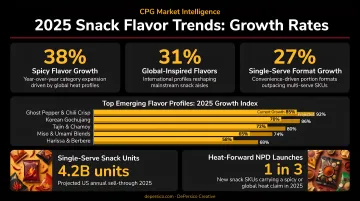
SNAC International's 2025 data shows spicy and globally inspired flavors saw a 15% increase in popularity, with spicy Nashville hot, mango habanero, and spicy margarita profiles recording triple-digit growth in 2023. Mintel's 2025 salty snacks research points to growing consumer interest in adventurous profiles like gochujang, hatch chili, and miso — while noting that nacho cheese and pizza remain the familiar anchors that keep category volume stable.
The takeaway isn't "go spicy." Novelty works best when paired with a familiar format or flavor base. A mango habanero twist on a classic chip format is more accessible than an entirely new flavor system in an unfamiliar snack vehicle.
Single-serve formats are also worth attention — SNAC reports single-serve packages grew 10% in sales, driven by portion-control preferences and convenience. That's a format decision with direct velocity implications at retail.
The Better-For-You Segment Has Real Scale
Grand View Research values the U.S. healthy snacks market at $31.90 billion in 2024, projected to reach $54.61 billion by 2033 at a 6.2% CAGR. SNAC's data shows **55% of consumers cite protein as the most important health claim**, and sales of organic and low-sodium snacks rose 12%.
One caveat: tapping a health trend only works when the product genuinely delivers. Consumers who buy a "high-protein" snack and get something that tastes like cardboard won't return — no matter how prominent the claim on the front panel. The health claim earns the first purchase; the eating experience determines every purchase after that.
Broaden Your Audience Intentionally
Quest Nutrition built its early following in the fitness and bodybuilder community, a dedicated but narrow base. Repositioning around "higher protein, lower sugar, lower carb snacking" for mainstream consumers helped transform Quest from a gym supplement into a broadly distributed snack. Simply Good Foods acquired Quest in 2019 for $1 billion, with Quest reporting net sales of $346 million in the prior year.
For growing snack brands, the same logic applies. If your first customers are health enthusiasts, the product likely serves a much wider audience with different language and framing:
- Busy parents packing lunches
- Office workers looking for afternoon fuel
- Travelers needing portable, satisfying options
- Kids who need something that feels like a treat
The product doesn't change. The positioning does.
DePersico Creative's Yummy Health project illustrates this repositioning process. The brand needed packaging that made healthy snacks look as craveable as traditional junk food — not just "good for you" but genuinely appealing to mainstream snack buyers. The redesign delivered a positioning line ("Crave something GOOD!"), bold shelf-competitive packaging, and brand language that reached well beyond the health-conscious niche.
Stay Focused on SKUs Early
Launching too many SKUs too soon is one of the most common growth mistakes. It strains co-manufacturing capacity, complicates retail buyer conversations, and splits marketing dollars across too many products to build velocity on any single one.
The right sequence:
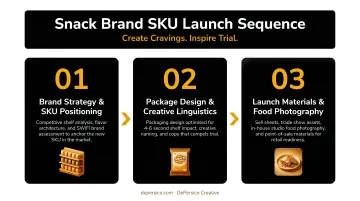
- Launch one hero SKU with maximum packaging and marketing investment
- Build velocity and retailer confidence in that SKU
- Introduce complementary SKUs once distribution is established and reorder rates confirm demand
Start Local, Then Scale Smart
The instinct to go national as fast as possible is understandable. It's also one of the most reliable ways to burn through capital before you've built a loyal base.
Utz Brands' growth model is instructive. According to Utz's 2024 Form 10-K, the company built an impenetrable regional base in Pennsylvania, Maryland, and Virginia before expanding nationally. As of late 2024, Utz operated approximately 2,500 DSD routes nationwide and had recorded six consecutive quarters of share gains in expansion geographies — a track record that started with regional dominance, not national ambitions.
What "Owning One Market" Actually Means
Local dominance isn't just being available in a market. It means saturation — placing product in every relevant channel within a defined geography:
- Grocery (multiple chains and independents)
- Convenience stores
- Specialty and natural food retailers
- Local foodservice accounts
When density is high enough, organic word-of-mouth takes over. Brand recall is unavoidable because consumers see the product everywhere they shop. That kind of presence is nearly impossible to replicate through paid media alone.
Regional identity also carries strategic weight beyond the home market. When a snack is primarily available in one region, buyers elsewhere perceive it as scarce and authentic — a signal that paid advertising can't manufacture. Local press coverage and community partnerships deepen that effect in ways a national campaign simply can't replicate.
When to Expand
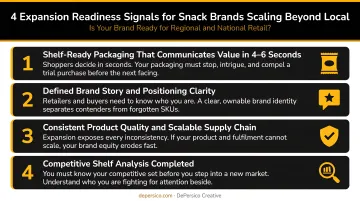
Once regional saturation is proven, expansion becomes a calculated next step — not a leap of faith. Look for these signals in your local footprint before committing:
- Consistent repeat purchase rates: buyers are returning without promotional pressure
- Strong retailer reorder velocity: shelves are turning, not sitting
- Operational readiness: manufacturing, logistics, and your sales team can replicate the model without degrading quality or service
- Profitability within the local market: expansion capital should come from proven revenue, not projections
Diversify Your Distribution Channels Strategically
No single channel serves all growth objectives. Retail drives mass penetration and brand credibility. DTC provides margin, consumer data, and a low-risk testing environment. Specialty channels reach early adopters who can amplify word-of-mouth. Foodservice creates habitual consumption occasions.
The right mix depends on where your target consumer actually shops and what your operational capacity can support.
The Graze Model: DTC to Retail
Graze started as a UK snack-box delivery subscription in 2008. By 2013, it had reached 500,000 subscribers. In 2015, it entered 1,600 UK retail stores. The U.S. followed in 2016 with distribution across 3,500 outlets including Walgreens and Kroger-family banners. Unilever later noted that retail transformed the brand's profitability.
The DTC phase built consumer data, validated flavor concepts, and established brand awareness before Graze ever sat across the table from a retail buyer. Used as a proving ground first, DTC lets you arrive at retail negotiations with velocity data and consumer proof already in hand — not just a promising pitch.
How to Approach Retail Buyers
Buyers evaluate snack brands on a short list of practical criteria:
- Velocity evidence: sales data from DTC, farmers markets, or current retail doors
- Shelf-ready packaging that meets the chain's spec requirements and holds its own on a planogram
- A clearly defined consumer target with a credible "why they buy" story
- A post-launch marketing plan showing how you'll drive shoppers to the shelf
Strong presentation materials — sell sheets, retail pitch decks, and shelf-ready packaging specs — signal that the brand is organized and ready to execute. That's where the work behind the pitch becomes as important as the product itself. DePersico Creative builds exactly these materials for snack brands entering retail — sell sheets that consolidate SKU details, competitive positioning, and consumer insights into a single document designed to hold up through a 20-minute line review.
Marketing Operations That Build Loyalty and Awareness
Snack brand marketing has three distinct jobs, and most brands only work on one of them:
- Penetration — getting new people to try the product
- Frequency — getting existing buyers to snack on it more often
- Premiumization — moving loyal buyers toward higher-value formats or SKUs
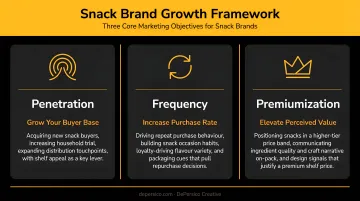
An effective marketing strategy activates all three over time, not just acquisition.
Build Awareness Where Snack Content Works
Short-form video is the most cost-efficient awareness channel for food brands at the growth stage. Rival IQ's 2024 benchmark report puts food and beverage TikTok engagement at a 1.80% median per video — among the stronger category benchmarks on the platform. Sprout Social's 2025 influencer report found that food and drink content captures consumer attention at 30% — the highest of any category tracked.
Before scaling paid media, focus on channels where organic snack content already performs:
- TikTok and Instagram Reels unboxing and taste-test formats
- Micro-influencer seeding with authentic audience alignment (not just follower counts)
- User-generated content campaigns that turn buyers into content creators
That emotional connection to taste and shared eating moments is what makes community-driven content work so well here. A genuine reaction to a new flavor is more compelling than a produced ad — and costs a fraction of the price.
Build Community, Not Just Customers
The snack product experience is immediate and sensory — people naturally want to share something that tastes good. That impulse is a marketing asset worth building around.
Practical ways to activate it:
- Loyalty programs and repeat purchase incentives that reward return buyers
- Brand ambassador structures that turn satisfied customers into advocates
- Shareable packaging or social prompts that make sharing frictionless
- Engagement touchpoints that connect buyers to the brand beyond the snack itself
Frequently Asked Questions
What are the 4 business growth strategies?
The four classic strategies come from the Ansoff Matrix: market penetration (selling more to existing customers), market development (entering new geographies or segments), product development (creating new SKUs for existing markets), and diversification (new products in new markets). Snack brands typically start with penetration and market development before expanding their product line.
What are the key C's of brand development and strategy?
The core C's — Consumer, Competition, Company, Channels, and Consistency — define a brand's strategic foundation. For snack brands, this means understanding the consumer's occasion, mapping competitive whitespace on shelf, and staying visually and verbally consistent across every channel to earn both retail space and repeat purchase.
What is the 3 3 3 rule in marketing?
For snack brands, the most relevant version is: capture attention in 3 seconds, build interest over 3 minutes, convert through 3 clear steps. A second interpretation targets 3 audiences with 3 messages across 3 channels. On shelf, the 3-second rule dominates — if packaging doesn't stop a shopper immediately, the opportunity is gone.
How do you grow a snack brand from local to national?
Start by dominating a single geography — saturate every relevant retail channel, build retailer reorder velocity, and prove profitability locally. Once the model works, use those metrics as evidence in conversations with distributors and retail buyers in adjacent regions. Replicate the local playbook rather than trying to manage national distribution before the operations are ready.
How important is packaging design for snack brand growth?
Packaging is the primary sales tool at the moment of truth. It communicates flavor, quality, and brand personality without any human support. Poor packaging is one of the most consistent reasons a genuinely good product underperforms in retail — shoppers simply don't stop to pick it up.
What makes a snack brand stand out on retail shelves?
Distinctive visual design, clear flavor communication, appetite-triggering photography, and ownable brand language are what cause a shopper to stop and pick up something unfamiliar. Packaging needs to create craving on sight — making someone want what's inside before they've read a word.