Introduction
Walk down any grocery aisle and the math becomes clear fast. The average U.S. supermarket now stocks 31,795 individual items, all competing for a few seconds of shopper attention before a hand reaches for something — or doesn't. According to FMI's Food Industry Facts, U.S. supermarket sales hit $1 trillion in 2024, yet Circana data shows food and beverage unit sales were essentially flat for early 2024. Growth isn't coming from a rising tide — shelf space is a zero-sum fight, and the brands winning it are doing something different.
What separates the products that generate repeat trial from those that collect dust? The difference is a system, not a single tactic. Effective food product marketing in 2026 means building a cohesive strategy that starts with packaging, flows through retail and digital channels, and stays anchored to a brand identity clear enough to communicate in under five seconds.
This guide walks through that system, from positioning and packaging to social, sampling, and Amazon — with a practical framework for sequencing your investment based on your brand's current stage.
Key Takeaways
- Packaging is your highest-impact marketing asset — it communicates your USP 24/7 at every retail location without a dollar of media spend.
- Strong CPG strategies combine at least four channels: packaging, retail/sampling, social/influencer, and content/SEO.
- Small brands can compete by owning a specific niche and investing in shelf appeal before scaling digital ad spend.
- Vague positioning is the most common reason well-distributed products fail to gain traction.
- Consistency across every touchpoint — from label copy to Instagram captions — turns first-time buyers into regulars.
What Is Food Product Marketing for CPG Brands?
Food product marketing is the strategic combination of branding, distribution, communication, and consumer engagement decisions that determine whether a product earns shelf space, trial, and loyalty.
What makes it distinct from general marketing? Three specific constraints:
- Shoppers decide whether to pick up or pass on a product in seconds, not minutes
- Your package competes against dozens of alternatives within arm's reach on the same shelf
- You're marketing to two completely different audiences — retail buyers and end consumers — at the same time
That last point is often underestimated. Your packaging, sell sheets, and brand positioning need to convince a category buyer in a 20-minute line review and stop a distracted shopper mid-aisle. The messaging has to work at both levels — which is why vague positioning fails so consistently in CPG.
The scale of the opportunity is real. With $1 trillion in U.S. supermarket sales and 45,575 supermarket locations nationwide, the market rewards brands that communicate clearly. With unit growth flat and tens of thousands of products launching annually, getting on shelf is only the first problem — staying there requires a brand that earns repeat purchase on its own.
Top Food Product Marketing Strategies for CPG Brands in 2026
The most successful food brands don't bet everything on one channel. They build layered strategies matched to their stage, target shopper, and distribution footprint. Here are the core tactics that move the needle.
Brand Positioning and USP Development
Brand positioning defines the specific emotional and functional territory your brand owns in a consumer's mind. A vague or generic position — "great taste," "quality ingredients," "made with care" — is one of the most common reasons new food products fail to gain traction even with solid distribution.
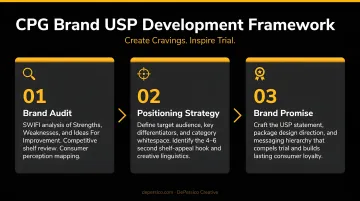
A practical framework for finding your USP:
- Audit your competitive shelf set — physically walk the aisle (or virtually map it) and identify every brand a shopper could choose instead of yours
- Find the under-owned attribute — look for ingredient stories, origin claims, health benefits, occasions, or emotional promises no one is owning clearly
- Translate it into a single brand promise — something specific enough to live on pack, in ads, and in retailer pitch decks without changing
The difference between "slow-smoked in small batches" and "hickory-smoked flavor" is the difference between a brand that creates appetite appeal and one that blends into the shelf. Specificity is the asset.
DePersico Creative's SWIFI process — a structured Strengths, Weaknesses, and Ideas for Improvement analysis — uses competitor shelf audits to surface exactly these gaps: what are competitors communicating well, where is the whitespace, and what messaging would give your brand a compelling, ownable position? That competitive intelligence drives every positioning and naming decision that follows.
Retail and In-Store Promotion
For most CPG brands, the retail shelf is the primary marketing battlefield. Shoppers make impulse decisions in seconds, so in-store visibility directly drives the velocity numbers that influence restock and distribution decisions.
Circana's analysis of U.S. grocery data found that products supported by both a feature and a display produced 129% unit lift for the 52 weeks ending Q3 2023. End caps, shelf talkers, and POS displays aren't optional extras — they're proven velocity drivers.
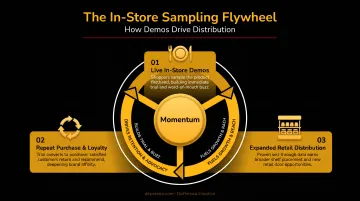
Food sampling deserves specific attention as a high-ROI tactic. Peer-reviewed research confirms that in-store sampling produces immediate and sustained sales increases, with repeated events generating multiplicative effects. For emerging brands, founder-led demos in early-adopter markets can create a real flywheel:
- Strong demo sell-through → retailer confidence
- Retailer confidence → broader distribution
- Broader distribution → organic online search demand
Sell sheets and retail presentation materials matter here too. DePersico Creative designs these as miniature brand stories — SKU details, competitive positioning, consumer benefits, and case pack economics — built to convert a retail buyer in a 20-minute line review.
Social Media and Influencer Marketing
For food brands, micro-influencers with genuine food audiences typically deliver stronger engagement and purchase intent than macro or celebrity partnerships — particularly for emerging CPG products where authentic recommendation carries more weight than paid placements.
CreatorIQ's 2024 Influencer Marketing Trends Report found that 66% of brand respondents said creator content drove more ROI than traditional digital advertising — though this is self-reported and cross-industry, so treat it as directional rather than a precise food CPG benchmark.
Platform considerations for food brands:
- TikTok and Instagram Reels — short-form video is the native format for food content; appetite appeal visuals are inherently shareable and can drive organic discovery at scale
- Pinterest — high purchase intent, particularly for recipe-driven content that connects a food product to a meal occasion
- YouTube — effective for longer-form recipe content and brand storytelling with audiences actively searching for food ideas
The category is visual by nature. A 30-second clip of a sauce being poured, a cheese being pulled, or a snack being bitten into can outperform weeks of static display advertising — and costs a fraction of a traditional production shoot.
Email, SMS, and Loyalty Programs
Social platforms come and go. Email and SMS are owned channels — no algorithm decides who sees your message, and no platform change can drain your list overnight.
Building a subscriber base early gives CPG brands a direct line to their most loyal customers for new launches, limited releases, promotional offers, and recipe content. For DTC-enabled brands, this channel also generates purchase frequency data (order value, repeat rate, time between purchases) that carries real weight in retailer negotiations.
Key tactics for emerging CPG brands:
- Loyalty and referral programs — personalized discount codes and repeat-purchase rewards are increasingly accessible through DTC e-commerce platforms
- SMS for urgency — time-sensitive promotions and limited-run product launches perform well through text
- Recipe-driven email — showing consumers how to use your product builds habit and increases purchase frequency
Content Marketing and SEO
SEO-driven content allows food brands to capture organic search demand long before a shopper encounters the product in a store. Someone searching "high-protein pasta alternatives" or "clean-label pasta sauce" can discover your brand at the top of the funnel — no paid media required.
Chicory's 2024 State of Online Recipes survey found that 91% of consumers now use online recipes, making recipe-focused content one of the most natural and high-intent discovery channels for food brands.
Content marketing also supports retailer pitches. A buyer reviewing your brand alongside three competitors notices when you show up in organic search for category terms they care about — it signals consumer pull, not just push marketing. Useful content types to build out include:
- Recipe content — ties your product to specific meal occasions and drives repeat search traffic
- Ingredient or origin stories — supports your USP claims with depth a shelf tag can't provide
- Category education — positions your brand as a trusted source, not just a product
- Buyer-facing case studies — ranking articles and press mentions that demonstrate consumer interest beyond sales data
Why Packaging Is Your Most Powerful CPG Marketing Tool
Your packaging works 24/7 in every retail location where your product sits. A social ad runs for a campaign window. A shelf display gets pulled at reset. Your package never stops selling.
The shelf moment is unforgiving. Packaging has roughly 4–6 seconds to communicate the essence and value of a product — the internal standard DePersico Creative applies across all packaging engagements. During that window, a shopper decides whether to pick it up or move past it. An Ipsos survey found that 72% of Americans say packaging design often influences their purchase decisions.
The Three Jobs Packaging Must Do Simultaneously
Effective food packaging isn't just attractive — it accomplishes three things at once:
- Attract attention through color, visual hierarchy, and structure that pulls the eye in a crowded shelf set
- Communicate the brand promise — the USP and emotional story, conveyed instantly without requiring the shopper to read
- Provide functional justification — ingredients, claims, and usage cues that confirm the purchase decision
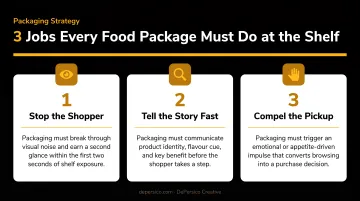
Miss any one of these and the shopper moves on — regardless of how well the other two are executed.
Creative Linguistics: Words That Create Cravings
One of the most underinvested areas of food packaging is the specific language used on pack. Generic copy — "great taste," "quality ingredients," "wholesome goodness" — blends into the shelf. Specific, evocative language is what makes a shopper stop.
DePersico Creative's creative linguistics process treats every word on a package as a deliberate choice. The approach focuses on answering real consumer questions: What is this? What will I experience? What does it offer that the others don't? The difference between "smooth, dreamy, and delicious" and "premium potato product" isn't just tone — it's measurable appetite appeal.
Real client examples illustrate the impact: for the Yummy Health rebrand, DePersico developed the positioning line "Crave something GOOD!" — six words that communicate both craveability and health benefit simultaneously. For DaVinci pasta, creative linguistics emphasized "variety and Italian restaurant quality," repositioning the product in a category where visual differentiation is minimal.
When Packaging Is Costing You Sales
If your product has distribution but weak velocity, packaging is almost always the first diagnosis. DePersico Creative's SWIFI process was built specifically for this — examining a product's visual hierarchy, competitor shelf context, and messaging gaps to identify whether current packaging is losing the shelf moment.
The three-phase structure:
- Strengths: What is the packaging already communicating well?
- Weaknesses: What visual signals or hierarchy issues cause it to blend in?
- Ideas for Improvement: What specific changes — in imagery, hierarchy, or language — would create a compelling, ownable position?
The results from past engagements are concrete. Idahoan's Steakhouse potato line redesign produced a 75% incremental sales increase for casseroles and grew the brand's casserole segment share from 11.6% to 23.1%. Sea Best's packaging overhaul fueled geographic expansion into the Northeast and helped the brand grow from 9 to 34 products.
Food Photography as Packaging Equity
The photography on your pack is part of the package. Flat, staged, or unappetizing food imagery undermines even excellent products. Professional photography — prepared and shot in a dedicated test kitchen — creates the appetite appeal that lifts both trial and premium perception at the shelf.
DePersico Creative's in-house test kitchen and studio handles the full shoot: food stylists manage plating and props across gourmet presentations, crisp liquid pours, and homestyle frozen food setups. All imagery delivers with full usage rights across packaging, digital, and print.
Digital Marketing Channels That Drive CPG Food Sales
Digital marketing does more than build awareness — it drives direct sales and generates the purchase data that gives you real leverage in retailer negotiations. Metrics like purchase frequency, average order value, and repeat rate tell a story that buyers at Kroger or Walmart want to hear.
Paid Social and Paid Search
Meta and TikTok are the two most scalable paid social channels for food brands. Structure campaigns to:
- Retarget website visitors who didn't convert
- Reach lookalike audiences based on existing customers
- Support new retail launches with geo-targeted ads in specific store zip codes
Google Shopping captures bottom-of-funnel intent from shoppers actively searching your category. Amazon Ads work the same way — but on a platform where purchase is one click away, which is why it warrants its own strategy.
Amazon as a CPG Marketing Channel
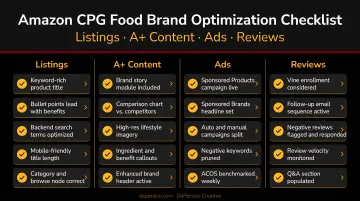
Amazon projected 18.5% of U.S. online grocery share by end-2024, making it a channel no serious CPG brand can ignore. Optimizing your Amazon presence means:
- Writing clear titles and benefit-driven bullet points paired with high-quality product imagery
- A+ Content: Amazon reports Basic A+ Content can increase sales by up to 8%, Premium A+ Content by up to 20%
- Sponsored Products ads: Improve both organic ranking visibility and direct sales
- Reviews: Volume and rating function as social proof that influences purchase decisions the same way shelf placement does in physical retail
One detail brands often overlook: your Amazon product imagery needs to carry the same visual identity as your physical packaging. Inconsistent photography undermines the brand recognition you've built on shelf. DePersico Creative's in-house studio produces product photography and e-commerce creative assets specifically designed to maintain that consistency across every touchpoint.
How to Prioritize Your Food Brand's Marketing Mix
The right marketing mix depends on where your brand is, not where you want to be.
The Recommended Sequence for Emerging Brands
- Packaging and brand foundation first — a weak brand identity generates poor return from any downstream spend, regardless of targeting precision
- Retail and sampling for velocity — drive in-store sell-through before scaling digital, because velocity data is what earns broader distribution
- Digital for scale: once your shelf presence converts attention into trial, digital spend accelerates demand rather than compensating for weak packaging
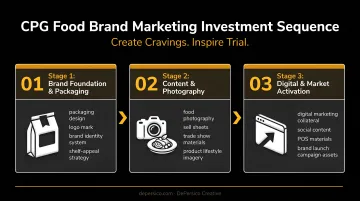
DePersico Creative's guidance reflects this directly: "packaging is the catalyst that drives trial and sets the trajectory for launch performance" — and advises brands not to wait for declining sales before revisiting the package.
The Most Common Prioritization Mistake
Spending heavily on digital advertising before investing in strong packaging and brand identity. The logic seems right — drive traffic, build awareness — but it creates a leaky funnel. Ads generate impressions, and weak shelf presence fails to convert those impressions into trial. The spend compounds the problem by bringing more shoppers to a package that isn't ready to close the sale.
Established Brands: Push and Pull Together
Brands with solid retail distribution should invest in both consumer pull and trade push simultaneously:
- Consumer pull (digital, social): builds awareness and drives shoppers to the shelf
- Trade push (in-store sampling, shopper marketing): converts that awareness into purchase
The two reinforce each other. Digital demand keeps the shelf stocked, and strong in-store presence converts the awareness that digital spending created.
Conclusion
Successful CPG food marketing in 2026 starts on the shelf and carries through every interaction a consumer has with your brand — from the package they pick up to the content they find online. The brands that win are the ones where every channel tells the same story.
Before scaling any marketing spend, audit what you have honestly. Does the packaging communicate the USP in under five seconds? Does the digital presence tell the same brand story? Is there a cohesive strategy connecting consumer demand to retail performance?
For CPG brands ready to evaluate whether their packaging is working as hard as it should, DePersico Creative's 45+ years of food and beverage expertise offers a grounded starting point. Our SWIFI visual assessment process diagnoses shelf-level positioning gaps before they become velocity problems, and our in-house photography studio and creative linguistics practice translate those insights into packaging that earns attention and drives trial.
Start with a free consultation at paul@depersico.com or by calling (484) 454-3844.
Frequently Asked Questions
What are some food marketing strategies?
The core strategies for food brands include brand positioning, packaging design, in-store sampling and retail promotion, social media and influencer marketing, content marketing and SEO, and email/SMS programs. The best results consistently come from combining multiple channels rather than relying on any single tactic.
What are the 5 main marketing strategies?
The five foundational strategies are product, price, place, promotion, and people/community. For food CPG specifically, packaging design and retail promotion tend to have the most direct impact on purchase decisions at the shelf.
What are the 5 P's of product marketing?
The 5 P's are Product, Price, Place, Promotion, and People. In food CPG, "Place" means retail shelf strategy and Amazon presence, "Product" covers both formulation and packaging design, and "People" includes loyalty programs and consumer engagement.
How important is packaging design in food product marketing?
Packaging is often the single most important marketing asset for CPG food brands — it's the last communication a brand has with a shopper before purchase. It must attract attention, communicate the brand story, and motivate trial all within a few seconds. No other asset does that job at every retail location, every day.
How can a small food brand compete with large CPG companies?
Small brands compete by owning a specific niche — an ingredient story, occasion, dietary need, or value that larger brands haven't claimed. Investing in premium packaging, building community through sampling and social media, and targeting specialty or regional retailers before pursuing mass distribution are each proven ways to gain early traction.