That framing is wrong, and it's expensive.
For food and beverage brands, story and performance aren't competing priorities. Story is what makes performance campaigns work. A shopper who doesn't recognize or trust your brand at shelf won't click your digital ad either. The visual and emotional signals your brand sends — through packaging, photography, copy, and identity — prime every downstream conversion metric you're paying to optimize.
This guide covers the consumer attention challenge unique to CPG, five specific storytelling elements tied to measurable performance outcomes, and a practical framework for tracking storytelling's contribution to ROI.
Key Takeaways
- Brand storytelling and performance marketing work together — story is what makes campaigns convert, not the alternative to conversion.
- CPG shoppers decide in seconds at shelf and while scrolling, so your story must land instantly through visual and linguistic cues.
- Visual identity, origin narrative, food photography, claims language, and emotional positioning each drive measurable performance outcomes.
- Packaging is a CPG brand's highest-reach, always-on asset — and brands consistently underinvest in its selling power.
- Measurable proxies for storytelling ROI include trial rate, repeat purchase, velocity data, and ROAS by creative variant.
Why the Brand vs. Performance Divide Costs CPG Brands ROI
The traditional marketing funnel separated brand work (awareness, emotion, loyalty) from performance work (clicks, conversions, ROAS). In a broadcast-media world where TV drove awareness and coupons drove trial, that separation made operational sense. Different teams, different budgets, different success metrics.
That model breaks down completely for CPG food and beverage.
A shopper who encounters your brand for the first time at shelf brings zero context. If the packaging doesn't communicate what the product is, who it's for, and why it's worth trying — in roughly four to six seconds — the sale is lost before any performance channel gets involved.
That same shopper, when retargeted through retail media or paid social, will scroll past your ad just as quickly if the visual language feels unfamiliar or the brand doesn't register.
The Compounding ROI Effect
Brand storytelling doesn't just build awareness in isolation. It improves the efficiency of every paid campaign running beneath it:
- Familiar brands earn faster attention, reducing the hesitation before clicking
- Recognizable creative drives higher CTR and lowers your effective cost per acquisition
- Consistent visual identity across channels compresses the buyer journey — fewer touchpoints before conversion
- Coherent brand signals build trust that performance spend alone can't manufacture
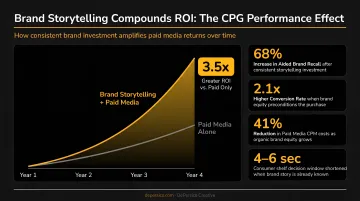
Research from Kantar found that strong performance across brand-building and activation can yield a 46% sales increase over three years — and that brands with growing equity increased brand value 72% compared to just 20% for brands with declining equity.
In CPG, brand storytelling is the cumulative message delivered by packaging, ad creative, product photography, claim language, and shelf placement — working together across every channel. A snack brand running aggressive retail media but shipping inconsistent packaging signals will see that Kantar-style compounding work in reverse. When those elements align, each paid impression pulls more weight because shoppers already know what they're looking at.
The Seconds Problem: How CPG Shoppers Actually Decide
A NielsenIQ webinar on packaging design noted that most shoppers look at a product for roughly 13 seconds before making a purchase decision. In practice, DePersico Creative — a food and beverage creative agency that has worked with brands including Idahoan, Ball Park, and Sea Best — operates on a 4–6 second benchmark as the critical window for packaging to earn a trial purchase.
Thirteen seconds on the generous end. Four seconds on the practical end. Either way, you're not telling a story. You're triggering a recognition.
The Same Problem Exists in Every Channel
The shelf and the scroll are more similar than most marketers acknowledge:
- A shopper scanning a grocery aisle processes hundreds of products per minute
- A user scrolling a social feed encounters hundreds of ads and posts per session
- In both environments, unrecognized or visually unclear brands are skipped without conscious evaluation
When brand story is weak or inconsistent in those seconds, the consequences show up in performance data: lower click-through rates, poor ad recall, higher cost-per-acquisition, and sluggish velocity at retail. Weak brand identity erodes the conversion metrics you're actively optimizing, not just the soft brand scores you report quarterly.
Visual Fluency as a Performance Multiplier
When packaging, ad creative, and social assets share a consistent visual language — what designers call visual fluency — shoppers recognize the brand faster across every channel. That speed of recognition reduces the friction standing between recognition and purchase.
Food and beverage brands face an amplified version of this challenge. In a single glance, packaging must communicate:
- Appetite appeal — does it look good enough to eat right now?
- Ingredient trust — does it signal quality, freshness, or clean sourcing?
- Lifestyle fit — does it belong in this shopper's cart?
That's a heavier visual lift than most categories. Cleaning products and personal care can lean on functional claims. Food packaging has to make you want it before you've read a word.
Five Brand Storytelling Elements That Move CPG Performance Metrics
Distinctive Visual Identity
A distinctive visual identity (color, typography, imagery style, logo mark) is the fastest storytelling signal a CPG brand can deploy. Within milliseconds, it communicates category membership and brand personality at once.
A color palette that mirrors competitors' packaging doesn't earn recognition — it creates confusion.
Ipsos and Jones Knowles Ritchie tested five types of brand assets with over 26,000 respondents globally and found that visual distinctiveness drives the mental availability that precedes purchase.
Consistency across packaging, digital ads, and marketing materials compounds this effect. Marq's research across 400+ organizations found consistent brand presentation can produce 10–20% overall revenue growth. For CPG brands, that consistency is the difference between a shopper who instantly registers your brand and one who sees it as a new product every time.
Origin and Mission Narrative
Shoppers increasingly reward brands that have a credible "why" — a founding story, family heritage, or sourcing commitment that gives the product humanity and earns emotional preference over generic alternatives.
The key phrase is "credible and distillable." An origin narrative that lives only on your About page has no performance value. It needs to compress into a single phrase or visual cue that works on the front panel:
- "Imported from Italy" (DaVinci pasta — communicating authenticity at a glance)
- "Family recipe since 1952" (signals heritage and consistency)
- "Straight from the farm" (establishes sourcing trust without a paragraph of copy)
DePersico Creative's work on DaVinci pasta illustrates this directly: after five years of declining sales, a SWIFI brand analysis revealed the packaging wasn't communicating the brand's authentic Italian origin effectively. Repositioning around that heritage — using handwritten script reminiscent of Leonardo da Vinci's journals and imagery of the Italian countryside — revitalized the brand and drove trial among shoppers who had previously walked past it.
High-Performance Food Photography
For CPG food brands, the image is the story. A flat, generic product shot communicates low quality before a shopper reads a single word. Appetite-forward imagery with proper styling triggers craving and removes purchase hesitation.
Academic evidence backs this up: a 2020 eye-tracking study found that food imagery on packaging held significantly more attention than baseline graphics, with total viewing-time effects at p < 0.001 across tested food categories. Separate research found transparent packaging windows that revealed the actual product could increase purchase intention by increasing psychological ownership — particularly for visually desirable foods.
Translating that science into actual packaging requires a studio setup built around food. DePersico Creative's in-house test kitchen, food styling team, and photography studio focus on capturing the appetite cues that drive shelf decisions: crunchy breading, moist fillings, vibrant textures. Every image delivers full usage rights across packaging, digital ads, e-commerce listings, and retail media.
Creative Linguistics: Claims and Copy
Creative linguistics — the specific words and phrases used on packaging and ad copy — affect both emotional resonance and conversion behavior. The right claim language increases ad engagement and shelf-scan purchase intent simultaneously. Vague or generic language measurably reduces both.
Claims that convert tend to fall into four language patterns:
- Sensory specificity: "slow-simmered," "stone-ground," "hand-pulled"
- Source credibility: "straight from the farm," "imported from Italy," "family-owned since 1977"
- Experience framing: "the way grandma made it," "restaurant-quality at home"
- Trust anchors: clean-label claims, origin designations, certifications
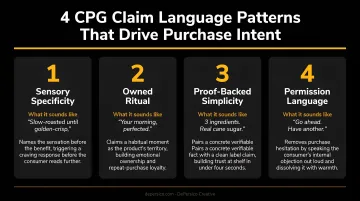
Mintel found that 84% of U.S. free-from food buyers purchase those products because they believe them to be more natural or less processed — a direct demonstration of how claim language shapes purchase behavior at category scale.
DePersico Creative treats word selection as a design decision. Every phrase on the package earns its space by answering what shoppers ask subconsciously: What is this? Who is it for? What will I experience? Why is it better?
Emotional Positioning and Lifestyle Relevance
Emotional positioning is the brand's answer to one question: what feeling do I give the buyer? Comfort, health pride, nostalgia, indulgence, adventure — campaigns anchored in a clear emotional position consistently outperform product-feature-only messaging.
Nielsen analyzed 100 ads across 25 FMCG brands: the most emotional ads generated a 23% sales increase over less emotional counterparts. Kantar and Affectiva found that digital ads evoking strong emotions are 4x more likely to drive brand equity.
The practical implication is straightforward. Leading with what the product does to someone — not just what it is — changes how creative performs across every channel. The emotion anchors the message; the product details close the sale.
Emotional territories that consistently drive CPG performance:
- Nostalgia and family connection (comfort foods, heritage recipes)
- Health pride (better-for-you, clean-label, functional categories)
- Indulgence and permission (premium, treat-yourself positioning)
- Adventure and discovery (global flavors, new formats, limited editions)
Your Packaging Is Your Best-Performing Ad
Every CPG brand running paid media is paying for impressions. Most are ignoring the one asset that reaches every single shopper who walks down the aisle — for free.
Packaging doesn't get a media budget line. It works at shelf, at the point of decision, with zero incremental cost per impression — making it the foundation of any performance strategy, not a downstream consideration.
When packaging is treated as a strategic selling tool, it does the job of a performance ad:
- Attracts attention through visual distinctiveness
- Communicates the brand story and product benefit in seconds
- Reduces purchase friction by answering key shopper questions instantly
- Drives trial — and the packaging experience shapes whether that shopper returns
Designalytics reported that a natural-foods brand package redesign helped boost sales 28%, measured through retail scanner data. DePersico Creative's work with Idahoan resulted in a 75% incremental sales increase for casseroles. The packaging redesign and storytelling refresh also grew the brand's share of the casserole segment from 11.6% to 23.1%.
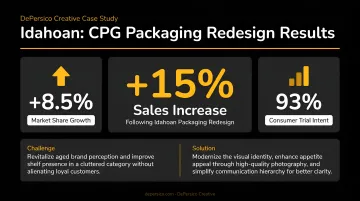
Those results start with an honest answer to a question most brands skip: is your packaging actually selling, or just occupying shelf space?
Auditing Whether Your Packaging Is Actually Selling
Most CPG brands can't answer that question with confidence.
DePersico Creative's SWIFI (Strengths, Weaknesses, and Ideas For Improvement) visual perception assessment is a structured audit that answers that question directly.
The process evaluates packaging against its strongest shelf competitors, identifying:
- Which visual and messaging elements communicate value effectively
- Which elements cause the product to blend in or be overlooked
- Specific opportunities to create a differentiated visual and linguistic position
For brands struggling with flat velocity, new-market trial challenges, or underperforming digital ad creative, SWIFI pinpoints exactly what's holding the package back — so any design investment targets the right problem from the start.
Measuring Brand Storytelling ROI: Metrics That Actually Matter
The reason many CPG marketers deprioritize brand storytelling investment is attribution difficulty. If you can't attach a conversion to a packaging decision, it gets treated as overhead rather than an investment with returns.
Skip the brand lift study. Track leading indicators instead.
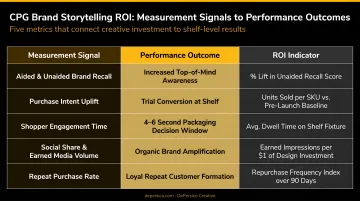
Key metrics that bridge storytelling and performance outcomes:
Five metrics give CPG marketers a consistent read on whether their storytelling investments are moving the needle:
| Metric | What It Measures | Storytelling Signal |
|---|---|---|
| Trial rate | New shoppers in new SKU or market | Packaging and creative are compelling at first contact |
| Repeat purchase rate | Return buyers within 60–90 days | Brand story matches product experience |
| ROAS by creative variant | Story-strong vs. generic creative | Which storytelling elements convert |
| Retail velocity | Units sold per store per week | Shelf-level storytelling effectiveness |
| Digital CTR by asset type | Photography vs. text-heavy vs. lifestyle | Appetite-forward creative vs. functional |
A/B Testing Storytelling as a Performance Variable
The most actionable measurement approach is running A/B creative tests in digital campaigns: different origin narratives, photography styles, or claim language tested against a control. This generates hard data on which story elements drive conversion — making creative decisions defensible rather than purely instinctive.
Build that test design carefully. Albertsons Media Collective research found that incremental ROAS can vary by a median 2.5x depending on measurement methodology, with 83% of campaigns potentially shifting from positive to negative ROI based on how incrementality is defined. Use controlled test designs — matched store groups or randomized holdout panels — when measuring creative impact, not raw ROAS comparisons.
Frequently Asked Questions
What is brand storytelling in CPG marketing?
Brand storytelling in CPG is the cumulative narrative communicated through packaging, ad creative, photography, and copy that gives a product meaning, context, and emotional appeal beyond its features. It's the difference between "pasta from Italy" as a bullet point and packaging that makes a shopper feel like they're choosing something authentic over a generic shelf alternative.
How does brand storytelling improve ROAS for food and beverage brands?
Brand recognition reduces the cognitive friction in purchase decisions — shoppers who recognize and trust a brand click more readily and convert at higher rates. Story-strong ad creative also earns more attention in a feed full of competing products, improving CTR and lowering effective cost per acquisition compared to generic product shots.
What makes packaging design a performance marketing tool?
Packaging reaches every in-store shopper at zero incremental media cost, functioning as an always-on conversion asset at the exact moment of purchase. It also establishes the visual and linguistic language used across digital ad creative — making packaging quality foundational to performance across every channel.
How do you measure the ROI of brand storytelling for a CPG brand?
Track trial rate, repeat purchase rate, retail velocity, and ROAS segmented by creative variant. A/B testing photography styles, claim language, or origin narratives in digital campaigns generates direct data on which story elements drive conversion — no formal brand lift study required.
How is CPG brand storytelling different from general consumer brand storytelling?
The "seconds problem" is more compressed. CPG decisions happen at shelf and mid-scroll, requiring stories that land through visual and linguistic cues in four to six seconds — not through long-form narrative. Every storytelling element must work at a glance, in thumbnail size, and in direct competition with dozens of adjacent products simultaneously.
Can a small CPG food brand compete with national brands through storytelling?
Yes — and authenticity is the advantage. A genuine origin story, a distinctive visual identity, and specific niche positioning allow emerging brands to outperform larger competitors on emotional resonance and trial rate. DePersico Creative's work has shown that clarity of story and visual distinctiveness matter more than budget size at shelf. Brands that say one thing well and say it visually tend to outperform bigger spenders who don't.