Introduction
Walk the aisle of any major grocery store and you're looking at roughly 31,795 items, according to FMI's 2024 Food Industry Facts. Every one of those SKUs is competing for shopper attention — and research from Nielsen citing Ehrenberg-Bass shows the average consumer spends just 13 seconds making a brand decision in-store.
That's the reality CPG marketers work inside. At that speed, intuition isn't enough — the brands that win are the ones backing every decision with the right data.
Food and beverage brands today rely on a specific set of tools — consumer trend intelligence, retail market data, digital performance tracking, and social listening — each answering a different question about where the brand stands. This guide breaks down the top CPG marketing analysis and strategy tools, what each does best, and how to match the right ones to your brand's current stage and goals.
Key Takeaways
- CPG marketing tools fall into five categories: trend intelligence, retail market data, digital analytics, social listening, and web performance
- Each category has a clear leader: Tastewise, NielsenIQ, Semrush, Hootsuite, and GA4
- Tool selection depends on your distribution scale, primary marketing channels, and whether you need real-time signals or historical benchmarks
- The most effective stacks pair at least one strategic intelligence tool with one tactical performance tool
- Insights from data only move product when they're translated into packaging, messaging, and shelf positioning that convert in seconds
What CPG Marketers Actually Need from Analysis Tools
"CPG marketing analysis" is not one thing. It covers at least four distinct needs:
- Consumer demand and trend tracking — what shoppers want and what's emerging
- Competitive benchmarking — how your brand stacks up against category competitors
- Digital campaign performance — what's working across paid and organic channels
- Brand sentiment monitoring — how consumers talk about and perceive your brand
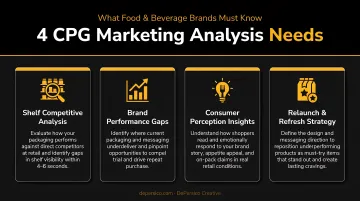
No single platform covers all four. That's why stack-building matters.
Strategic vs. Tactical Tools
The distinction between strategic and tactical tools shapes how you prioritize spending:
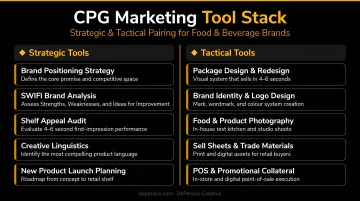
Strategic tools (NielsenIQ, Tastewise) inform planning decisions — where to compete, which trends to target, how to position a product for retailer sell-in. These are the tools you use before a campaign launches.
Tactical tools (GA4, Semrush, Hootsuite) measure performance while campaigns run. They answer questions like: which channel is converting, which keywords are driving traffic, which posts are getting engagement.
Early-stage brands typically need tactical tools first. Scaling brands with retail distribution need both.
The Gap Data Tools Can't Fill
Even with a complete analytics stack, food and beverage brands have a blind spot: the shelf itself. FMI's 2026 Grocery Shopper Trends report shows 54% of shoppers always shop in-store at their primary grocery store, with 77% digitally engaging before they arrive.
Data tools can inform your strategy, but the purchase decision still happens in front of the fixture.
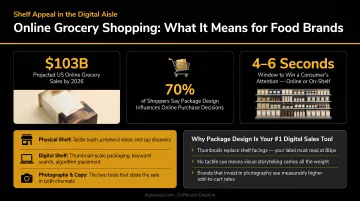
That's where packaging and visual identity do the work. DePersico Creative's SWIFI assessment (Strengths, Weaknesses, and Ideas for Improvement) is a structured visual perception process that evaluates how a product communicates its value against its strongest shelf competitors. It translates market insights into the 4–6 second decision window that analytics platforms can't measure directly.
Top Tools for CPG Marketing Analysis & Strategy
These tools were selected for their CPG relevance, accessibility across brand sizes, depth of insight, and ability to inform both planning and execution decisions.
Tastewise
Tastewise is an AI-powered food and beverage intelligence platform that analyzes consumer demand signals across social media, restaurant menus, and digital content to surface emerging ingredient, flavor, and product trends. The platform is powered by more than 1 trillion data points, including home-cooking panels and social posts.
Where Tastewise earns its place in the F&B stack: brand managers use it to identify trends before they peak, build retailer sell-in stories backed by real consumer demand signals, and reach audiences already expressing interest in relevant categories — specificity that general analytics platforms can't match for food and beverage.
| Attribute | Details |
|---|---|
| Key Features | AI-driven trend detection, consumer sentiment analysis, retailer sell-in kits, audience discovery and targeting recommendations |
| Best For | Food and beverage CPG brands focused on new product development, retail sell-in, or understanding consumer demand shifts |
| Pricing | Subscription-based; custom quote — visit tastewise.io/pricing for current tiers |
NielsenIQ
NielsenIQ's Retail Measurement Services (RMS) provide syndicated retail data — category share, competitive benchmarking, distribution points, and promotional lift analysis — aggregated across major retail chains and e-commerce channels.
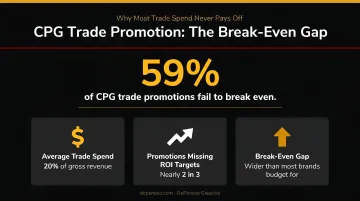
The strategic value is specific: NielsenIQ gives brands a retailer-validated view of their market position. Category managers use it to negotiate better shelf placement, identify category whitespace, and defend listings with hard numbers. McKinsey data shows CPG companies invest roughly 20% of annual revenue in trade promotions, with 59% of promotions failing to break even — NielsenIQ's promotional effectiveness tracking directly addresses that problem.
| Attribute | Details |
|---|---|
| Key Features | Retail measurement data, market share by SKU and region, consumer panel insights, category management frameworks, promotional effectiveness tracking |
| Best For | Mid-to-enterprise CPG brands with national or multi-regional retail distribution seeking competitive benchmarking and category-level strategy |
| Pricing | Annual subscription; pricing varies by category scope and geography — contact NielsenIQ directly at nielseniq.com |
Semrush
Semrush is a digital marketing intelligence platform covering SEO, content analytics, paid advertising research, and competitive benchmarking. For CPG brands investing in DTC e-commerce or content marketing, it provides competitive keyword data, backlink analysis, and ad research that reveal gaps in digital share of voice.
The platform also includes social analytics and integrates paid and organic channel visibility in one place — useful for brands managing multi-channel campaigns where attribution gets messy. Entry-level pricing starts at $139.95/month (as of June 2026; verify current pricing at semrush.com/pricing).
| Attribute | Details |
|---|---|
| Key Features | Keyword research, competitor website analysis, SEO audit, paid ad intelligence, content optimization, rank tracking, social media analytics |
| Best For | CPG brands with active DTC websites, content marketing programs, or digital advertising campaigns that want to benchmark against competitors online |
| Pricing | Tiered subscription starting at ~$139.95/month; enterprise plans available |
Hootsuite
Hootsuite is a social media management and analytics platform supporting Facebook, Instagram, TikTok, LinkedIn, YouTube, X, and other major channels. Beyond scheduling, its analytics give CPG marketers visibility into which content formats drive category engagement, how audiences talk about the brand versus competitors, and when target audiences are most active. A 2024 systematic review in Trends in Food Science & Technology reviewed 377 studies classifying social media as a tool, determinant, and behavioral driver in food consumer research — which is why listening to those channels matters as much as publishing on them.
| Attribute | Details |
|---|---|
| Key Features | Multi-platform content scheduling, brand monitoring and social listening, engagement analytics, competitor benchmarking, audience insights, ad campaign management |
| Best For | CPG brands actively managing social channels who want to monitor brand sentiment, track campaign performance, and benchmark against competitors |
| Pricing | Plans start at $99/user/month (Standard); Enterprise uses custom pricing — verify at hootsuite.com/plans |
Google Analytics 4 (GA4)
GA4 is a free web and app analytics platform from Google tracking how users find, navigate, and convert on a brand's digital properties. It integrates natively with Google Ads and Search Console, giving a connected view of paid and organic performance in one dashboard.
For CPG brands, GA4 matters because online grocery isn't a niche anymore. U.S. online grocery sales reached $9.6 billion in December 2024, up 19% year-over-year. Any brand driving digital traffic — whether to a DTC store, a retail locator, or recipe content — needs this foundation before investing in paid analytics tools.
| Attribute | Details |
|---|---|
| Key Features | Traffic source analysis, audience demographics, conversion tracking, event-based behavioral data, Google Ads integration, real-time reporting |
| Best For | CPG brands at any stage with a website or e-commerce presence, particularly those running paid digital campaigns who need a free, reliable analytics foundation |
| Pricing | Free (standard); Google Analytics 360 available at custom pricing for enterprise-level data limits |
How We Chose These Tools
Each tool in this list was evaluated on four criteria:
- CPG and F&B relevance — does it address problems specific to food and beverage brands, not just general marketing?
- Accessibility across brand sizes — is it usable by a regional snack brand, not just a Fortune 500?
- Depth and timeliness of insight — does it surface insights you can act on, not just metrics to monitor?
- Gap-filling — does it address a distinct layer in the analytics stack that other tools don't cover?
These four filters cut through the noise quickly. That said, even well-intentioned selection processes often stumble at the same point.
The Most Common Mistake in Tool Selection
Brands frequently choose tools based on feature count rather than fit. A regional snack brand doesn't need enterprise syndicated data. A DTC-first beverage brand doesn't need retail execution software. Match the tool to your current distribution model before committing to a subscription.
The most effective CPG marketing stacks combine at least one strategic intelligence tool (Tastewise or NielsenIQ) with at least one tactical performance tool (GA4 or Semrush). Strategic tools tell you where to compete; performance tools measure how well you're executing once you're there.
Conclusion
The right analytics stack scales with your brand. Early-stage brands should anchor with GA4 and a social listening tool — low cost, high signal. As distribution expands, layer in trend intelligence like Tastewise and retail measurement like NielsenIQ to support category conversations with retail partners.
One thing no analytics tool measures: what happens the moment a shopper picks up your product. Most grocery purchase decisions still happen in-store, where packaging does the selling. Brands that combine strong market data with compelling shelf presence consistently outperform those relying on either alone. The data tells you what consumers want. The packaging has to deliver it in four seconds.
That shelf-level conversion gap is where DePersico Creative's SWIFI brand analysis process operates. DePersico is a three-generation food and beverage creative agency with over 45 years of experience working with brands like Ball Park, Idahoan, and Sea Best.
Using a visual perception methodology, they evaluate how well your current packaging and messaging translate consumer demand into purchase decisions. That same approach helped Idahoan achieve a 75% incremental sales increase and helped Ball Park become the number-one national hot dog bun brand.
If your data tools are surfacing insights but your packaging isn't converting them at shelf, schedule a free 30-minute consultation with DePersico Creative. Reach out at paul@depersico.com or call (484) 454-3844 to explore how brand strategy and creative execution can convert the insights your analytics stack surfaces into shelf-level results.
Frequently Asked Questions
What are the marketing strategies used by CPG companies?
CPG brands typically deploy trade promotions, digital advertising, influencer campaigns, omnichannel retail programs, and consumer loyalty initiatives. The most effective strategies are built on validated consumer demand data — without it, McKinsey estimates 59% of trade promotions fail to break even.
What are the 4 tools of marketing?
The classic 4 Ps — Product, Price, Place, and Promotion — form the foundational framework of marketing strategy. Modern CPG brands use digital analytics platforms and consumer intelligence tools to optimize each dimension, from pricing elasticity modeling to shelf placement negotiation.
What is CPG marketing analytics and why does it matter for food brands?
CPG marketing analytics is the practice of collecting and interpreting data from retail sales, consumer behavior, digital channels, and competitive activity to guide smarter marketing decisions and justify trade spend. For food brands, it also generates the evidence retail buyers expect before granting shelf space or promotional support.
How do I choose the right CPG marketing tool for my brand's size and goals?
Start by identifying your biggest current gap: consumer understanding, competitive benchmarking, digital performance, or social listening. Then match a tool to that specific gap based on your distribution stage. Most brands need at least two tools, one strategic and one tactical, to get a complete picture.
What data should CPG food brands track to improve shelf performance?
The most actionable metrics are sales velocity by SKU and retailer, out-of-stock rates, share of shelf, consumer sentiment on social, and category trend signals. These metrics inform campaign decisions, product positioning, and packaging changes that affect in-store conversion.
How does packaging design connect to a CPG marketing strategy?
Packaging is where analytics meet execution — it communicates the brand promise and drives purchase decisions in seconds, without any media spend. Agencies like DePersico Creative specialize in translating consumer insights into the visual and verbal cues that convert shoppers at shelf.