The typical culprit isn't product quality. It's a lack of competitive intelligence before launch.
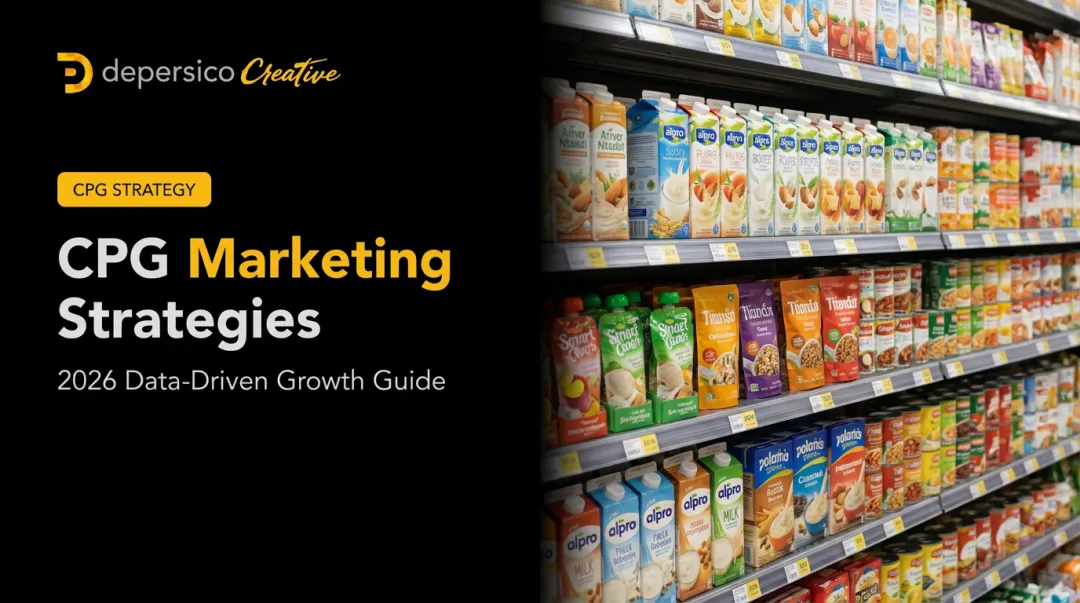
When shoppers spend roughly 8 seconds deciding what to pick up, the entire competitive set — every neighboring package, every competing claim, every color block and benefit callout — shapes that decision simultaneously. Brands that don't understand that landscape before they enter it are essentially launching blind.
This guide breaks down what CPG competitive analysis actually involves, why the packaging and shelf-level audit is the most underutilized piece of the process, and how to convert raw competitive intelligence into positioning and design decisions that move product.
Key Takeaways
- CPG competitive analysis means mapping direct, indirect, and replacement competitors across pricing, packaging, claims, and shelf presence
- The packaging audit is the most overlooked step and the most consequential for driving trial
- Treat competitive analysis as a repeatable process tied to business milestones, not a one-time project
- The primary output is a clear picture of visual and messaging gaps — the white space your brand can own
- Insights only matter when they drive specific design, language, and go-to-market decisions
What Is CPG Competitive Analysis?
CPG competitive analysis is the structured process of gathering and interpreting data about competing products — their packaging, pricing, positioning, claims, and channel strategy — to identify where your brand can differentiate and win share.
The Three Competitor Types You Need to Map
Most brands only track head-to-head competitors. That's a meaningful blind spot. A complete competitive picture includes three categories:
- Direct competitors — same product type, same target audience. For a protein bar brand, that's every other protein bar on the shelf
- Indirect competitors — different format, same consumer need. Greek yogurt and trail mix both serve the "portable, high-protein snack" occasion without occupying the same category
- Replacement competitors — entirely different products competing for the same purchase moment or budget. A protein shake competes with a coffee drink if both solve the 10am energy gap
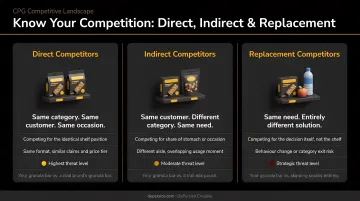
Brands that skip indirect and replacement competitors often miss the category shifts that erode their share before they appear in sales data.
What a Thorough Analysis Actually Covers
Price is just the starting point. A complete CPG competitive audit examines:
- Pricing tiers and pack size architecture
- Packaging design, color blocking, and visual hierarchy
- Product claims and on-pack language — what's front and center versus buried
- Promotional cadence and depth
- Shelf placement and share of space
- Brand messaging tone and personality
Pricing comparisons are easy to pull. The shelf-level signals — what competitors are saying visually, how they're structuring their benefit hierarchy, what emotional register they're using — are where the gaps your brand can actually own tend to show up.
Why CPG Competitive Analysis Matters
It Reveals Category White Space
White space in CPG shows up on the shelf before it shows up in spreadsheets. If every competitor in your category uses dark, ingredient-forward packaging with clinical nutritional language, a clean, warm design with emotionally resonant copy represents unclaimed visual territory. That kind of observation only surfaces through a structured shelf audit.
This matters more as categories get crowded. The average U.S. supermarket carries 31,795 items, and independent brands under $100M in sales account for 35% of category growth, according to McKinsey. The opportunity is real — but only for brands that know exactly where the openings are.
It Sharpens Your USP
Articulating what makes your product different requires a clear picture of what every competing product is already saying. Competitive claim mapping, a review of the language competitors lead with on front-of-pack, frequently reveals that several brands are making the same claim with nearly identical wording.
That's useful intelligence. If five competitors all lead with "high protein," positioning around "real ingredients, clean energy" isn't just differentiation: it's owning an uncontested message.
The Packaging-Specific Payoff
Competitive analysis at the shelf level directly informs the visual and verbal decisions that determine whether a shopper notices, picks up, and buys your product. Studying competitors' color palettes, typography choices, photography style, and benefit hierarchy tells you what visual language the category has already normalized — and where the genuine contrast opportunities are.
A shopper decides in roughly 4–6 seconds. The brands that win that window understand their shelf context. The ones that don't are designing in a vacuum.
Key signals to track during a shelf audit:
- Color palette patterns — what hues dominate and which are absent
- Claim hierarchy — whether competitors lead with ingredient, outcome, or lifestyle language
- Typography tone — clinical vs. handcrafted vs. bold and minimal
- Photography style — plated food, raw ingredients, lifestyle imagery, or abstract
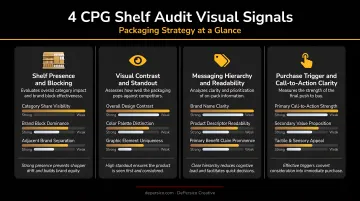
This is the bridge between market intelligence and packaging design strategy. Without it, design choices reflect internal preference, not the competitive context a shopper sees in a single sweeping glance down the aisle.
How to Conduct a CPG Competitive Analysis: Step by Step
The process works best as a structured discipline rather than a once-a-year check-in. The most overlooked stage is almost always the packaging audit — where most brands simply don't look closely enough or systematically enough to surface actionable insights.
Step 1 — Define Your Competitive Set
Cast a wide net. Include direct, indirect, and replacement competitors. The best guide at this stage is consumer behavior: who else does your target shopper buy when they're in this category or solving this need?
Starting narrow means building a competitive picture around the brands you already know, which tends to reinforce existing assumptions rather than challenge them.
Step 2 — Gather Market and Shelf Intelligence
Pull from two distinct data streams:
- Secondary research: syndicated reports from NielsenIQ, Circana, or SPINS for market-level context — sales trends, share data, category velocity, distribution benchmarks
- Primary shelf audits: walking the actual shelf, photographing competitive sets, noting pricing, placement, and share of space at multiple retail accounts
These sources reveal different things. Syndicated data shows what's selling and where. An in-store audit shows what the shopper actually sees — the visual environment, the competitive noise, the physical shelf position — which syndicated data alone can't capture.
Step 3 — Conduct a Packaging and Visual Competitive Audit
This is the most consequential step for CPG brands and the most consistently underused. Evaluate each competitor across:
- Dominant colors and overall visual design style
- Benefit claims and on-pack language — what's first, what's small, what's missing
- Photography and appetite appeal
- Pack size and format variety
- Brand tone and personality cues
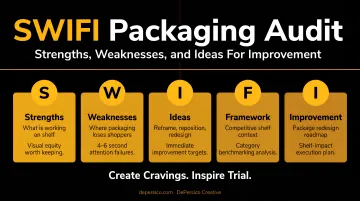
DePersico Creative's proprietary SWIFI framework (Strengths, Weaknesses, and Ideas for Improvement) provides a structured approach to this evaluation. It maps what competitors are doing well (from appetizing imagery to clear copy hierarchy), identifies where products blend into the shelf rather than standing out, and generates specific ideas for how your packaging can claim visual and messaging territory competitors have left open — all evaluated against the 4-to-6 second window consumers actually use to make shelf decisions.
Step 4 — Analyze Pricing, Promotions, and Assortment
With packaging intelligence in hand, the next layer is commercial: how competitors price, promote, and structure their assortment.
Track competitor pricing across entry, mid, and premium tiers. Note promotional cadence : how frequently they discount, at what depth, and whether they rely on multipack or bundle strategies. Document SKU and flavor variety.
This data shapes your own pricing architecture decisions. U.S. private label products now hold 24% value share within food and beverage, which means any mid-tier positioning needs a clear answer to the private label value proposition, not just a comparison against national brands.
Step 5 — Identify Gaps and Opportunities
Synthesize the data into a clear opportunity map:
- Unclaimed visual territories (color, design style, photography approach)
- Underserved consumer segments not directly targeted by current competitors
- Benefit claims no one is leading with on front-of-pack
- Pricing tiers with limited differentiation or brand identity
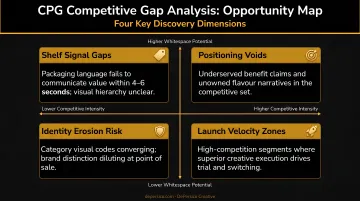
The goal at this stage is specificity: not "we should look more premium" but "no competitor in this set is using dark backgrounds, and three are making the same freshness claim on front-of-pack."
Step 6 — Translate Insights into Brand and Packaging Strategy
Competitive insights only create value when they become specific creative decisions. The output of your analysis should directly inform:
- Packaging redesign direction and visual positioning
- Front-of-pack benefit claim prioritization
- Creative linguistic choices — the specific words and phrases that create consumer connection
- Channel and retailer targeting based on where competitive gaps are largest
CPG Competitive Analysis in Action: A Walkthrough Example
This is an illustrative scenario, not a real case study.
A regional better-for-you snack brand is preparing to expand into a national grocery chain. The category is growing — better-for-you snacking is growing at 7% while conventional snacks are slightly declining — but the shelf is crowded with established players.
Steps 1–3: The brand maps 6 direct competitors and 3 indirect ones (energy bars, trail mixes), conducts shelf audits at 3 retailers, and photographs the full competitive set. The packaging audit surfaces something immediately: 5 of the 6 direct competitors use busy, cluttered packaging with small benefit claims buried below the brand name. The shelf looks visually loud and uniform. That's a clear gap.
Steps 4–5: The pricing audit reveals the brand is positioned in the middle tier with minimal visual or messaging differentiation from private label. The opportunity is clear: move toward cleaner, more premium design language that stands apart from the visual noise, and restructure the front of pack to lead with the most compelling consumer benefit — one no competitor has claimed.
The outcome: The brand uses these insights to brief a packaging redesign with three focused priorities:
- Own visual white space to stand out against the cluttered competitive set
- Elevate appetite appeal photography to drive shelf impact
- Rewrite on-pack language so the primary consumer benefit leads, not the brand name
The competitive analysis wasn't an optional preliminary step — it was the brief. Without it, the redesign would have been driven by internal preference rather than shelf reality.
The most common mistake at this stage: redesigning based on what the internal team finds appealing rather than what the shelf actually shows. Internal instincts are a starting point, not a substitute for shelf-level intelligence.
How DePersico Creative Can Help
DePersico Creative connects competitive intelligence directly to packaging execution — a gap most agencies leave for clients to bridge on their own.
Founded in 1977 and family-owned across three generations, DePersico has spent over 45 years working exclusively in food and beverage. That depth of category experience — across snacks, frozen meals, seafood, condiments, beverages, dairy, and baked goods — means the team brings pattern recognition across hundreds of shelf sets that most brands don't have internally.
Clients have included Kellogg's, Campbell's, McCormick, Ball Park, Idahoan, and Sea Best, alongside regional brands and startups at every stage of growth.
The SWIFI Process in Practice
DePersico's proprietary SWIFI assessment — Strengths, Weaknesses, and Ideas for Improvement — is a structured competitive shelf audit built around how shoppers actually make decisions.
The process evaluates visual hierarchy, claims language, appetite appeal, brand story differentiation, and competitor white space. The output identifies specifically where a package is losing attention, where on-pack language is underperforming, and what design and messaging changes would create a stronger first impression.
The DaVinci pasta redesign illustrates how this works: a SWIFI audit revealed that competitors defaulted to blue packaging. DePersico's analysis of that visual landscape directly informed the decision to use distinctive purple packaging — a direct example of competitive intelligence driving a design choice that creates immediate shelf contrast.
What the Engagement Looks Like
- Competitive brand analysis and SWIFI visual assessment
- Creative linguistics — identifying the most compelling words and phrases for your specific category and audience
- Package design and brand identity
- In-house food photography — prep kitchen, styling team, and studio at the West Chester, PA headquarters
- Marketing materials — sell sheets, trade show materials, point-of-sale displays
Every project is handled in-house with the same senior team, regardless of scope or budget. Clients work directly with the President, not an account manager, and project-based pricing makes the full range of services accessible to brands at any stage — from first launch to national portfolio refresh.
Frequently Asked Questions
What are the 5 steps of a competitive analysis?
Define your competitive set, gather market and shelf intelligence, analyze competitor packaging and positioning, identify gaps and opportunities, and translate findings into brand strategy. In CPG, the packaging audit in step three is where most brands underinvest and where the sharpest insights typically surface.
What are the 4 P's of competitive analysis?
The 4 P's — Product, Price, Place, and Promotion — provide a framework for evaluating competitors across what they sell, how they price it, where they distribute it, and how they market it. Applied to CPG shelf analysis, each dimension reveals different competitive pressures and differentiation opportunities.
What does CPG stand for in research?
CPG stands for Consumer Packaged Goods — frequently purchased, consumable products sold through retail channels. In research contexts, it refers to the broader category tracked through retail measurement services like NielsenIQ and Circana, covering everything from food and beverage to household cleaning products.
What are some examples of CPG products?
Common CPG categories include food and beverage, snacks, condiments, frozen meals, dairy products, household cleaning products, and personal care items. All are defined by high purchase frequency, retail distribution, and short consumption cycles that keep shoppers returning.
What is the difference between direct and indirect CPG competitors?
Direct competitors offer the same product type to the same target audience. Indirect competitors solve the same consumer need through a different format — a protein bar brand's indirect competitors might include Greek yogurt or trail mix. Both matter because shoppers rarely confine themselves to a single category when satisfying a need.
How often should CPG brands update their competitive analysis?
At a minimum, conduct an annual shelf audit — but also revisit at key milestones: product launch, packaging redesign, entering a new retail channel, or whenever a major competitor makes a visible move. Category dynamics shift faster than most annual calendars account for.