A quality product is necessary. It's not sufficient. Consumers scanning a grocery aisle make decisions in seconds, and if your packaging, positioning, and messaging don't immediately connect with what they care about, they'll pick the brand next to yours.
The challenge is specific to organic: these consumers aren't motivated by price or convenience the way conventional shoppers often are. They buy based on values — health, environmental impact, ethical sourcing. That means the standard food marketing playbook doesn't work here.
This guide covers the strategies that do: audience targeting, brand identity, packaging, digital marketing, social media, and retail placement.
Key Takeaways
- Define your organic consumer psychographically — values and lifestyle, not just age and income
- Build brand identity around transparency and transformation-focused storytelling, not vague "natural" claims
- Treat packaging as your most critical in-store marketing tool — shoppers decide in seconds
- Use SEO-driven content and email to build long-term trust with values-aligned consumers
- Lean on micro-influencers, authentic social content, and community engagement to grow without mass advertising
Know Your Organic Consumer: Audience and Positioning
Who's Actually Buying Organic
The typical organic buyer profile is well-documented. Gen Z, millennials, households with children, and households earning $100,000+ all over-index for organic purchases. Nearly 90% of Gen Z consumers are committed or relatively new organic buyers, according to the OTA — which makes younger, higher-income families the primary target audience for most brands.
Demographics alone won't build your messaging. What drives these consumers to pay more is a combination of health outcomes, environmental concern, and ethical sourcing. A 2024 study confirmed that environmental values, health consciousness, and value perception are among the strongest drivers of organic purchase decisions. Those motivations need to shape how you position and present your product at every touchpoint.
Psychographic Segmentation Over Demographics
Go deeper than age brackets. Organic buyers tend to share specific lifestyle markers:
- Active engagement with fitness and wellness routines
- Preference for local and independent businesses
- Strong interest in sustainability and reduced environmental impact
- Skepticism toward large food corporations and industrial agriculture
These shared values make messaging specificity matter. A campaign built around "certified clean ingredients for your family" lands differently than one built around "great taste at a great price." For this audience, the former wins — consistently.
Positioning for a Crowded Shelf
SPINS reported $302 billion in U.S. natural and organic consumer sales in 2023, and Mintel tracks over 45,000 new global CPG launches monthly. The organic seal alone is no longer differentiation. Brands need a specific, credible positioning anchor to justify premium pricing and stand apart. That anchor might be:
- Local or traceable sourcing with a named farm or region
- A superior certification stack (USDA Organic + Non-GMO + B Corp)
- A distinct functional benefit tied to a specific health outcome
- A compelling origin story that makes the brand feel human
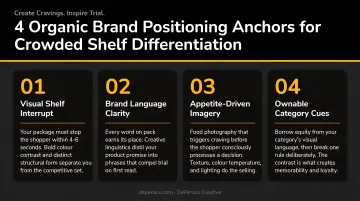
Without one of these, organic products risk blending into a shelf that's increasingly crowded with similar claims and similar packaging.
Build an Authentic Brand Identity That Resonates
Storytelling and Transparency
Organic consumers actively research the brands they buy. They want to know where the food comes from, how it was grown, and what certifications actually mean in practice. Brands that openly document sourcing, farming methods, and production processes build measurably stronger trust than those relying on vague "natural" language.
A 2021 food-system trust review found that product assurance — through packaging labels, attribute claims, certifications, and origin information — is the primary mechanism through which consumers extend trust to food brands. That trust is fragile.
A 2025 study confirmed that perceived greenwashing directly reduces purchase intention — meaning unsubstantiated environmental or health claims don't just fail to help, they actively damage the brand.
Move from an origin story — where the brand is the hero — to a transformation story where the consumer is the hero. The consumer's life gets better, their values get expressed, their family eats cleaner. Your product enables that. This approach tends to resonate far more strongly with buyers who see purchasing decisions as identity statements.
Visual Identity and Creative Linguistics
Consistent visual identity — color palette, typography, imagery style — signals brand values before a single word is read. For organic brands, this typically means clean design, natural textures, and photography that conveys freshness and authenticity rather than industrial perfection.
Language matters just as much. Generic buzzwords like "natural," "eco-friendly," and "wholesome" have lost their ability to move shoppers. Precise, sensory, and specific language earns attention — phrases that give consumers something concrete to remember and repeat:
- "Stone-ground" or "cold-pressed" (process transparency)
- "Grown by three generations" (origin credibility)
- "No added anything" (clean-label directness)
- Named ingredient sources tied to a specific region or farm
That precision is exactly what DePersico Creative's Creative Linguistics service is built around. Every word on a package is evaluated for relevance, uniqueness, simplicity, and memorability — tested against the four-to-six-second decision window shoppers actually operate in. The goal isn't description; it's connection.
Key principle: Anchor every claim in a verifiable fact — a USDA Organic certification, a specific farming practice, a named ingredient source. Claims that can't be substantiated should be cut before they reach print.
Make Packaging Your Most Powerful Marketing Tool
For organic brands sold at retail, packaging is where marketing actually happens. An ad might build awareness. The package is what converts a passing glance into a purchase — or sends the shopper to a competitor.
Research confirms packaging has only one or two seconds to engage shoppers. In a category as crowded as organic food, that window is everything.
What Effective Organic Packaging Actually Does
High-performing organic food packaging communicates four things almost instantly:
- What it is: product name and descriptor readable at three to five feet
- Why it's better: one primary benefit or differentiator front and center
- That it's verified: certification badges (USDA Organic, Non-GMO Project) placed prominently
- That it looks worth the price: photography and design that signal quality, not compromise
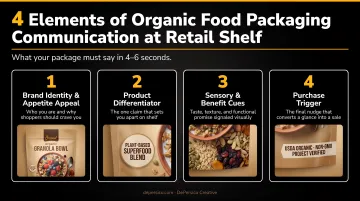
Most small brand packaging tries to say everything at once — origin story, certifications, tagline, ingredient callouts, and usage occasions all competing for the same real estate. The result says nothing clearly. The brands that win on shelf choose one primary message and make everything else subordinate to it.
The SWIFI Assessment Process
Before redesigning any packaging, a structured competitive audit is essential. DePersico Creative's SWIFI framework (Strengths, Weaknesses, and Ideas for Improvement) is built specifically for this.
The process pulls competitive products off the shelf and evaluates them side by side — examining what each package communicates visually, what claims it makes, and where gaps exist that the client brand could credibly occupy.
This kind of structured assessment answers the question that matters most: not "does our packaging look good?" but "does our packaging stop someone who wasn't already looking for us?"
Photography as a Non-Negotiable Investment
Food photography on packaging directly shapes consumer perception of product quality. A 2022 study of organic food purchase drivers found that epistemic and emotional value — curiosity, appetite appeal, sensory expectation — significantly influence purchase intention alongside functional value. Photography that evokes those responses functions as a direct sales tool.
DePersico Creative operates a dedicated in-house test kitchen and photography studio, capturing product images at multiple angles for use across packaging, sell sheets, and digital channels. All images come with full usage rights — which matters when you need consistent visuals across retail packaging, your website, and social media simultaneously.
Strong photography delivers on several fronts:
- Creates immediate appetite appeal at shelf
- Sets accurate quality expectations before first purchase
- Provides consistent assets across all marketing channels
Packaging as the Visual Foundation
Packaging visuals shouldn't exist in isolation. When packaging is built from a strong positioning strategy, it becomes the foundation for the entire visual system — campaign creative feels aligned, trade materials feel polished, digital assets feel intentional. Brands that treat packaging and digital presence as separate design projects end up with fragmented identities that erode recognition at every touchpoint.
Digital Marketing Strategies That Drive Organic Brand Growth
SEO and Content Marketing
Organic consumers don't impulse-buy. They research. A consistent SEO-driven content strategy positions your brand as a trusted authority in the category and builds the attitude shift that precedes purchase.
A 2024 study on organic food purchase intention found that knowledge affects purchase intention indirectly through attitude — meaning educational content doesn't convert immediately, but it builds the foundation that makes conversion possible. Content that works:
- Recipe posts showing the product in real, appealing use
- Behind-the-scenes production and sourcing content
- Plain-language explanations of what certifications actually mean
- Ingredient guides and sustainability explainers
These pillars serve SEO while simultaneously reinforcing brand values — which makes content a more efficient investment for organic brands than it is for conventional ones.
Email Marketing
Email reaches your most loyal customers without algorithmic interference. For organic brands, where brand relationship and trust drive repeat purchase, that directness is valuable.
Litmus reports email generates an average $36 for every $1 spent — making it one of the highest-ROI digital channels available. Building the list matters: offer exclusive recipes, early access to new products, or behind-the-scenes farm updates as incentives.
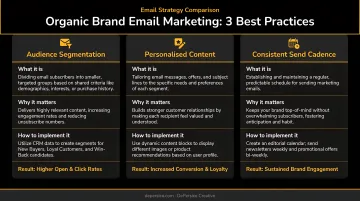
Best practices for organic brand email:
- Personalize by purchase history — someone who bought your granola wants different content than someone who bought your pasta sauce
- Write in an authentic brand voice — community newsletter tone, not promotional blast
- Use email between purchase moments to deepen the relationship, not just to push discounts
Addressing Price Sensitivity Through Messaging
Channel strategy only goes so far — at some point, every organic brand has to address price. Research shows nearly 62% of consumers accept organic premiums no greater than 20%, while actual observed premiums often exceed 35%. That gap is largely a messaging problem.
Justify the price; don't hide from it. Frame premium pricing around concrete specifics rather than generic "better for you" language:
- Name the certifications and what they actually require
- Reference sourcing practices by farm, region, or standard
- Highlight measurable quality differences consumers can see or taste
Consumers who understand what they're paying for are far more willing to pay it.
Social Media and Influencer Marketing for Organic Brands
Platform and Content Strategy
Different platforms, different roles:
- Instagram and Pinterest — aspirational lifestyle imagery, product photography, recipe inspiration
- TikTok — authentic behind-the-scenes content, recipe demos, sourcing stories
Raw, genuine content consistently performs well with organic food audiences. These consumers associate heavily produced brand content with the industrial food system they're deliberately moving away from. A shaky farmer video or an imperfect home kitchen recipe can outperform a polished production because it signals the authenticity they're looking for.
Influencer Marketing Done Right
Follower count is a poor proxy for influence in this category. What matters is values alignment. A micro-influencer with 15,000 highly engaged followers in the wellness or sustainable living space will typically outperform a celebrity with millions of followers who has no authentic connection to organic food.
What to look for in an influencer partner:
- Genuine product usage, not just sponsored posts
- Audience demographics that match your organic consumer profile
- Existing content that reflects values consistent with your brand
- Engagement patterns that suggest real community, not passive scrolling
Inauthentic partnerships — where the influencer clearly has no connection to the product category — are immediately obvious to organic consumers and damage brand credibility more than no partnership at all.
Community Engagement as Strategy
Social media for organic brands isn't a broadcast channel. It's a community channel. Building that community means actively participating in it:
- Responding to comments and questions promptly
- Asking followers questions that invite real conversation
- Sharing user-generated content to spotlight your customers
- Handling negative feedback transparently rather than deleting it
These habits build the kind of loyalty that generates referrals — the most valuable marketing an organic brand can earn.
Research confirms the impact: a peer-reviewed study on food consumer behavior found that user-generated content and perceived food quality both significantly affect purchase intention. Encourage customers to share recipes, post reviews, and tag your brand — then amplify the strongest content. When a real customer shows how they use your product, it converts better than anything your brand produces on its own.
Retail Placement, Events, and Strategic Partnerships
Shelf Position Is a Marketing Decision
Physical retail placement directly affects sales velocity, and brands that treat it as fixed leave performance on the table. A 2020 systematic review confirmed that food store product placement strategies directly influence purchase behavior — endcaps, eye-level positioning, and category adjacency all matter.
Research on organic point-of-purchase displays found that shelf education materials increased organic sales for coffee and olive oil — though the same intervention reduced sales of organic flour. The lesson: retail signage and placement strategies need to be tested by category, not assumed to work uniformly.
Work actively with retail partners to improve your position:
- Request endcap opportunities for new launches
- Use shelf talkers and educational cards where your category responds well to them
- Track sales lift by placement type to build the data case for future negotiations
Events, Farmers' Markets, and Partnerships
In-person engagement builds the kind of direct consumer relationships that no digital campaign can replicate quickly. Farmers' markets and food festivals allow brands to:
- Sample products and collect immediate feedback
- Gather authentic user-generated content in natural settings
- Identify values-aligned brands for co-marketing opportunities
Strategic partnerships with complementary organic and wellness brands expand reach without paid media costs. An organic grain company collaborating with an organic nut butter brand on a recipe campaign, for example, gives each brand a credible introduction to the other's audience.
Visual consistency across these touchpoints matters — the same brand story that sells on the shelf should carry through to event signage, POS materials, and any co-branded collateral.
Frequently Asked Questions
What are organic marketing strategies?
These strategies center on authenticity, transparency, and verifiable certifications rather than mass promotional tactics. They use strategic packaging design and targeted digital engagement to reach values-driven consumers who prioritize health and environmental impact — and who can spot hollow claims immediately.
What are the 4 Ps of marketing strategy for organic food brands?
The classic 4 Ps — Product, Price, Place, Promotion — apply directly to organic brands. Premium quality must be backed by certifications, pricing requires clear benefit communication to justify the premium, placement spans both retail and online channels, and promotion centers on authentic storytelling over discounting.
How do you market organic food to health-conscious consumers?
Speak to their values rather than generic health claims. Use verifiable certifications, specific sourcing details, and educational content that reduces uncertainty. Reach them through targeted digital channels and social proof from trusted community voices. Micro-influencers and genuine customer reviews carry more weight here than broad advertising.
What makes organic food marketing different from conventional food marketing?
Conventional food marketing competes on price and convenience. Organic marketing competes on values alignment, authenticity, and trust. That shift requires storytelling, transparency, and community-building — not deeper discounts or mass-reach campaigns.
How important is packaging design for organic food brands?
Packaging is the most critical marketing touchpoint at retail, where purchase decisions happen in one or two seconds. Design quality determines whether a consumer picks up the product or walks past it. That makes it a higher-stakes investment than most digital advertising.
How can small organic food brands compete with larger companies?
Small organic brands hold a structural authenticity advantage. They can share genuine human stories, build tight-knit communities, and offer the sourcing transparency that large corporations struggle to replicate. Positioned honestly, "small" signals craft and care — qualities that resonate with exactly the consumers organic brands are trying to reach.