Introduction
Walk down any grocery aisle and watch what shoppers do before dropping something in their cart. More often than not, they flip the package over. The ingredient list has become a dealbreaker.
"Clean label" is now one of the most powerful forces reshaping the food and beverage industry. The clean label ingredients market was valued at USD $50.2 billion in 2024, projected to reach $69.3 billion by 2029 — a signal that consumer demand for transparency isn't slowing down.
The catch? There's no single agreed-upon definition. No FDA rule, no USDA certification, no legal standard. That ambiguity creates both opportunity and risk for food brands trying to compete in this space. Understanding what clean label actually means — and how to communicate it credibly — is where brands win or lose on shelf.
Key Takeaways
- "Clean label" has no FDA definition — it's a consumer-driven concept, not a regulated term
- Nearly 70% of consumers say they'd pay more for clean label products
- Organic and clean label are not the same thing — conflating them on packaging creates real brand risk
- Artificial colors, preservatives, and unrecognizable additives are the top exclusions
- Packaging is where clean label wins or loses — the words and visuals you choose determine whether shoppers trust the product
What "Clean Label" Actually Means (and Why There's No Official Definition)
No FDA rule defines "clean label." No eCFR entry, no USDA certification category. It's a consumer-driven positioning term — which means every brand and every shopper defines it slightly differently.
The Four Pillars Most Experts Agree On
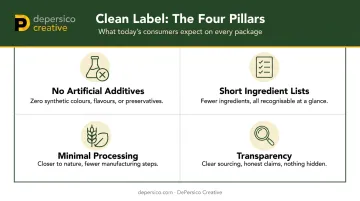
Industry researchers and food scientists generally cluster clean label around four ideas:
- No artificial additives — no synthetic dyes, flavors, or preservatives
- Short ingredient lists — fewer ingredients, each one recognizable
- Minimal processing — the product hasn't been fundamentally altered from its natural state
- Transparency — honest sourcing and production claims that hold up under scrutiny
The Scientific Name Problem
FDA regulations under 21 CFR 101.4 require ingredients to be declared by their common or usual name in descending order by weight. The result? Perfectly safe, familiar ingredients appear suspicious because their technical names read as foreign to most shoppers.
- Tocopherol = Vitamin E
- Ascorbic acid = Vitamin C
- Thiamine hydrochloride = Vitamin B1
A consumer scanning an ingredient list quickly may flag these as industrial chemicals. They're not. Perception drives purchase decisions — not ingredient literacy.
The Awareness Gap
IFIC's research found that Millennial and Gen Z consumers (ages 18–34) had "little awareness" of what clean label actually means — most loosely connected it to no artificial ingredients, fewer ingredients, and less processing. With no consistent definition across age groups, brands that use the term without explaining it are building on unstable ground.
That gap creates tangible brand risk. Companies claiming clean label status without a consistent internal standard face increasing scrutiny from:
- Advocacy groups tracking ingredient and sourcing claims
- Informed shoppers who cross-reference labels with third-party databases
- Retailers and buyers who ask brands to substantiate their positioning
Without a clear definition anchored to your product, "clean label" is a liability as much as a selling point.
Why Consumers Are Demanding Clean Label Products
The demand for cleaner ingredients didn't emerge overnight. It built over years of food safety scares, growing distrust of ultra-processed foods, and a consumer base that now reads ingredient panels the way earlier generations read nutrition facts.
The Numbers Behind the Trend
- 79% of Americans consider whether a food is processed before purchasing it
- 63% actively avoid processed foods at least sometimes
- Nearly 70% of consumers say they'd pay more for food and beverage products with a clean label (Kalsec)
- 65% of global consumers say "free from additives" influences their food and drink choices (FMCG Gurus, 2026)
That willingness to pay a premium has real shelf implications. One plain yogurt study found consumers would pay $2.54–$3.53 more for a clean label 32-ounce option — before taste even factored in. For brand managers, that's not a niche signal. It's a pricing and positioning opportunity.
Part of a Larger Values Shift
Clean label buying behavior doesn't happen in a vacuum. It tracks closely with three other priorities reshaping how shoppers choose products:
- Plant-based eating — 52% of clean label consumers try to eat a largely plant-based diet; 83% of plant-based consumers specifically avoid complicated or unrecognizable ingredients
- Ultra-processed food avoidance — consumer confidence in the U.S. food supply dropped from 70% to 62% in a single year (IFIC 2024)
- Environmental sustainability — 31% of U.S. consumers say sustainability has a significant impact on their food purchase decisions
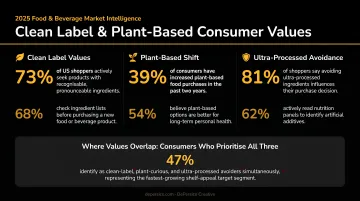
For food brands, this overlap matters. A shopper avoiding ultra-processed ingredients is often the same shopper paying attention to sustainability claims and gravitating toward plant-based options — making clean label a signal that touches multiple purchase drivers at once.
Clean Label vs. Natural vs. Organic: What's the Difference?
These three terms get used interchangeably. They shouldn't be.
| Term | Regulatory Status | Key Distinction |
|---|---|---|
| Clean label | No formal FDA/USDA definition | Consumer/industry concept; no enforceable standard |
| Natural | FDA informal policy (not finalized) | Nothing artificial or synthetic added; FDA opened public comment in 2015 |
| Natural (meat/poultry) | USDA FSIS definition | No artificial ingredient or added color; minimal processing only |
| Organic | USDA NOP certification | At least 95% organic ingredients; strict production and sourcing standards |
Why Organic ≠ Clean Label
This one catches brands off guard. USDA organic certification is rigorous, but the National Organic Program's National List permits certain synthetic substances for specific uses. Potassium bicarbonate, for example, is allowed for organic crop disease control.
That means a product can carry organic certification and still include compounds that don't fit clean label expectations. It also works the other way: a product can use clean, recognizable ingredients without ever qualifying for organic certification.
Using these terms interchangeably on packaging misleads consumers and creates compliance risk. Each carries different legal weight and consumer meaning — use them precisely.
What Ingredients and Practices Define a Clean Label Product
Clean label is partly about what's absent and partly about what replaces it.
What's Typically Excluded
- Artificial colors (FD&C synthetic dyes)
- Artificial flavors
- Artificial preservatives — BHA, BHT, TBHQ, sodium benzoate
- High-fructose corn syrup
- Synthetic stabilizers and thickeners with unfamiliar names (xanthan gum and guar gum often raise flags despite being naturally derived)
What Replaces Them
Rather than synthetic preservation, clean label formulations typically turn to:
- Rosemary and green tea extracts — recognizable on ingredient lists, effective antioxidants
- Vinegar-based antimicrobials — increasingly common for clean-label shelf stability
- Fermentate-based ingredients — natural preservation through fermentation science
- Plant extracts — broad category of naturally derived stabilizers and antioxidants
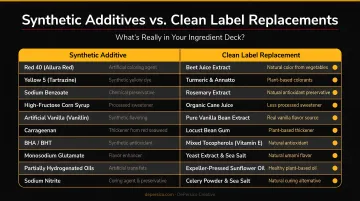
The challenge is that these alternatives rarely replace synthetics one-for-one. Shelf life, texture, and microbial stability all require rigorous reformulation work before a brand can confidently make the switch.
Third-Party Validation
Rigorous reformulation is only half the equation — brands still need proof consumers can trust. That's where independent certification comes in.
The Clean Label Project tests products for over 300 contaminants — heavy metals, pesticide residues, plasticizers, and more. They use ISO-accredited lab testing on retail-purchased samples, so brands have no control over what gets submitted or tested.
Gerber has pursued Clean Label Project certification for over 115 of its baby food products. For brands serious about clean label positioning, that kind of verification is what separates a credible claim from a marketing phrase.
How Clean Label Brands Communicate Transparency on Packaging
Getting the formulation right is only half the job. Shoppers decide in seconds — Nielsen research puts the average in-store brand purchase decision at 13 seconds. The packaging has to do a lot of work, fast.
Front-of-Pack vs. Back-of-Pack
These two surfaces serve different purposes, and they must be consistent with each other:
Front of pack — short, specific, consumer-friendly claims:
- "No artificial preservatives"
- "5 ingredients"
- "Made with real [ingredient]"
Back of pack — the proof layer:
- Clean, readable ingredient list
- Sourcing notes or brand story
- Third-party certifications
If the front promises simplicity but the back lists 22 ingredients with unfamiliar chemical names, consumer trust collapses immediately. Both panels have to tell the same story.
The Role of Creative Linguistics
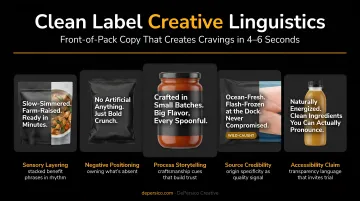
Word choice on packaging is a strategic decision, not a copywriting afterthought. The same ingredient can evoke confidence or suspicion depending on how it's named.
That's why agencies like DePersico Creative treat language as a core design element. With over 45 years in food and beverage packaging, they use what they call creative linguistics — a deliberate approach to selecting brand names, taglines, product messages, and back-of-pack copy that creates an emotional or logical connection with shoppers. The goal is choosing words that resonate within seconds, communicating benefits like clean ingredients or superior taste before a shopper has time to think twice.
Their process evaluates language against four criteria: relevance to the product, uniqueness from competitors, simplicity in pronunciation, and memorability. For clean label brands, this means translating genuine formulation work into language that feels honest and accessible — without oversimplifying or making claims that can't be substantiated.
Visual Design as a Trust Signal
Design communicates "clean" before a single word is read. Clean label packaging typically relies on:
- White or neutral backgrounds that signal simplicity at a glance
- Green and earth tones tied to natural ingredients and health-forward positioning
- Minimal layouts with fewer competing elements for faster clarity
- Ingredient-forward imagery — botanicals, fruits, or grains that reinforce what's inside
- Transparent windows that let the product speak for itself
These visual choices must match the ingredient story. A beautiful minimal design on a product with a 25-ingredient list feels dishonest. Shoppers notice the disconnect.
Challenges Food Brands Face When Going Clean Label
Going clean label involves real operational trade-offs — in cost, complexity, and credibility.
Reformulation Is Hard
Artificial preservatives, stabilizers, and colors aren't in products by accident — they perform specific functions. Replacing them requires:
- Testing multiple natural alternatives for efficacy
- Validating shelf stability under real distribution conditions
- Confirming sensory parity (texture, color, taste) matches the original product
Natural alternatives rarely replace synthetics one-for-one. A reformulation that looks right on paper can fail on shelf when the product's texture or appearance changes over time.
Cost Goes Up
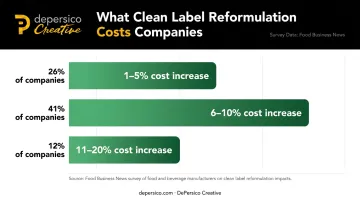
Food Business News survey data found that clean label reformulation increased costs for most companies surveyed:
- 41% saw cost increases of 6–10%
- 26% saw increases of 1–5%
- 12% saw increases of 11–20%
Sourcing natural ingredients at scale also introduces supply chain variability that synthetic inputs don't have. Brands need to budget for this before making public commitments.
The Clean Washing Risk
Adopting clean label language without substantive formulation changes is a fast path to backlash. The cases are already in the record: Holk v. Snapple involved high-fructose corn syrup in beverages marketed as "natural"; Bohac v. General Mills challenged "all natural" claims on products containing GMOs.
Vague terms like "natural flavoring" can obscure ingredients consumers would reject if they knew what they were. Informed shoppers, advocacy organizations, and regulators are increasingly watching. The FDA has specifically flagged labeling claims like "No Artificial Colors" as an area of heightened scrutiny.
The real standard for clean label claims goes beyond legal compliance. A claim needs to hold up when a knowledgeable consumer reads every word on the back of the package.
Frequently Asked Questions
What is a clean label food brand?
A clean label food brand formulates and markets its products with short, recognizable ingredient lists, no artificial additives or preservatives, and a commitment to sourcing transparency. There's no official regulatory definition, so standards vary by brand — look for third-party certifications to verify the claim.
Is clean label legit?
The concept is genuine — it reflects real consumer demand for simpler, more transparent ingredients. But without a regulated definition, the term can be misused. Third-party certifications and a clean ingredient list are more reliable signals than front-of-pack marketing language alone.
What is the difference between clean label and organic?
"Organic" is a USDA-regulated certification with specific production and sourcing standards. "Clean label" is an unregulated marketing concept with no legal definition. A product can be one without being the other — they're not interchangeable.
What ingredients are typically avoided in clean label products?
The most common exclusions are artificial colors (FD&C dyes), artificial flavors, artificial preservatives (BHA, BHT, TBHQ), high-fructose corn syrup, and synthetic additives consumers wouldn't recognize from home cooking.
How can a food brand get clean label certified?
The Clean Label Project is one of the leading independent certification organizations. Certification involves third-party testing for heavy metals, pesticide residues, plasticizers, and over 300 contaminants using ISO-accredited labs.
Does going clean label affect shelf life or taste?
Replacing synthetic preservatives with natural alternatives can create formulation challenges around stability, taste, and texture. Many brands navigate this successfully through careful ingredient selection and testing, but it requires investment in reformulation before making any public clean label claim.