Introduction
Picture this: a shopper walks down the freezer aisle, reaches for a 6-count ice cream bar box without breaking stride, and drops it in the cart. They never looked at the individual bars inside. The outer carton made the sale before the primary packaging was ever seen.
Secondary packaging did its job. It's also the most underestimated selling surface in frozen food retail.
Many ice cream brands invest heavily in primary container design — the tub, wrapper, or cup — while treating the outer carton as a logistics formality. That's a missed opportunity.
The multi-pack carton on that freezer shelf is often the first brand impression a shopper receives. In a category generating $7.8 billion in annual US sales, the difference between a carton that stops shoppers and one that gets skipped past is measurable in velocity.
What follows breaks down the key retail formats, the functional demands of frozen distribution, and how to design outer packaging that drives purchase decisions — in a freezer aisle where shoppers decide in seconds.
Key Takeaways
- Secondary packaging groups primary ice cream containers into shelf-ready units and often delivers the first brand impression shoppers see
- Common formats include multi-pack cartons, retail-ready cases, club store boxes, and seasonal gift packs
- Frozen distribution demands moisture resistance, structural integrity at sub-zero temperatures, and stacking strength
- The freezer aisle requires bolder contrast, larger type, and stronger color blocking than ambient retail environments
- Sustainable options must balance recyclability goals against frozen food's strict moisture-resistance demands
What Is Ice Cream Secondary Packaging?
The Three-Tier Hierarchy
Secondary packaging is the outer layer that groups, protects, or presents one or more primary packages. It never directly contacts the ice cream itself. To understand where it fits, the three-tier structure matters:
- Primary packaging — the tub, wrapper, cone sleeve, or cup that touches the ice cream directly
- Secondary packaging — the multi-pack carton, retail box, or grouped sleeve that contains multiple primary units
- Tertiary packaging — the pallet-level shippers used for bulk distribution, rarely seen by retail shoppers
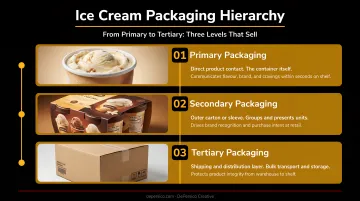
The EU Packaging and Packaging Waste Regulation describes this as sales packaging (primary), grouped packaging (secondary), and transport packaging (tertiary) — a framework that maps cleanly to how ice cream moves from manufacturer to shopper's cart.
Most shoppers interact with secondary packaging far more than they realize. When you grab a box of 6 ice cream sandwiches, you're holding a secondary package.
Why Ice Cream Secondary Packaging Carries a Unique Burden
Most ambient food categories ask secondary packaging to do one thing well: protect the product and look decent on shelf. Ice cream asks for much more.
Secondary ice cream packaging must simultaneously:
- Withstand sub-zero storage, repeated temperature cycling in frost-free freezers, and heavy stacking loads
- Communicate the brand clearly in one of retail's most visually difficult environments — frosted glass, dim lighting, densely packed shelves
- Meet retail-ready standards at major grocery chains, where the secondary carton goes directly onto the freezer shelf
Condensation compounds every one of those demands. As products move through distribution temperature zones, secondary packaging absorbs moisture, which weakens its structure and degrades print quality simultaneously. That's why design decisions that work fine for a dry-goods box often fail completely in the freezer aisle.
Common Formats of Ice Cream Secondary Packaging
Multi-Pack Cartons
The dominant format on supermarket shelves. Paperboard or coated corrugated boxes group individual bars, sandwiches, novelties, or cones into 4-, 6-, or 12-count configurations. Brands like Good Humor, Magnum, and Klondike built their supermarket presence largely on this format.
The key brand advantage: printable surface area. A 6-count novelty carton offers far more canvas than any individual wrapper — enough room for flavor storytelling, appetite photography, and brand messaging that simply won't fit on a primary package.
Retail-Ready and Shelf-Ready Packaging (RRP/SRP)
Designed to ship as a closed case and open directly onto the freezer shelf with minimal retailer handling — typically via a perforated tear-away front panel. Research from Refrigerated & Frozen Foods noted that corrugated RRP packaging for frozen goods must withstand fluctuating humidity and temperatures while supporting up to 10 times its own weight.
Major grocery chains increasingly require RRP formats as a condition of ranging. For brands pursuing distribution at Walmart, Kroger, or Wegmans, designing secondary packaging to RRP specifications is a non-negotiable entry requirement.
DePersico Creative coordinates directly with retailer-specific RRP guidelines for Walmart, Target, Costco, Sam's Club, Kroger, Wegmans, and Publix when developing secondary packaging, ensuring structural and graphic design both meet retailer requirements before a single carton goes into production.
Club Store and Bulk Formats
Oversized cartons — 18- or 24-count — designed for warehouse club environments like Costco, Sam's Club, and BJ's Wholesale Club. The Kirkland Signature 18-count ice cream bar box is a representative example of this format at scale.
The distinct design challenge here: shoppers browse quickly and stand further from the product than in a standard supermarket aisle. Cartons must communicate value and brand identity at a larger scale, with bolder visual elements and stronger hierarchy. DePersico's club store secondary packaging work for Idahoan used the larger box format to feature restaurant-quality food photography — imagery that drove the brand's premium positioning in a format that demanded visual impact from a distance.
Gift and Premium Packaging
Seasonal cartons, holiday gift boxes, and limited-edition presentation packs. This format carries elevated design expectations and strong impulse purchase potential. Swapping an outer carton for a holiday design is considerably lower-cost than redesigning primary containers, yet it drives shelf novelty and encourages unplanned purchases.
DePersico's approach to seasonal secondary packaging keeps core brand elements intact — logo, typography, color — while layering in seasonal motifs that feel special without overwriting the product message. Shoppers recognize the brand instantly and respond to the occasion, which is exactly what moves product during high-traffic seasonal windows.
DTC and Branded Corrugated Shippers
Once treated as purely functional transit packaging, branded corrugated shippers have become a visible brand touchpoint as direct-to-consumer ice cream shipping has grown. Jeni's Splendid Ice Creams, for example, ships frozen goods in insulated boxes with dry ice on 48-hour transit windows.
For DTC ice cream brands, the outer shipper is no longer incidental. The unboxing experience it creates is part of the brand story — and a direct driver of social sharing and repeat orders.
Key design considerations for DTC shippers:
- Insulation messaging: communicate cold-chain reliability directly on the box
- Brand consistency: extend visual identity from primary packaging to outer shipper
- Unboxing cues: guide the customer through opening sequence with printed instructions or reveals
- Sustainability signals: call out recyclable or compostable materials where applicable
Functional Requirements: What Ice Cream Secondary Packaging Must Do
Structural Integrity at Sub-Zero Temperatures
Paperboard and corrugated materials behave differently at freezing temperatures. They can delaminate, warp, or lose compressive strength — especially under stacking loads in a distribution environment. Polyethylene (PE) or polypropylene (PP) coatings and moisture-resistant adhesives are standard mitigations.
Compressive strength is central to this. ASTM D642 and TAPPI T804 are the standard tests for how shipping containers resist external compressive forces. The structural specification for any secondary ice cream package should reflect actual stacking height, pallet pattern, and distribution conditions. There's no universal BCT requirement — brands that apply ambient food packaging specs to frozen distribution are taking a measurable structural risk.
Moisture Resistance and Condensation Management
Research from Georgia Tech on moisture effects on box compression strength found that at 80% relative humidity, box compression strength loss can reach approximately 32%. For secondary ice cream packaging moving through refrigerated distribution, humidity exposure at that level is routine, not exceptional.
Coating options that address this:
- PE extrusion-coated paperboard — effective moisture barrier, widely used in frozen food secondary packaging
- PP coatings — suitable for deep freezing with good sealing properties
- Dispersion barrier coatings (DBC) — water-based coatings that provide moisture and vapor barriers while maintaining paper-based recyclability, an emerging option for brands with sustainability goals
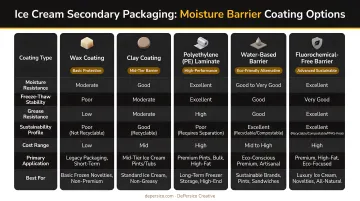
The recyclability tradeoff is real: How2Recycle's 2024 guidelines classify 2-sided poly-coated paper as "Not Yet Recyclable," while optimally recyclable paper boxes use clay coating only. Dispersion barrier coatings represent one route to closing this gap.
Right-Sizing and Logistics Efficiency
Cartons with excessive headspace waste material and reduce stacking efficiency. Right-sizing — designing cartons to minimize void space — improves both pallet density and material usage. For high-volume frozen novelty brands, even small carton dimension reductions compound across tens of thousands of cases annually.
Secondary Packaging as a Branding and Selling Tool
The Freezer Aisle Attention Window
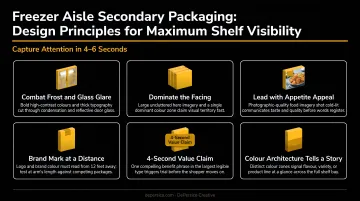
The freezer aisle is not a forgiving retail environment. Frosted glass doors, fluorescent or LED strip lighting, and tightly packed shelving mean that packaging designed for optimal studio viewing often performs poorly at point of sale. An eye-tracking benchmark study from RIT's Journal of Applied Packaging Research found time to first fixation in the frozen treats category averaged just 2.18 seconds, with a total fixation duration of 0.58 seconds.
That's the entire attention window. Secondary packaging must earn that fixation and convert it.
What this demands from design:
- Higher contrast than ambient shelf products — not against a white background, but against the actual competing products in that freezer case
- Bolder color blocking that reads through frosted glass
- Larger, legible typography — brand name and product descriptor readable at 3–5 feet
- One primary message that communicates instantly, with everything else subordinate to it
Appetite-Driving Photography
Large, high-quality food photography of the actual product — showing creamy texture, visible inclusions, or a plated serving — is among the most powerful conversion tools available on secondary packaging. The multi-pack carton's larger surface area makes this possible in a way that individual wrappers cannot accommodate.
DePersico Creative's fully equipped test kitchen and food photography studio handles exactly this — styling and shooting frozen products to capture the appetite appeal that turns a glance into a purchase.
Primary and Secondary Design Developed Together
One of the most avoidable mistakes in packaging development: locking in the primary container design, then treating secondary packaging as an afterthought. Color systems, typographic hierarchies, and icon systems developed for a primary container often don't translate cleanly to the larger, different-shaped secondary format.
The stronger approach is developing both tiers simultaneously — building a packaging system rather than a single package. DePersico designs "always stays" elements that anchor the system across primary and secondary formats, then applies layout templates that allow individual SKU differentiation through color variation and flavor indicators while preserving brand cohesion at shelf.
Scaling Across a Multi-SKU Line
That same system-level thinking becomes even more critical when scaling across multiple SKUs. A multi-flavor ice cream line needs its secondary packaging to do two things at once: signal brand family clearly enough that shoppers recognize the line, and differentiate flavors distinctly enough that the right product is easy to find. These goals pull in opposite directions, and a poorly designed system produces either a shelf set that looks like generic products or one where every carton looks so different the brand disappears.
The solution is a modular layout system: fixed brand lockup position, consistent structural hierarchy, and deliberate color coding per flavor or product tier. When done correctly, a well-designed system allows a 12-SKU ice cream line to scale without each new addition requiring a full design rethink.
Sustainability in Ice Cream Secondary Packaging
Consumer pressure on packaging sustainability is real. NIQ research found that 92% of shoppers say sustainability is important when choosing a brand. McKinsey and NielsenIQ separately found that CPG products making ESG-related claims averaged 28% cumulative growth over five years versus 20% for products without such claims.
Secondary packaging — with its larger printable surface — is actually well-positioned to communicate eco-credentials credibly. There's enough space to explain recycled content, recyclability instructions, or FSC certification in a way that reads as informative rather than a greenwash footnote.
Sustainable options gaining traction in ice cream secondary packaging:
- Recycled corrugated content — widely available, commercially scalable, and increasingly expected by major retailers
- Mono-material paperboard cartons — maximizes recyclability but requires careful moisture-resistance engineering
- Dispersion barrier coatings — paper-based recyclability with functional moisture barrier performance, as demonstrated by suppliers including Walki and Kemira
- Right-sizing — reducing material volume through tighter carton dimensions, with no recyclability tradeoff
The practical tension: standard PE-lined board provides reliable moisture resistance but creates recyclability challenges under How2Recycle's 2024 guidelines. Brands pursuing recyclability claims need to verify their actual substrate choices against these standards before putting "recyclable" on a carton. Dispersion barrier coatings currently offer the clearest path to achieving both goals.
Unilever tested this tradeoff directly: a Solero multipack in the UK used integrated compartments with a thin PE barrier layer in the secondary carton to eliminate individual primary packaging on each ice lolly, reducing total packaging material while maintaining frozen performance.
Design Principles for Ice Cream Secondary Packaging That Sells
Legibility at Distance First
Design for the freezer case, not the design file. Three principles apply directly:
- Brand name and product descriptor must read at 3–5 feet — not comfortable in a studio, readable in a freezer aisle under retail lighting
- Contrast against competitors, not against white — finalizing color choices requires competitive research in the actual freezer set, not just a mood board
- One primary message wins — cartons that try to lead with product name, tagline, certifications, origin story, and ingredient callouts simultaneously end up communicating nothing clearly
Information Hierarchy Across the Carton
A multi-panel carton gives more real estate than a primary container — use it strategically, not exhaustively.
Panel hierarchy that works:
- Front panel: Brand, flavor identity, appetite photography, one key claim — readable at distance with nothing competing for attention
- Side panels: Ingredient story, flavor depth, brand narrative — the panels shoppers read after the front panel earns their interest
- Back panel: Nutrition, ingredients, and legal copy — required by regulation, not by selling logic
- Top panel: Retail-ready brand block for shelf visibility in open-front RRP formats
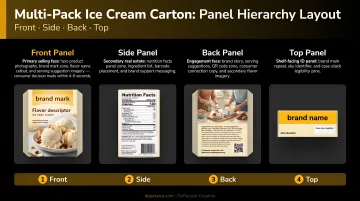
Once the layout is set, the words inside it either pull their weight or waste space. Panel hierarchy determines where shoppers look — copy determines whether they reach for the product.
Copy Decisions That Do the Selling
Every word on a multi-pack carton should earn its place. For ice cream secondary packaging, the highest-value linguistic decisions are:
- The flavor name and descriptor on the front panel
- The one-line positioning or benefit statement that frames appetite appeal
- Any texture or ingredient call-out that differentiates the product from adjacent SKUs
A single well-chosen phrase can do more selling work than three generic claims stacked on a crowded panel.
Frequently Asked Questions
What does "secondary packaging" mean?
Secondary packaging is the outer layer that groups or contains one or more primary packages, never directly contacting the product inside. It serves both a protective function — containing multiple units through distribution — and a brand communication function as the primary brand display surface in multi-unit retail contexts.
What are the different types of ice cream packaging?
Ice cream packaging operates across three tiers. Primary packaging — tubs, cups, wrappers, and cone sleeves — contacts the ice cream directly. Secondary packaging groups primary units into multi-pack cartons, retail-ready cases, and club store boxes. Tertiary packaging covers bulk shippers and pallets used in distribution, never seen by retail shoppers.
How is secondary packaging different from primary packaging?
Primary packaging is in direct contact with the ice cream and focuses on individual product protection and single-unit branding. Secondary packaging groups multiple units, never contacts the product, and functions as the main brand display surface in retail — often the first brand impression a shopper receives when browsing the freezer aisle.
What materials are commonly used for ice cream secondary packaging?
Coated paperboard and PE- or PP-lined corrugated board are the dominant materials, with moisture-resistant adhesives throughout. All materials must perform structurally at sub-zero temperatures. Dispersion barrier coatings are an emerging alternative to PE liners for brands pursuing recyclability alongside moisture resistance.
Why does secondary packaging design matter for ice cream brands?
Multi-pack cartons and retail-ready cases are often the first visual brand touchpoint a shopper encounters in the freezer aisle — before any individual primary container is seen. Secondary packaging design directly drives shelf visibility, purchase decisions, and brand recognition — it's a selling tool with real commercial impact.
What sustainability options exist for ice cream secondary packaging?
Options include recycled corrugated content, mono-material paperboard cartons, dispersion barrier coatings as a PE-liner alternative, and right-sizing to reduce material volume. Every choice must still meet the moisture-resistance demands of frozen food distribution. Verify substrate choices against How2Recycle's current guidelines before making any recyclability claims on-pack.