Introduction
Food and beverage brands face a real tension with secondary packaging: the same box or carton that must satisfy FDA regulators also needs to stop a shopper cold in a crowded aisle and communicate product value in seconds. Getting any one of those three things wrong carries real consequences.
The compliance stakes are real. A GMA-sponsored analysis found that 81% of companies characterized recall financial risk as "significant" or "catastrophic", with business interruption and product disposal topping the list of direct costs. Warning letters, lost retail placement, and reprinted packaging aren't hypothetical — they're routine outcomes for brands that treat labeling as an afterthought.
This guide walks through the practical side of FDA secondary packaging compliance — so your packaging checks every regulatory box without giving up an inch of shelf appeal.
Key Takeaways
- Secondary packaging is any outer layer — boxes, cartons, shrink wrap, multipack outers — that groups or protects primary packaging without contacting the food itself
- Four frameworks govern compliance: FDCA Section 403, 21 CFR Part 101, FSMA, and FALCPA (updated by the 2021 FASTER Act)
- Required label elements include statement of identity, net quantity, ingredient list, allergen declarations, nutrition facts panel, and manufacturer/distributor information
- Undeclared allergens are the number-one cause of Class I food recalls — a labeling error, not a food safety failure
- FDA-required elements don't have to fight shelf appeal — treat them as design constraints, and they become opportunities
What Is Secondary Packaging? Defining the Three Tiers
Primary Packaging
Primary packaging is the layer in direct contact with the food or beverage itself — the inner pouch inside a cereal box, a glass bottle, a sealed retort pouch. It keeps the product safe from the point of fill through the consumer's hands, and falls under food-contact material regulations governed by 21 CFR Parts 174–186 (indirect food additives).
Secondary Packaging
Secondary packaging is the outer layer that groups, brands, or protects the primary package — without touching the product. Common forms include:
- Folding cartons and printed boxes
- Sleeve labels and shrink wraps
- Multipack overwraps
- Retail-ready cases and club-store display cartons
This is the tier most consumers actually see at retail — where brand impression is made and where the bulk of FDA labeling requirements land. It's also where design decisions carry the most commercial weight.
For DePersico Creative's clients — including Idahoan, Ball Park, and Sea Best — secondary packaging often does double duty: a retail-ready merchandising unit and a primary brand communication vehicle. The Idahoan Steakhouse club-store pack illustrates this well: a four-pack carton built to carry restaurant-quality food photography at scale for warehouse club environments, contributing to a 75% incremental sales increase for casseroles.
Tertiary Packaging
Tertiary packaging handles bulk transport — pallets, stretch wrap, corrugated shippers. FDA labeling requirements don't extend here, but cGMP requirements under 21 CFR Part 117 still apply: tertiary packaging must protect food and food-packaging materials from contamination during distribution.
FDA Regulatory Framework Governing Secondary Packaging
Four regulatory instruments define what food and beverage brands must get right on secondary packaging. Here's what each one requires.
FDCA Section 403 — The Misbranding Standard
The Federal Food, Drug, and Cosmetic Act is the foundation. Section 403 (21 U.S.C. § 343) deems food misbranded if its labeling is false or misleading in any way, or if required information is missing.
The FDCA also requires label information to be prominent and conspicuous enough to read under ordinary purchase conditions — meaning small, low-contrast text doesn't just look bad, it can constitute misbranding.
21 CFR Part 101 — Food Labeling
This is the operational rulebook. Part 101 governs:
- What must appear on the Principal Display Panel (PDP) vs. the Information Panel
- Minimum type sizes relative to PDP area
- Ingredient list format and order
- Nutrition Facts panel layout and content
- Manufacturer/distributor name and address requirements
FSMA Section 204 — Traceability
For foods on the FDA's Food Traceability List (leafy greens, finfish, shell eggs, nut butters, ready-to-eat deli salads, and others), the traceability rule requires Key Data Elements — including traceability lot codes and pack dates — to be maintained and passed forward in the supply chain. Case labels are the practical mechanism most operators use to carry this information.
FALCPA and the FASTER Act — Allergen Declarations
The Food Allergen Labeling and Consumer Protection Act requires all major allergens to be declared on the label. The FASTER Act added sesame as the ninth major allergen, effective January 1, 2023. Any brand that hadn't updated its secondary packaging artwork by that date was out of compliance the moment the deadline passed.
FDA Labeling Requirements for Food & Beverage Secondary Packaging
Principal Display Panel (PDP) Requirements
The PDP is the panel most likely to face a consumer at retail. Under 21 CFR Part 101, it must carry:
- Statement of identity — the common or usual name of the product (per 21 CFR 101.3)
- Net quantity of contents — placed in the bottom 30% of the PDP, in both metric and U.S. customary units (per 21 CFR 101.7)
- Any required nutrient content or health claim disclosures
Minimum type height for the net quantity statement scales with PDP area:
| PDP Area | Minimum Type Height |
|---|---|
| 5 sq in or less | 1/16 inch |
| 5–25 sq in | 1/8 inch |
| 25–100 sq in | 3/16 inch |
| 100–400 sq in | 1/4 inch |
| Over 400 sq in | 1/2 inch |
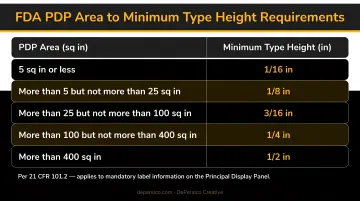
Miscalculating PDP area — common on irregular package shapes — causes type size failures even when the designer thinks they've complied.
The information panel has its own equally firm ruleset — and it starts with location.
Information Panel Requirements
The information panel sits immediately to the right of the PDP (as viewed by a consumer facing the package). Required elements must appear together, in sequence, without intervening material:
- Ingredient list (descending order by weight, per 21 CFR 101.4)
- Major food allergen declarations (per FALCPA / 21 CFR 101.4)
- Nutrition Facts panel (per 21 CFR 101.9)
- Name and place of business of the manufacturer, packer, or distributor (per 21 CFR 101.5)
If the named firm isn't the manufacturer, a qualifying phrase — "Manufactured for" or "Distributed by" — is required.
Allergen Declaration Rules
The nine major food allergens under current law are: milk, eggs, fish, Crustacean shellfish, tree nuts, wheat, peanuts, soybeans, and sesame.
Each must be declared by common name using one of two approved methods:
- Parenthetical in the ingredient list — for example: "flour (wheat)"
- Separate "Contains:" statement — placed immediately after or adjacent to the ingredient list: "Contains: Wheat, Milk, Sesame"
Missing or incorrect allergen labeling is not a minor infraction. FDA warned Whole Foods Market in December 2020 after the company recalled more than 30 products in a single year due to undeclared allergens, stating that undeclared allergens had been the number-one leading cause of Class I food recalls for at least three consecutive years.
What Secondary Packaging Must NOT Contain
FDA enforcement targets errors of commission as much as omission:
- False or misleading statements of any kind
- Unauthorized health claims — structure/function and health claims must meet specific FDA criteria
- "Healthy" claims that don't satisfy FDA's updated nutrient content requirements (finalized in 2024)
- "Natural" claims applied to products containing artificial or synthetic additives
- Implied claims through imagery — front-of-pack photos or graphics that suggest a benefit the ingredient panel doesn't support
A 2022 FDA warning letter to H2 Beverages cited unauthorized disease claims on product labels — a reminder that implied or explicit claims both trigger enforcement when they exceed what the formulation supports.
Common FDA Secondary Packaging Compliance Mistakes
Undeclared Allergens
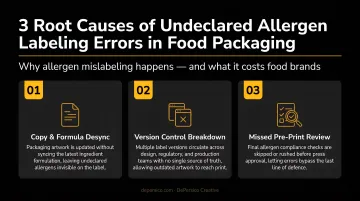
This is the leading cause of FDA-initiated food recalls. A peer-reviewed analysis of FDA allergen recalls found that wrong package or label was the most frequent root cause — meaning the formula was fine, but the packaging didn't reflect what was actually in the product.
How it happens:
- Ingredient supplier changes without a triggered label review
- Reformulations that add or remove allergens mid-production run
- No version control linking current formulas to current artwork
The fix is process-based: any formula, ingredient, or supplier change must automatically trigger a label review before new packaging is approved for print.
Unauthorized Claims and Misleading Statements
Terms like "healthy," "natural," and "heart-healthy" each carry specific regulatory definitions. Using them without meeting FDA's criteria creates enforcement exposure. Imagery carries the same risk. Common violations include:
- Explicit claims — using "natural" or "heart-healthy" without meeting FDA's qualifying criteria
- Visual implied claims — a lush vegetable garden on a product with minimal produce content
- Descriptor mismatches — "farm fresh" on a shelf-stable product, which can trigger review under 21 CFR 101.65
Formatting and Readability Violations
Common formatting failures that FDA inspectors flag:
- Type size failures — net quantity or other required text below the minimum for the calculated PDP area
- Insufficient contrast — required text rendered in low-contrast color combinations
- Obscured Nutrition Facts panels — text placed across a fold, seam, or die-cut opening
- Intervening material on the information panel — promotional copy or decorative elements inserted between required information blocks
These are misbranding violations even when the underlying data is accurate. Presentation that violates Part 101 is sufficient grounds for enforcement, regardless of content correctness.
Best Practices for FDA-Compliant Secondary Packaging That Converts
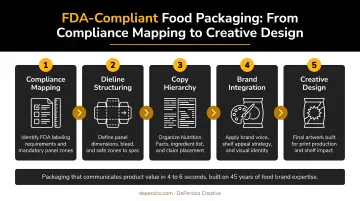
Mandatory FDA elements — product name, net quantity, ingredient list, nutrition facts — can be arranged to reinforce brand identity and guide a shopper's eye to the most persuasive information first. The brands that struggle are the ones that bolt compliance onto finished artwork as a final step rather than building it in from the start.
Build Compliance Into the Dieline Early
Map every required FDA element to a specific panel zone before design exploration begins. Confirm PDP area calculations, establish type size minimums, and lock information panel sequence before the first creative concept is developed. This prevents the expensive scenario where finished artwork has to be restructured after regulatory review.
That upfront structure should account for all required disclosures: FDA nutrition facts panel rules (21 CFR 101.9), allergen declarations, country-of-origin statements, and any retailer-specific clean-label scorecard requirements. Locking these in early keeps the creative process focused on selling, not retrofitting.
Treat FDA-Required Elements as Design Opportunities
The product name is the largest type on the PDP — and it's also the primary brand communication. Net quantity placement in the bottom 30% of the PDP creates a natural anchor for the panel hierarchy. The ingredient list, properly typeset and organized, signals transparency to ingredient-conscious shoppers.
According to NielsenIQ BASES, optimized package designs generate an average 5.5% lift in forecasted revenue, and shoppers take approximately 19 seconds to make a purchase decision at shelf. How required elements are arranged and typeset directly influences whether those 19 seconds end in a pick-up or a pass.
DePersico's SWIFI process — evaluating packaging for Strengths, Weaknesses, and Ideas for Improvement against direct competitors — is designed to identify both compliance gaps and weak visual communication before artwork is finalized, not after.
Three Actionable Best Practices
- Maintain a master label template with locked compliance zones updated to current CFR requirements — so the type size minimums, PDP area calculations, and information panel sequence are pre-built into every new project
- Establish a change-control trigger so any formula, ingredient, or supplier update automatically initiates a label review before new artwork goes to print
- Test before you print — run designs against both a regulatory checklist and real-world shelf simulation. A/B shelf mocks and competitive set comparisons catch both compliance gaps and weak brand communication before the print run locks them in
Frequently Asked Questions
What is primary and secondary packaging in GMP?
In GMP (Good Manufacturing Practice), primary packaging makes direct contact with the product (blister packs, inner pouches, bottles), while secondary packaging is the outer layer that groups primary packages without touching the product, such as cartons and boxes. Both tiers must meet applicable FDA and cGMP standards under 21 CFR Part 117. Secondary packaging requirements center on labeling accuracy, physical protection, and material safety rather than direct product compatibility.
What are the FDA packaging requirements?
For food products, FDA requirements under 21 CFR Part 101 cover:
- Mandatory labeling elements: statement of identity, net quantity, ingredient list, allergen declarations, Nutrition Facts, and manufacturer information
- Tamper-evident features where applicable
- Child-resistant packaging for products containing 250 mg or more of elemental iron per package
- Material safety standards ensuring packaging doesn't adulterate the food
Requirements vary by product category and distribution channel.
What information must appear on FDA-compliant food secondary packaging?
Beyond listing required elements, placement and formatting matter. The product name and net quantity must appear on the Principal Display Panel (PDP). The ingredient list, allergen declarations, Nutrition Facts panel, and manufacturer address go on the information panel. Type size minimums, panel hierarchy, and layout rules are all governed by 21 CFR Part 101.
Does secondary packaging need to be tamper-evident under FDA rules?
Tamper-evident requirements under 21 CFR 211.132 apply specifically to OTC drug products, not conventional food. However, certain food categories and distribution channels may require tamper evidence based on risk profile and retailer requirements. When a tamper-evident feature is used, secondary packaging must include a label statement describing the specific feature.
What are the most common FDA labeling violations found on secondary packaging?
The most common violations include:
- Missing or undeclared allergens — the leading cause of food recalls
- Unauthorized or misleading nutrient and health claims
- Required text below the minimum type size for the package's PDP area
- Nutrition Facts panels formatted incorrectly or obscured by design elements, folds, or seams
Can secondary packaging design affect food product sales?
Yes. Secondary packaging is often the first and only brand communication at retail, and NielsenIQ data shows shoppers take roughly 19 seconds to make a purchase decision. How required elements like the product name, claims, and imagery are arranged directly influences that decision. Optimized package designs generate an average 5.5% lift in forecasted revenue, which compounds meaningfully across a full distribution footprint.