 in Food Manufacturing](https://file-host.link/website/depersico-40hhi8/assets/blog-images/ca2e8d20-b4c3-417a-9c32-39752e0eb9ba/1780912420523464_2cf40a1ee5f64dab825c7d87b5d7b3c8/360.webp)
Introduction
Walk down a biscuit aisle and you'll notice something quickly: the packaging does most of the selling. Before a shopper reads a single ingredient or checks a price, the outer container has already made an impression — or failed to.
Secondary packaging is the layer between the biscuit itself and the shipping pallet. It's the printed carton, decorative tin, shrink-filmed multipack, or shelf-ready tray that groups primary-wrapped biscuit units together for retail sale. It's also the first branded surface a shopper actually sees.
In a category packed with competing SKUs, secondary packaging does three jobs at once: it protects product during distribution, organizes it for retail display, and communicates brand identity at the exact moment a purchase decision forms. For biscuit brands, that last job is often the hardest — and the most consequential.
WestRock's Packaging Matters study found that 66% of consumers tried a new product because the packaging caught their eye. On a shelf crowded with biscuit options, choosing the wrong secondary format can cost you that moment entirely.
This article covers the four main types of biscuit secondary packaging used in food manufacturing, how they differ from one another, and how to select the right format for your brand's goals.
Key Takeaways
- Secondary packaging is the outer container that groups primary-wrapped biscuit units together for retail display, protection, and branding
- It serves three simultaneous roles: product protection, retail display, and brand communication
- The four main formats are folding carton boxes, metal tins, shrink-wrapped multipacks, and retail-ready packaging (RRP)
- Format selection should align with retail channel, price positioning, and brand experience goals
- Getting the format right from the start avoids costly redesigns after launch
What Is Biscuit Secondary Packaging?
In food manufacturing, secondary packaging sits between the biscuit itself and the shipping pallet. It contains one or more primary-packaged units — such as flow-wrapped biscuit slugs or sealed inner pouches — but has no direct contact with the biscuits. A practical example: a printed paperboard carton holding three individually wrapped biscuit sleeves is secondary packaging. The film wrap on each sleeve is primary packaging.
The Three Layers Explained
| Layer | What it is | Primary function |
|---|---|---|
| Primary | Film wrap, inner tray, or pouch in direct contact with biscuits | Freshness, moisture barrier, food safety |
| Secondary | Outer carton, tin, shrink wrap, or tray | Protection, retail display, brand communication |
| Tertiary | Corrugated shipping cases, pallets | Bulk transport and warehousing |
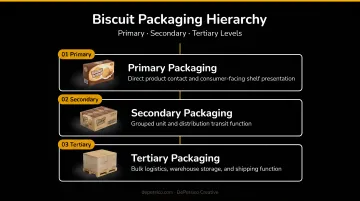
Secondary packaging serves two functions at once: it handles the logistics of transport and provides the main printable surface for brand communication to shoppers.
Why Secondary Packaging Matters in Biscuit Manufacturing
Product Protection
Biscuits are physically fragile. Research shows that checking — the spontaneous cracking caused by uneven internal moisture — can reduce a biscuit's breakage force significantly, with affected biscuits breaking at roughly 9.6 N versus 12.5 N for sound biscuits. Primary film wrap does nothing to absorb the compression and impact forces of a transit journey. Secondary packaging is the structural layer that handles both.
Without adequate secondary protection, the result is breakage, partial refunds, and retailer chargebacks — costs that compound quickly on high-volume lines.
Retail Display and Shelf Presence
Secondary packaging determines how a product sits on the shelf, how much visual real estate it occupies, and whether it arrives display-ready or requires manual handling by store staff. The 2012 POPAI Shopper Engagement Study found that 76% of purchase decisions are made in-store — meaning the shelf moment is decisive.
For biscuit brands, shelf presence isn't just about size. It's about whether the format allows the brand to stand out visually in a high-SKU environment.
Brand Communication at the Point of Sale
The exterior surface of secondary packaging is the primary brand canvas. Every brand element reaches the consumer through it:
- Logo and color system
- Appetite photography and flavor cues
- Health claims and usage occasions
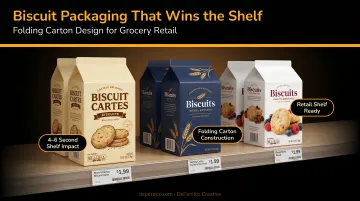
That surface real estate drives trial decisions. DePersico Creative, a food packaging agency with over 45 years in the industry, treats the secondary package as the front line of trial conversion — designing to communicate product value within 4–6 seconds at shelf.
Types of Biscuit Secondary Packaging
No single format works for every biscuit product. The right choice depends on price point, retail channel, brand positioning, and what the packaging needs to communicate. Here's how the four main types compare.
Folding Carton Boxes
Folding cartons are rectangular paperboard structures, typically made from coated SBS (solid bleached sulfate) board, that enclose one or more primary-wrapped biscuit packs. They are the most widely used secondary format in the biscuit category.
Best suited for: Mass-market retail lines in grocery chains; brands requiring significant visual branding space; products where shelf stacking efficiency matters.
Key strengths:
- Large, flat printable panels on all sides — ideal for appetite photography, flavor cues, and certifications
- Lightweight and cost-effective at volume
- Easy to open and stack for retail fixture efficiency
- Widely recyclable — the U.S. cardboard recycling rate sits at 69–74% according to AF&PA's 2024 data
Limitations:
- Lower physical protection than tins or rigid formats — not ideal for very fragile products or long export distances without additional cushioning
- Standard paperboard has limited moisture resistance; specialist coatings are available but add cost
- Structural integrity can degrade in humid storage environments
Folding cartons work across mid and premium price tiers, making them the default format for most grocery biscuit lines. A large printable surface means brand execution is visible and immediate, which rewards strong design investment.
Metal and Tin Containers
Metal tins, typically steel or aluminum, are rigid, fully enclosed containers. Biscuits are packed either in bulk or in nested inner trays. The lid-and-base construction is immediately associated with gifting, seasonal promotions, and heritage brands.
Best suited for: Premium and specialty lines, gift-set formats, seasonal launches, export products requiring maximum physical protection, brands seeking to command a higher shelf price.
Key strengths:
- Superior protection against breakage and compression during transit
- Strong premium brand signal — premium bakery products, including biscuits, are routinely packed in metal tins as gift formats
- Collectible and reusable format extends brand exposure well beyond the initial purchase
- Steel packaging achieves an 82% recycling rate in the EU market, making it a credible sustainability story for export-focused brands
Limitations:
- Significantly higher per-unit packaging cost than cartons
- Heavier, which increases freight costs — a real consideration for high-volume or international distribution
- More complex to fill on automated high-speed lines
- Everyday consumers may find dedicated metal recycling infrastructure less accessible than cardboard
Tins signal premium pricing. A tin on a discount shelf creates consumer confusion — the format and the price point need to be consistent, because shoppers read the container before they read the label.
Shrink-Wrapped Multipacks
Shrink-wrapped multipacks use a thin polyolefin or PVC film applied over a cluster of primary-packaged biscuit units (typically two to six packs) then heat-shrunk to conform tightly. The primary packaging remains visible through or within the film.
Best suited for: Value and bulk SKUs in club stores or discount retail; promotional "buy more, save more" configurations; situations where primary packaging already carries full brand identity.
Key strengths:
- Low material cost relative to carton or tin formats
- Fast application on automated shrink tunnel lines
- Creates multi-unit promotional packs without requiring a full carton redesign
- Minimal excess packaging material, which can support sustainability messaging
Limitations:
- Minimal branding surface — messaging must live on the primary pack or a small applied label
- Less structural protection than cartons or tins; products are more vulnerable to shelf handling damage
- Perceived as a value or economy format, which creates tension with premium brand positioning
NielsenIQ research identifies online and mass/value channels as growth areas for snacks. Shrink multipacks fit well in those environments. Outside of them, the format's cost advantages rarely offset its branding and protection limitations.
Retail-Ready Packaging (Shelf-Ready Packaging)
Retail-ready packaging (RRP), also called shelf-ready packaging (SRP), is a secondary format that ships as a case and converts directly into a display-ready shelf unit in-store. The structure is typically a corrugated or paperboard tray with a detachable or perforated front panel. Store staff open the front, place the tray on the shelf, and replenishment is complete.
Best suited for: Fast-moving biscuit SKUs in high-volume grocery, convenience, and discount channels; brands focused on on-shelf availability; new product launches needing immediate fixture presence.
Key strengths:
- Reduces in-store labor for shelf replenishment — and the 2024 Shelf Ready Packaging Toolkit notes a 1% improvement in on-shelf availability typically delivers a 0.3% revenue uplift
- Maintains consistent, organized shelf presentation — products are less likely to be mishandled during restocking
- Carries brand graphics on all exterior panels, providing branding during transit and in the aisle
- Meets the packaging specifications required by major grocery retailers
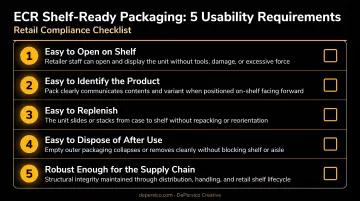
ECR's five usability requirements for SRP:
- Easy to identify as retail-ready
- Easy to open (perforations, tear strips)
- Easy to shelf (tray drops cleanly onto fixture)
- Easy to dispose of (folds flat for recycling)
- GS1-compliant barcodes visible and scannable
Limitations:
- Requires careful structural engineering — a front panel that breaks open in transit defeats the entire purpose
- More complex die-cut and print specifications increase design and tooling complexity
- Retailer-specific structural requirements (Walmart, Kroger, Tesco each have their own guidelines) can limit standardization across different retail partners
How to Choose the Right Secondary Packaging for Your Biscuit Brand
The "right" format is defined by strategic fit, not by what's most common or cheapest in isolation.
Match Format to Retail Channel
Where the product sells first determines the format. Different channels have specific requirements:
- Mass grocery (Walmart, Kroger, Tesco): RRP/SRP structural compliance is typically mandatory. Walmart's 2023 Secondary Packaging Supply Chain Standards and Kroger's 2024 Packaging Supplier Resource Guide both document specific packaging requirements for their respective channels.
- Club stores (Costco, Sam's Club): Shrink multipacks or club-format cartons; high-volume, value-oriented presentation
- Specialty and premium retail: Folding cartons with strong visual design, or tins for gifting lines
- E-commerce: Structural protection becomes more important; cartons need to survive individual parcel shipping, not just pallet transport
Align Format with Price Positioning
| Format | Price tier signal | Consumer expectation |
|---|---|---|
| Metal tin | Premium / gift | High perceived value, collectible |
| Folding carton | Mid to premium | Standard grocery expectation, brand-led |
| Retail-ready tray | Value to mid | Fast-turn, convenience-driven |
| Shrink multipack | Value | Bulk purchase, price-conscious |
Misalignment creates consumer confusion. A premium biscuit in shrink-film multipack packaging will struggle to justify a premium price point.
Plan for Branding and Design Requirements
If secondary packaging is a primary brand communication vehicle — carrying appetite photography, seasonal graphics, or detailed product storytelling — the chosen format must provide sufficient print surface to execute that vision.
DePersico Creative's process, for example, starts with competitive shelf analysis (their SWIFI methodology) before any format or design decisions are made. That analysis determines what visual territory is available in the category and what structural format gives the brand the surface area to own a distinct position.
Format choice and design execution are treated as one integrated decision — surface area, print capability, and shelf presence are evaluated together from the start.
Account for Operational and Production Fit
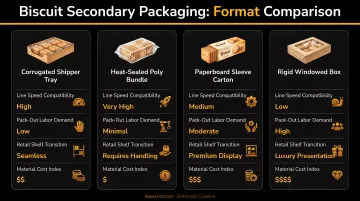
Every format carries distinct operational requirements that affect line investment and throughput:
- Tins require different filling equipment and lower line speeds than carton or shrink formats
- RRP trays require precise die-cut tooling and quality checks to ensure front panels survive distribution intact
- Shrink lines require heat tunnel investment but offer fast throughput once installed
- Budget for tooling, design production, and per-unit material cost against realistic production volume before committing
Common Mistakes to Avoid
Choosing the most premium format without the retail channel to support it. A decorative tin on a discount shelf creates a cost structure that erodes margin without delivering a meaningful consumer payoff. The format must match where the product actually sells.
Ignoring retailer structural requirements. Major grocery retailers have specific SRP/RRP structural and barcode specifications. Non-compliance can result in rejected shipments or forced redesigns after launch. Both outcomes are costly and preventable through competitive shelf analysis and retailer-specific briefing before production begins.
Copying the category rather than differentiating from it. Secondary packaging should create a distinct identity, not replicate what competitors are already doing. WestRock's research found 35% of consumers switched brands because of new packaging design. The shelf is an active competitive battleground, not a neutral display area.
A snack packaging design study published in SAGE Open identified color, shape, image, line, and typography as the five key design characteristics that drive purchase behavior. All five are fully controllable decisions on a secondary package — and each one is an opportunity to stand apart from competitors already lining the shelf.
Conclusion
Biscuit secondary packaging earns its keep at every stage — protecting product through distribution, meeting the structural demands of the retail channel, and communicating brand identity at the exact moment a shopper decides what goes in the basket.
The four formats — folding cartons, metal tins, shrink multipacks, and retail-ready packaging — each serve distinct needs. Folding cartons offer the broadest branding canvas at accessible cost. Tins command premium pricing and gifting occasions. Shrink multipacks serve value and bulk channels efficiently. RRP solves the replenishment labor problem for fast-moving grocery lines.
Once the right format is selected, design execution determines whether the package actually sells. A folding carton or tin can check every structural box and still disappear on shelf if the visual design doesn't stop a shopper in three seconds. Choosing a format is the foundation — but the design built on top of it is what creates the craving.
Frequently Asked Questions
What is the secondary packaging process?
The secondary packaging process takes primary-packaged biscuit units (already wrapped in film or sealed in inner pouches) and groups them into an outer package — a carton, tin, tray, or shrink wrap — then seals that outer container for distribution and retail display.
What is the secondary packaging for biscuits?
For biscuits specifically, secondary packaging is the outer layer (most commonly a folding carton, metal tin, shrink-wrapped multipack, or retail-ready tray) that holds one or more individually wrapped biscuit units together for retail sale and distribution.
What are examples of secondary packaging?
Examples in the biscuit context include: a printed cardboard carton holding three flow-wrapped sleeves, a decorative metal tin containing individually wrapped portions, a shrink-filmed two-pack of biscuit pouches, and a corrugated shelf-ready tray loaded with single-serve packs.
What is the difference between primary and secondary packaging in biscuits?
Primary biscuit packaging directly contacts or encloses the biscuits (the flow-wrap film or inner tray), with freshness and barrier protection as its priority. Secondary packaging groups one or more of those primary units into an outer container: the layer shoppers see on-shelf and the primary surface for brand identity.
How does secondary packaging affect biscuit shelf life?
Secondary packaging provides an additional physical barrier against moisture, light exposure, and compression damage. The primary packaging film remains the main freshness barrier — secondary packaging supports and extends it rather than replacing it.
What makes effective secondary packaging design for biscuits?
Effective design combines the right structural format for the retail channel with strong visual communication: appetite-driven imagery, clear flavor cues, and a differentiated shelf presence. Together, those elements make the packaging a selling tool that drives trial within seconds of a shopper's glance.