This guide covers recommended label dimensions for the most common bottle types, how to measure your container, and the design factors to weigh before you lock in your specs.
Key Takeaways
- Bottle label sizes vary by bottle type, volume, and format — there is no universal standard
- Common starting points by bottle type:
- 8" × 2" — 16 oz water or sparkling water bottles
- 4" × 3.5" — 32 oz juice or functional drink bottles
- 3" × 3.5" — 12 oz sauce or flavored beverage bottles
- 2" × 2" — 2 oz small or sample-size bottles
- Always measure your specific container — two bottles with the same volume can have different label zones
- Label size is a brand decision, not just a technical spec: it determines how much room you have to create shelf presence
What Is a Bottle Label Size?
A bottle label size is the flat artwork width × height — the physical canvas your designer works within when creating a product label.
For front and back labels, size is determined by the usable flat zone on each panel. For wraparound labels, the width is driven by the bottle's full circumference, and the height by the cylindrical zone between the shoulder curve and the base taper.
Take a 16 oz water bottle: a wraparound label runs roughly 8″ × 2″ as a single piece circling the body, while a front-panel-only label on the same bottle lands closer to 4″ × 2″. Same bottle, half the canvas, very different creative demands.
For food and beverage packaging, the FDA's definition of the principal display panel (PDP) adds a compliance layer: for cylindrical containers, the PDP area is calculated as 40% of the product of container height times circumference, excluding tops, bottoms, shoulders, and necks. That number defines your compliance floor — the minimum display area your label must account for before any creative decisions are made.
Here's how the two primary label formats compare at a glance:
| Label Type | Width Basis | Typical 16 oz Example |
|---|---|---|
| Front/back panel | Flat usable zone per panel | ~4″ × 2″ |
| Wraparound | Full bottle circumference | ~8″ × 2″ |
Why Getting Bottle Label Size Right Matters
Research from Ipsos found that 72% of consumers say a product's packaging design influences their purchase decisions. NIQ's packaging research puts the average time a shopper looks at a product before deciding at just 13 seconds. That's the entire window your label has to work.
A label that's too small disappears on shelf. One that's oversized wrinkles, misaligns, or overlaps bottle curves — instantly communicating a lack of quality before the product gets a chance. Both outcomes undermine the investment brands put into their formulation and brand identity.
Beyond aesthetics, incorrect sizing creates real compliance risk. Undeclared allergens are the leading cause of Class I FDA food recalls — and cramming required information onto an undersized label is exactly how allergen declarations, ingredient lists, and Nutrition Facts panels get dropped or made illegible.
What goes wrong without proper sizing:
- Brand name and logo compress into illegibility at shelf distance
- Required regulatory copy drops below readable size (the practical floor is ~6–7 pt)
- Label wrinkles or pulls on tapered or irregularly shaped containers
- Visual hierarchy collapses, leaving the shopper with no clear focal point
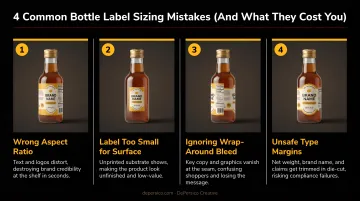
Label dimensions determine how much visual hierarchy, negative space, and storytelling your design can achieve. That's why sizing isn't a spec to finalize after the creative work is done — it's a decision that shapes every design choice that follows. DePersico Creative treats label sizing as part of the design strategy from day one, which is why their packaging work for brands like Ball Park, Idahoan, and Sea Best holds up at both shelf distance and close inspection.
Bottle Label Sizes by Bottle Type
Label sizing depends heavily on bottle category, container volume, and label format. The dimensions below are widely used starting points from supplier conventions — always verify against your specific container before designing.
Beverage Bottles (Water, Juice, and Soft Drinks)
Most beverage bottle labels are wraparound formats sized to the bottle's circumference. Here are common supplier-published dimensions for cylindrical PET and glass bottles:
| Bottle Size | Typical Label Dimensions | Format |
|---|---|---|
| 8–12 oz | 8" × 2" | Full wraparound |
| 16 oz / 500 mL | 8" × 2" or 8.5" × 2" | Full wraparound |
| 1 liter | 4" × 5" (panel) | Front panel or wrap |
| 1.5 liter | 8" × 2.5" | Full wraparound |
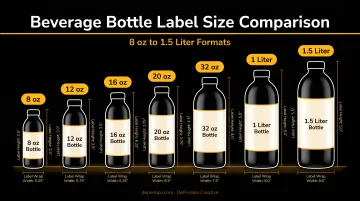
Two format options exist for beverage bottles:
- Full wraparound — circles the entire body; ideal for water brands emphasizing minimalism and clarity
- Front panel only — leaves bottle surface partially visible; works when a clear or tinted liquid is part of the brand aesthetic
The narrow height on most beverage labels (often under 3 inches) limits design real estate. Hierarchy has to be ruthless: brand name and primary visual must read clearly from several feet away without relying on fine detail.
Condiment, Sauce, and Specialty Small Bottles
Small-format bottles present the steepest design challenge. Very limited label real estate means every element must earn its place.
| Bottle Type | Typical Label Dimensions |
|---|---|
| 1 oz Boston Round glass | 4" × 1.5" |
| 2 oz Boston Round glass | 2" × 2" square |
| 5 oz woozy / hot sauce | 2" × 4" |
| 8 oz PET Boston Round | 3" × 3" square |
For a 2 oz jar or bottle, a label of approximately 1.5" × 2" to 2" × 2.5" works as a front panel, or a round label of 1.5"–2" diameter for lid or cap application. Always measure the flat label zone of the specific container before committing.
The difference between a strong label and a forgettable one is most visible in this format. There is no room to hide weak hierarchy — every design decision has to work harder when the canvas shrinks. A label that can't communicate product value within a few seconds loses the shelf moment entirely.
For hot sauce and condiment labels, FDA compliance copy must fit alongside the design — not get squeezed in afterward. Required elements include:
- Ingredients list
- Allergen declarations
- Net quantity statement
- Nutrition Facts panel (where applicable)
Size the label to accommodate both design and compliance copy before artwork begins.
Glass Juice and Functional Beverage Bottles
Glass juice bottles, kombucha, and functional beverage containers follow their own label conventions — shaped by the bottle's silhouette, often tapered or embossed, which shrinks the usable flat label zone.
| Format | Typical Label Dimensions |
|---|---|
| 10–12 oz glass juice bottle | 3.5" × 4" front panel |
| 16 oz glass kombucha / functional | 4" × 4.5" front panel |
| 32 oz glass juice / cold-press | 4" × 5" front panel |
| 12 oz bullet / contour bottle | 3" × 3.5" (contoured panel) |
Two format decisions shape this category:
- Front panel only — standard for premium juice and functional drinks; lets the glass or product color show through on sides
- Full wraparound — less common on glass but used for maximum ingredient and compliance copy space
Embossed or tapered bottles require a die-cut label to follow the bottle contour. A flat rectangular label on a curved surface will buckle — so contour measurement matters as much as overall dimensions.
How to Measure Your Bottle for the Right Label Size
Two measurements lock in your label dimensions before any design work begins — get these right, and everything else follows:
- Circumference — wrap a flexible tape measure around the widest cylindrical part of the bottle body. For a full wraparound label, this is your width. For a front panel label, divide by roughly half (or test physically).
- Label zone height — identify the flat, straight section between the shoulder curve and the base taper. Labels adhere cleanly in this zone without bubbling or lifting. Measure this vertical distance; it sets your maximum label height.
Once you have those numbers, verify them physically before sending anything to print. The paper cut-out method is the most reliable real-world check:
- Cut a piece of paper to your intended dimensions
- Hold it against the actual bottle
- Trim until it sits flat without wrinkling or overlapping curves
- Measure the trimmed piece — that's your working label size
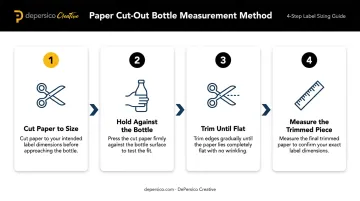
Different bottles within the same nominal volume can have meaningfully different body dimensions. Always measure the specific container you plan to fill — not a generic reference for the volume category.
What to Check Before Finalizing Your Bottle Label Design
A label that looks proportional in a design file can still fail on the actual bottle. Before approving any production run, run through this checklist:
Fit and application:
- Does a physical printed sample sit flat on the container without wrinkling or edge lift?
- Have you verified fit on the specific bottle you're filling, not a similar-looking one?
- Have you confirmed gap or overlap tolerance with your label printer and applicator setup?
Compliance and content:
- Does the label have enough space for FDA-required copy at readable sizes (minimum ~6–7 pt)?
- Are allergen declarations, ingredient list, net quantity, and Nutrition Facts all accounted for in the layout?
- If the bottle is very small, does it qualify for a small-package Nutrition Facts format?
Design hierarchy:
- Does the brand name read clearly from three to five feet away?
- Is there one dominant visual element, or does everything compete equally?
- Have you tested by showing the label to someone for three seconds and asking what the product is?
Label design and label sizing need to move together from the start. Locking dimensions before design begins creates awkward constraints; designing freely and retrofitting a standard size creates a different set of compromises. When a food and beverage package design team handles both simultaneously, sizing decisions inform hierarchy choices — and regulatory requirements don't get discovered at the end of the process as a problem to solve around.
Frequently Asked Questions
What size should a bottle label be?
It depends on the container type and volume. Common starting points: 8" × 2" for a 16 oz water or juice bottle wraparound, 3" × 3.5" for a 12 oz sparkling water front label, and 2" × 4" for a tall 8 oz glass bottle. Always measure your specific bottle before designing — volume alone doesn't determine the label zone.
What size label do I need for a 2 oz jar?
A 2 oz glass bottle typically uses a 2" × 2" square front label as a starting point, or a round label of 1.5"–2" diameter for lid or cap application. Confirm by measuring the flat label zone of the actual container before committing to artwork dimensions.
What label size fits a standard wine bottle?
A 750 mL Bordeaux-style bottle most commonly uses a front label of 3.5" × 4" (portrait) or 4" × 3.5" (landscape). Wine bottles are often paired with a neck label of approximately 1.5"–2" wide × 3.5"–4" tall — plan both as part of one label system, not separately.
What is the difference between a front label and a wraparound label?
A front label covers one face of the bottle, while a wraparound label runs the full circumference as a single piece. Wraparound labels are sized by the bottle's full circumference width and require a design that holds together from every viewing angle.
How do I measure my bottle for a custom label?
Use a flexible tape measure to find the circumference of the bottle's cylindrical body (wrap width) and the height of the flat zone between the shoulder curve and base taper (label height). Cut a paper template to those dimensions and place it on the bottle to confirm fit before designing.
Does label size affect how my brand looks on shelf?
Directly. Too small and the label disappears at shelf distance; too large and it wrinkles or overwhelms the container. The right size gives the design enough room to establish hierarchy, communicate brand identity, and capture attention within the seconds a shopper spends scanning the shelf.