Introduction
Walk through any grocery aisle and you'll notice something uncomfortable: your eyes skip most of what's there. Shoppers aren't reading — they're scanning, and packaging has less than two seconds to engage them before they move on. That means your positioning can't just live in your marketing campaigns. It has to work on the shelf, in the moment, every time.
The harder truth is that the food market is saturated in nearly every category. Great-tasting products fail routinely — not because of quality, but because shoppers can't tell why they should choose one product over the familiar option next to it. A 2021 academic study of over 83,000 new SKUs found that roughly 40% stopped selling within two years. Most of those weren't bad products. They were under-positioned products.
What follows breaks down the four core positioning strategy types, real-world examples across brand sizes, and a practical framework you can use to build a positioning strategy that actually sticks.
Key Takeaways
- Food product positioning defines who your product is for, what it offers, and why shoppers should choose it over alternatives
- The four core strategies are: attribute-based, price/value-based, use-case/occasion-based, and quality-based
- Strong brands often layer two strategies but lead with one primary angle
- Packaging executes positioning at retail — visual design, photography, and language all send positioning signals to shoppers
- Positioning must be tested and updated as consumer preferences shift
What Is Food Product Positioning?
Food product positioning is the strategic process of shaping how a specific product is perceived in consumers' minds relative to competing options. It answers three questions: what does this product offer, who is it for, and why is it the better choice over alternatives?
That's different from branding. Branding tells the story of who a company is. Positioning defines what a specific product does for a specific person — and why it deserves to be chosen over the dozen other options on the shelf next to it. Get positioning wrong, and even a well-branded product can stall.
Why Positioning Is a Survival Requirement
The global consumer packaged goods market was valued at over $5.6 trillion in 2025, and the USDA reported more than 21,000 new food and beverage products launched on U.S. retail shelves in a single year. In that environment, a product without a clear positioning strategy gets buried.
Positioning is not a marketing exercise. It's the strategic foundation that determines everything downstream:
- What goes on the front panel
- How the product is photographed
- What the tagline says
- Which retailers carry it
- What price it commands
Understanding what positioning actually is — and what it isn't — makes every decision that follows easier to get right.
The 4 Core Food Product Positioning Strategies
Most food products fall into one of four positioning categories. The right choice depends on where a product's genuine strengths lie and what its target consumers actually care about.
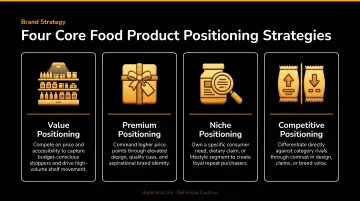
Attribute/Trait-Based Positioning
This strategy centers on a specific product characteristic: a unique ingredient, a functional benefit, a distinctive format, or a production method that competitors don't own.
Poppi is a clear recent example. The brand positioned around a single attribute: prebiotic soda with no more than 5 grams of sugar and 25 calories per serving. That one differentiator, consistently communicated, drove $391 million in sales over a 52-week period and ultimately led to a $1.95 billion acquisition by PepsiCo in 2025.
Attribute positioning works when the trait is defensible and genuinely meaningful to the target consumer. A functional claim anyone can copy in six months is a temporary label, not a positioning strategy.
Price/Value-Based Positioning
This covers both ends of the spectrum. Premium positioning signals superior quality, craftsmanship, or exclusivity at a higher price point. Accessible/value positioning emphasizes affordability without sacrificing quality.
Neither approach is inherently stronger — the key is alignment. A premium price signals premium expectations, and packaging that contradicts that signal will lose the sale. NielsenIQ data shows 62% of shoppers still default to branded products they trust, with twice the emotional connection versus store brands, even as private-label sales hit a record $282.8 billion in 2025.
The consumer decides in seconds whether the price feels justified. Every visual element on the package is either confirming or undermining that judgment.
Application/Use-Case-Based Positioning
This strategy anchors a product to a specific occasion, lifestyle, or need state. Functional foods, on-the-go snacking, family meal solutions, dietary requirements (keto, plant-based, allergen-free) — the product's relevance to a particular context becomes the primary differentiator.
The global functional foods market reached $357 billion in 2024 and is projected to exceed $586 billion by 2030, driven largely by use-case positioning around health outcomes. When a product owns a specific moment or dietary context, it creates relevance that generic claims can't match.
Quality-Based Positioning
Quality positioning differentiates through perceived or demonstrated superiority — sourcing transparency, artisan production, nutritional depth, or consistency. The critical word is demonstrated. Generic claims like "premium quality" carry no weight. Certifications, origin stories, and third-party validation are what actually move the needle.
Label Insight research found 94% of consumers stay loyal to a brand that offers complete transparency, and 73% would pay more for it. Quality positioning without proof points is just marketing copy. With proof points, it's a durable competitive advantage.
Important note: These four strategies aren't mutually exclusive. Many strong brands layer two together — quality plus attribute-based is a common pairing. But effective positioning leads with one primary angle. Spreading the message across all four dilutes each one; the consumer remembers nothing specific.
Real-World Food Product Positioning Examples
The best way to understand positioning strategy is to see it working across different categories and brand sizes.
Chobani: Attribute + Quality Positioning in a Commoditized Category
When Chobani entered the yogurt market in 2007, Yoplait, Dannon, and Fage already owned the category. Chobani didn't compete on price or variety — it combined a specific product attribute (Greek yogurt, higher protein) with a quality narrative built on natural ingredients and no artificial additives.
The founder story amplified this. Hamdi Ulukaya's narrative of bringing authentic Greek yogurt to American consumers gave the positioning emotional credibility that no private-label competitor could replicate. By 2022, Chobani held 20.8% market share in the $8.6 billion yogurt category. In 2025, Forbes reported $3 billion in annual revenue.
Attribute positioning and quality positioning compound when they're rooted in an authentic story.
Siete Foods: Cultural Authenticity as a Positioning Advantage
Siete Foods built its position by pairing two things most snack and tortilla brands weren't offering simultaneously: Mexican-American heritage and grain-free innovation. Their first product — an almond flour tortilla — addressed a genuine dietary need within a specific cultural context, creating a positioning angle that felt both personal and functional.
That combination proved defensible. By the time PepsiCo acquired Siete for $1.2 billion in 2025, products were available in 40,000+ retail locations. The cultural authenticity wasn't a marketing theme layered over the product — it was built into the origin of the brand itself.
Beyond Meat: Sustainability + Use-Case Positioning for a New Category
Beyond Meat built its positioning on a dual foundation: a sustainability mission and a direct use-case claim that a plant-based meat substitute could perform like the real thing in cooking. That combination attracted health-conscious consumers and sustainability advocates simultaneously, enabling mainstream grocery distribution across Kroger, Walmart, Albertsons, and Target.
At its peak, Beyond Meat products were available at 122,000 retail and foodservice outlets across 80+ countries.
However, recent performance tells a cautionary story. Net revenues of $326.5 million in 2024 alongside a $160 million net loss show that even strong initial positioning requires ongoing validation. Consumer interest in plant-based products shifted, and positioning that isn't refreshed can drift out of alignment with the market.
Small Brand Spotlight: Fly By Jing
Fly By Jing is a useful counterexample to the idea that positioning requires a large marketing budget. Founded in 2018, the brand positioned around a single authentic angle: Sichuan chili crisp rooted in the flavors of Chengdu and inspired by the city's informal "fly restaurants." That specificity — not trying to be a generic Asian condiment brand — created immediate credibility with food-forward consumers.
The result: expansion to 1,200 Target stores in 2023, followed by distribution in 2,000+ Walmart stores in 2024, alongside Whole Foods, Safeway, and Sprouts. A narrow, authentic positioning angle outperformed the generic "Asian sauce" category because it owned something no mass competitor was offering.
Across all four examples, a few patterns hold:
- Positioning anchored in a genuine product truth outlasts positioning built on marketing claims alone
- Specificity — cultural, functional, or use-case — creates defensibility that broad category plays can't match
- Even strong positioning requires ongoing validation as consumer expectations evolve
Best Practices for Building Your Food Product Positioning Strategy
Step 1: Define Your Core Consumer and Their Unmet Need
Positioning starts with a specific person, not a demographic. Go beyond age and income — understand the psychographic motivations, purchase triggers, and frustrations that drive behavior in your category.
The most common mistake here is trying to position for everyone. A product positioned for "health-conscious snackers who don't want to give up bold flavor" is infinitely more actionable than one positioned for "adults who enjoy snacking." Broad positioning resonates with no one — least of all at the shelf, where the decision happens in seconds.
Step 2: Map the Competitive Landscape to Find White Space
Positioning strategy is only as strong as the gap it occupies. Before writing a single word of copy or choosing a color palette, map your competitive set:
- What positioning angles are already crowded (and easily confused)?
- Which consumer frustrations are competitors failing to address?
- Where is the category vocabulary repetitive and undifferentiated?
- What does no one currently own?
DePersico Creative's SWIFI (Strengths, Weaknesses, and Ideas for Improvement) process is built around exactly this analysis — assessing competing products across visual hierarchy, ingredient claims, brand story differentiation, and the specific cues that drive trial, to surface the unoccupied positioning angle a brand can own.
Step 3: Build a Positioning Statement as Your Internal Compass
The classic positioning statement formula:
For [target customer] who [specific need or problem], [product name] is a [category] that [primary benefit], unlike [key competitor], because [reason to believe / proof point].
This statement is not consumer-facing copy. It's an internal strategic anchor that aligns product development, packaging design, photography direction, and all marketing communication. If your packaging and your social media and your sell sheet are all saying different things, you don't have a positioning strategy — you have three uncoordinated messages.
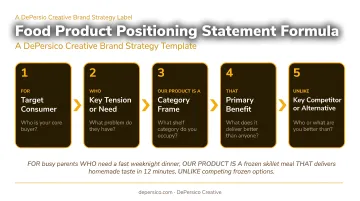
Step 4: Communicate Positioning Consistently Across Every Touchpoint
Positioning only creates value when it's consistent. Every consumer interaction should reinforce the same core signal: packaging, product photography, website copy, retail shelf presence, and digital advertising all need to speak the same language.
Label Insight's research found that 94% of consumers are likely to remain loyal to brands offering complete transparency. Inconsistency between channels doesn't just create confusion — it erodes the trust that drives repeat purchase. A premium positioning story told on packaging but undercut by low-quality photography on a product listing page sends a mixed signal that shoppers pick up on, even when they can't articulate why.
Step 5: Test, Measure, and Refine
Consumer preferences shift. New competitors enter. Cultural trends reframe what certain claims mean. Positioning that was defensible two years ago can become category noise today.
Build regular testing into your process:
- A/B test messaging variations on digital ads and PDPs
- Monitor conversion at shelf and online to catch positioning drift
- Gather qualitative feedback from actual shoppers, not just internal teams
- Track shelf performance metrics — velocity, repeat rate, placement
Beyond Meat's trajectory is a useful reminder that no positioning strategy is permanent. The brands that sustain shelf performance revisit their positioning regularly — adjusting claims, language, and visual cues as the category around them evolves.
How Packaging Brings Your Positioning to Life on the Shelf
For most food products, the package is the positioning. It's often the first — and only — consumer touchpoint before a purchase decision. Research from Ipsos found that 72% of Americans say packaging design often influences their purchase decisions, and with less than two seconds to engage a shopper, every element on the front panel has to earn its place.
The Three Packaging Levers That Carry Positioning
Three elements control how positioning lands at shelf:
- Color and visual design signal premium, accessible, bold, or heritage before a shopper reads a single word. Earthy tones imply artisanal quality; clean white space reads premium; bold color blocks communicate energy and value. The palette is a positioning statement.
- Photography and appetite appeal answer a critical question: does this look like it tastes the way it's positioned? Premium packaging calls for elegant plating and controlled lighting; homestyle products benefit from warm, casual imagery. Misalignment between positioning and photography is one of the fastest ways to lose a shopper's confidence.
- Creative linguistics — the specific words and phrases used on-pack — may be the most underestimated positioning tool in food marketing. The right words create immediate emotional connection and drive trial. A single well-chosen positioning line can outperform an entire paragraph of product description.
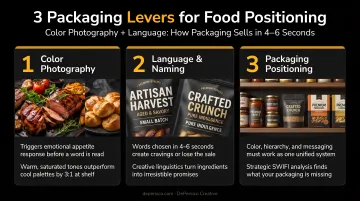
DePersico Creative's approach treats language as strategic: every brand name, tagline, product story, and front-panel claim is evaluated against whether it communicates the brand's intended positioning within that four-to-six-second decision window at shelf.
For brands looking to close the gap between intended positioning and shelf-level execution, a structured audit is a practical starting point. DePersico Creative's SWIFI assessment evaluates a product's current packaging against its competitive set — identifying specifically where the positioning is landing, where it's getting lost, and what changes would make it work harder.
Frequently Asked Questions
What is the positioning of food products?
Food product positioning is the strategic process of shaping how a product is perceived relative to competing options. It defines the distinct value a product offers, to whom, and why it deserves to be chosen — not just what it is, but what it stands for.
Which is an example of food product positioning?
Chobani is a strong example. In a saturated yogurt category, Chobani carved out a dominant position by leading with a specific attribute (Greek yogurt, higher protein) combined with a clean-ingredient quality narrative — rather than competing on price or flavor variety alone.
What are the main types of food product positioning strategies?
The four core types are: attribute/trait-based, price/value-based, application/use-case-based, and quality-based. The right choice depends on what genuinely sets a brand apart and what target consumers prioritize at the shelf.
How does packaging design affect food product positioning?
Packaging is often a food product's primary positioning vehicle at retail. Visual design, photography, and the language used on-pack all communicate positioning signals to shoppers making decisions in seconds — well before any advertising or marketing message reaches them.
How do I write a food product positioning statement?
Use this formula: For [target customer] who [specific need], [product] is a [category] that [primary benefit], unlike [competitor], because [proof point]. It's an internal strategic compass — not consumer-facing copy — that aligns packaging, photography, and marketing around one consistent message.
What makes a food product positioning strategy fail?
The most common causes: positioning for too broad an audience, building around a claim competitors can easily copy, inconsistency across touchpoints, and failing to revisit positioning as consumer preferences evolve. Any one of these can sideline a strong product regardless of what's inside the package.